
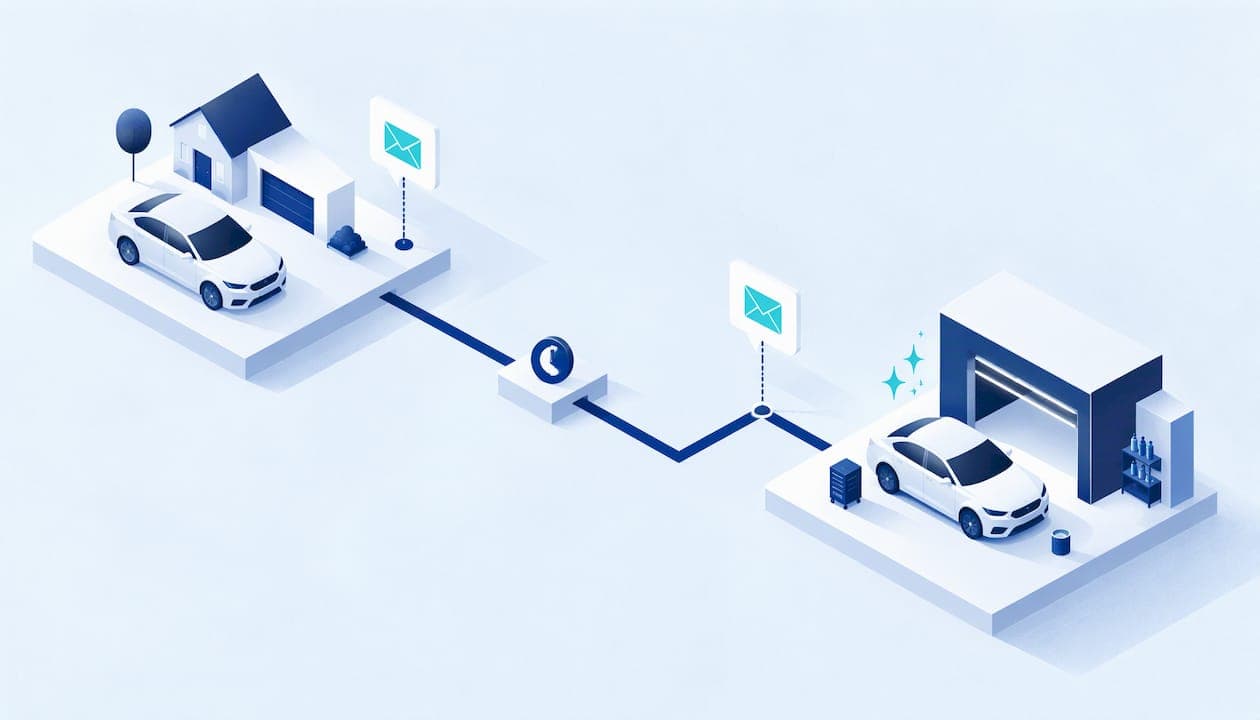
SMS marketing works for detailers because detailing is a repeat business and text messages reach customers where they already are. The best use is a small set of automated texts: booking confirmations, reminders, "on my way" updates, review requests and a maintenance nudge a few weeks after each job. Add one or two seasonal offers a year, get written consent before you send any promotion, and honor every STOP reply.
This guide shows which messages to send, when to send them, how to word them, which rules apply in the U.S., and how to tell whether any of it pays off.
TL;DR
- Start with service texts (confirmations, reminders, arrival and completion notices). They are the least intrusive and cut no-shows.
- Use promotions sparingly and tie them to the customer's last job, vehicle or season.
- Get clear written consent before marketing texts, identify your business in every message, and treat STOP, QUIT, END, REVOKE and OPT OUT as opt-outs.
- Track opt-outs, replies, bookings and reviews, not just opens. Published benchmarks are ranges, not promises.
- Automate from your booking and customer records so every text matches the job and the vehicle.
Table of Contents
- Why texting fits the detailing business
- The messages worth sending
- Templates you can adapt
- Timing and frequency: useful, not intrusive
- U.S. rules you need to follow
- Automating texts around the job
- Measuring whether SMS is working
- Perspective
- Put it to work with Mobile Detail AI
- A simple 30-day launch plan
- FAQ
- Sources
Why texting fits the detailing business
A detailing customer rarely buys once. A ceramic coating needs maintenance washes. A daily driver needs an interior reset every few months. A truck owner wants a wash before winter. The business depends on being the first name a customer thinks of when the car gets dirty again, and a text is a fast, low-friction way to be there.
Platform data reported for car wash and detailing businesses points to several uses across the customer journey: converting first-time customers into members, prompting renewals, filling weather-driven demand and encouraging referrals. For a mobile detailer the translation is simple. Use texts to confirm the job, reduce the chance someone is not home, ask for the review while the car still looks great, and bring the customer back before the finish fades.
The same logic explains the keyword's top search results, which are mostly general auto shop and dealership guides: reminders, service-complete notices and coupons. Detailing has one extra advantage. You already know the vehicle, the package and the date of the last job, so your texts can be specific instead of generic.
The messages worth sending
Think of your texts in four groups, ordered from least to most promotional.
1. Booking and reminder texts
These are expected by the customer and carry the most value per message.
- Confirmation: sent right after booking, with the date, time window, address, vehicle and package.
- Reminder: one text the day before, optionally a second a couple of hours before. Include a simple way to reschedule so a conflict becomes a move, not a no-show.
- Prep note: access to water and power, where to park, and removing personal items. This saves time on site.
We go deeper on this group in our guide to SMS appointment reminders that cut no-shows.
2. Day-of service updates
Mobile detailing means a stranger arrives at someone's home or office. A short sequence builds trust:
- "On the way" with an arrival estimate.
- A delay notice if the previous job runs over. Customers forgive a late van far more easily than a silent one.
- "All done" with a photo or a summary of what was completed and any recommendations.
If you want these to be live rather than manual, see how real-time service updates can be set up for a detailing team.
3. Review and feedback requests
Send the request soon after the job, while the result is fresh, and make it a single tap. Ask a plain question first ("How did we do?") and send happy customers to your review page. Our walkthrough on automating review requests within 72 hours covers timing and wording.
4. Retention and promotional texts
This is where SMS earns repeat revenue, and where most detailers overdo it. Good retention texts include:
- Maintenance nudge: a few weeks after a coating or paint correction, suggesting a maintenance wash.
- Seasonal prompts: pollen, road salt, summer sun and monsoon dust (relevant in Arizona) each give a natural reason to text.
- Loyalty updates: points, a free add-on after a set number of visits, or a referral reward.
- Slow-day fills: a limited slot offer for a day with openings, sent only to customers who are nearby and have opted in.
Our article on detailing customer retention explains how to pair three automations with a maintenance rhythm so you are not inventing campaigns from scratch.
Templates you can adapt
Keep every message short, name your business, and give one clear action. Replace the brackets with the customer's details.
| Moment | Sample text |
|---|---|
| Confirmation | Hi [Name], this is [Business]. You're booked for [Package] on [Date], [Time window] at [Address]. Reply C to confirm or R to reschedule. |
| Day-before reminder | [Business] reminder: we'll be at [Address] tomorrow between [Time window] for your [Vehicle]. Please leave access to water and power. Reply R to reschedule. |
| On the way | [Name], [Detailer] from [Business] is on the way and should arrive around [Time]. |
| Complete | Your [Vehicle] is done! Here are a few photos and care tips: [link]. Thank you for choosing [Business]. |
| Review request | Thanks again, [Name]. If you're happy with the work, would you leave us a quick review? [link] |
| Maintenance nudge | Hi [Name], it's been 6 weeks since your [Service]. A maintenance wash keeps the finish looking its best. Book here: [link]. Reply STOP to opt out. |
| Seasonal offer | [Business]: Dust season is here. Book an exterior detail this week and add a wheel clean for free. [link]. Reply STOP to opt out. |
For longer follow-ups that do not belong in a text, our email templates for detailers are a good companion: use SMS for the short, time-sensitive message and email for photos, care guides and detailed quotes.
Timing and frequency: useful, not intrusive
A text interrupts. That is why it works and why it can backfire. A few working rules:
- Match the message to the moment. Reminders go the day before. Reviews go within a day or two. Maintenance nudges go when the finish actually needs attention, not on a calendar blast.
- Send during normal waking hours. Aim for mid-morning to early evening in the customer's time zone. Service texts on the day of the job are the exception, since the customer is expecting them.
- Cap promotions. A reasonable starting point is no more than one or two promotional texts a month per customer, fewer if the customer only books once or twice a year. Adjust based on opt-outs.
- Give a reason for every text. Each message should offer something: a time slot, a reminder of value, a useful tip. If you cannot say what the customer gets, do not send it.
- Write like a person. Use the customer's first name, the vehicle, and the service they bought. "Your Tahoe's ceramic coating is due for a maintenance wash" beats "Special offer just for you!"
- Make replying easy. Two-way texting lets customers ask a question, send a photo of a stain or move a slot. Answer quickly during business hours.
Segmenting is what makes this practical. A customer who books monthly interior cleans needs a different message than someone who bought a one-off paint correction. Our practical guide to customer segmentation for detailers shows how to group customers by service, vehicle and visit frequency.
U.S. rules you need to follow
This section is general information, not legal advice. If you plan to text a large list, or you operate across several states, ask an attorney who handles telemarketing compliance to review your consent wording.
Get consent before marketing texts. The FCC states that commercial texts require written consent, while informational texts can rely on consent that is less formal. In practice, that means a customer who gives you a number to receive appointment updates is in a different position than one you want to text a coupon. For promotions, collect a clear opt-in, such as a checkbox on your booking form that says the customer agrees to receive marketing texts from your business, and keep a record of when and how they agreed.
Do not buy lists or text strangers. Cold texts to numbers scraped from maps or bought from a broker are a quick way to complaints, carrier filtering and legal risk. Detailers on forums regularly complain about unsolicited texts from people pitching partnerships, which is the opposite impression you want to leave.
Honor opt-outs. Under the FCC's 2024 order, consumers can revoke consent in any reasonable manner, including replying with words such as STOP, QUIT, END, REVOKE or OPT OUT. Businesses must honor the request within a reasonable time, not to exceed 10 business days. The safest practice is to stop immediately and automatically, and to confirm the opt-out with a single final message if your texting setup allows it.
Identify yourself. Put your business name in the text, and include opt-out language in promotional messages. Customers should never wonder who is texting.
Use daytime hours and check state rules. Some states set their own limits on when and how often solicitation texts can go out. If you serve customers outside Arizona, check each state's rules before launching a campaign.
A simple compliance habit covers most of this: store the consent record in the customer's profile, tag opted-out numbers so they can never be added to a campaign, and never send promotions to anyone who only gave you their number to book a one-off job without agreeing to marketing.

Automating texts around the job
Manual texting does not scale past a handful of customers a week. The goal is to trigger messages from events in your booking and customer records:
- Booking created: confirmation text.
- 24 hours before: reminder with reschedule option.
- Technician en route: arrival text.
- Job marked complete: completion summary, then a review request after a set delay.
- X weeks after the job: maintenance nudge based on the package (a coating customer and an interior-only customer should not get the same timing).
- Season or inactivity trigger: a promotion to customers who have not booked in several months and have opted in.
The key is a customer record that remembers the vehicle, services and dates. That is what lets a text say "your Silverado" and "six weeks since your coating" instead of a generic blast. Route and schedule data also help: a nearby opening can go only to customers who live close to that day's route.
Measuring whether SMS is working
Track a small set of numbers monthly:
| Metric | What it tells you |
|---|---|
| Opt-out rate | Whether you are texting too often or about the wrong things |
| Reply rate | Whether customers feel invited to respond |
| Bookings from texts | The real return, tied to a tracked link or a reply |
| Reviews collected | How well the request timing works |
| Repeat customers | Whether your maintenance rhythm is retaining people |
Published benchmarks give context but should not be treated as guarantees. Aggregated platform data reported for car wash businesses includes 95%+ open rates, 15–25% conversion of first-time visitors to members, 70–85% membership renewal and 20–35% more visits on weather-alert days, described as typical ranges. Car washes with memberships are not the same as mobile detailers selling one-off jobs, so use these as a sanity check, then build your own baseline.
On the warning side, one retail guide suggests a healthy opt-out rate is typically under 2% per message, and that going over signals too many texts or irrelevant content. That is a handy tripwire: if opt-outs climb after a campaign, reduce frequency and tighten the audience before sending another.
Perspective
Most detailers we talk to do not have a marketing problem. They have a follow-up problem. The work is excellent, the customer is delighted, and then nothing happens until the customer remembers the detailer's number, or does not.
We built Mobile Detail AI around the idea that messaging should come out of the job, not sit beside it. When the booking, the vehicle, the service history, the schedule and the payment live in one place, a reminder, an arrival update or a maintenance nudge stops being extra work and becomes the natural next step. Our CRM is designed so solo operators and multi-van teams can keep that rhythm without living on their phones.
Our view is that the best SMS program is a quiet one: a handful of well-timed, relevant texts that customers are glad to get. Start with service messages, earn the right to send offers, and let the customer's history decide what to say.
Mobile
Put it to work with Mobile Detail AI
If you want booking, scheduling, customer records and invoicing in one place so your follow-ups can run from real job data, look at our provider plans. They include CRM-Only at $1 per month, Marketplace at $59 per month and Preferred at $139 per month. The CRM includes visual scheduling, route optimization, customer management, invoicing and business analytics, and the marketplace lets car owners find and book you instantly.

Car owners can browse vetted detailers on our discover page, and detailers curious about how marketplace bookings add jobs can read about detailing marketplace benefits.
A simple 30-day launch plan
Week 1: set up consent. Add an opt-in line to your booking form and a way to record it. Write your STOP handling and confirm it works.
Week 2: turn on service texts. Confirmation, day-before reminder, on-the-way and completion messages. Test them on your own phone and a friend's.
Week 3: add the review request. Send it one to two days after completion. Watch how many customers respond.
Week 4: launch one retention text. Pick your most common package and write a maintenance nudge for it. Send it only to opted-in customers who bought that package six to eight weeks ago.
After 30 days, review opt-outs, replies, bookings and reviews. Keep what customers respond to, cut what they ignore, and add one new message at a time.
FAQ
Do I need permission to text my detailing customers?
For marketing texts, yes. The FCC says commercial texts require written consent. Get an explicit opt-in on your booking form and keep a record of when it was given. Appointment-related texts are treated differently, but ask a compliance attorney about your specific setup.
How do I handle customers who reply STOP?
Stop all marketing texts to that number right away. The FCC's 2024 order says consumers may opt out in any reasonable way, including STOP, QUIT, END, REVOKE or OPT OUT, and that requests must be honored within 10 business days at most. Automating the opt-out is far safer than doing it by hand.
How many texts per month is too many?
There is no universal number. Service texts tied to a booking are fine. For promotions, one or two a month is a cautious ceiling, and less for customers who book rarely. Watch your opt-out rate: one retail guide treats anything above 2% per message as a sign you are over-texting or off-topic.
Should I use SMS or email for detailing marketing?
Use both for different jobs. SMS suits short, time-sensitive messages such as reminders, arrival updates and review requests. Email suits photos, care guides and longer offers. Many detailers send the review request by text and the seasonal care tips by email.
Sources
- SMS Marketing for Car Wash & Detailing
- FCC TCPA Consent Order, FCC 24-24
- FCC: Stop Unwanted Robocalls and Texts
- The Complete 2026 SMS Marketing Guide for Retailers