
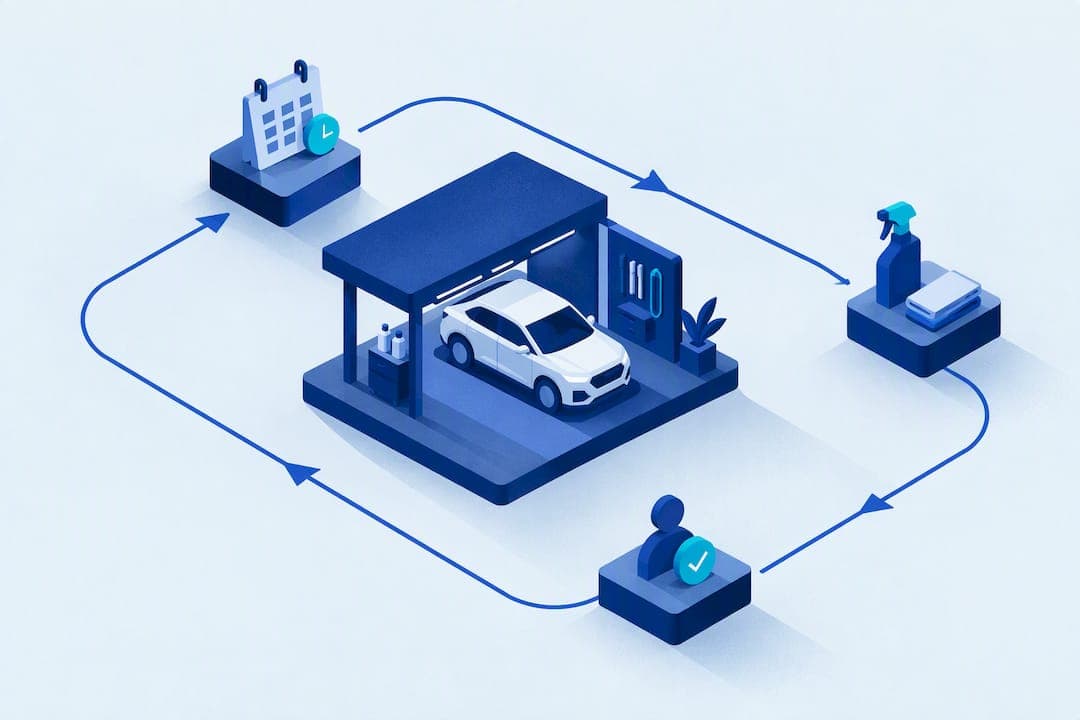
The fastest way to raise repeat bookings is to sell a predictable rebook cadence, like a maintenance package or short membership, and pair it with three automated touchpoints: a thank-you and rebook prompt right after service, a mid-cycle check-in, and a win-back message by day 120. We built Mobile Detail AI's booking and CRM tools around exactly this rhythm, because frequency, not one-off discounting, is what drives recurring revenue.
TL;DR:
- Track retention, repeat booking share, customer lifetime value, and satisfaction monthly so a weakening customer group surfaces before it affects an entire quarter.
- Flag customers after 90 to 120 days without a booking, then send a personal message referencing their last service and a reason to return.
- Prepaid packages of three or four visits suit solo operators by securing revenue and the next booking, while monthly memberships fit fleet shops.
- Providers using photo or video inspection records saw 41% acceptance of recommended work, compared with 17% among providers without documentation.
- Send negative or neutral feedback to a manager the same business day, then follow up personally within 48 hours and offer a specific remedy.
Table of Contents
- Why customer retention matters: the math and key metrics for detailers
- Actionable retention strategies: prioritized checklist you can implement this week
- Designing a loyalty program and rebooking offers that actually work
- CRM and tech: automations that save time and increase rebooks
- Measure and close the loop: KPIs and a recovery workflow for at-risk customers
- How Mobile Detail AI maps to these retention tactics
- Expert takeaway: prioritize frequency, not one-off discounting
- Get started with Mobile Detail AI
- FAQ
- Sources
Why customer retention matters: the math and key metrics for detailers
Winning a new customer almost always costs more than keeping one, which is why even small gains in repeat business tend to produce outsized gains in profit, a pattern well documented in CX economics. For a detailing shop, that means your existing customer list is your cheapest growth channel.
Three numbers matter most:
- Retention rate: the share of customers who book again within a defined period, usually calculated quarterly or annually.
- Repeat purchase rate: the percentage of total bookings that come from existing customers rather than new ones.
- Customer lifetime value (CLV): average job value multiplied by average visits per year multiplied by average customer lifespan in years.
A service-focused case study identified three high-impact engagement windows: 0 to 30 days, 120 days, and 210 days, where visit frequency strongly correlates with long-term loyalty. That means your first follow-up matters, but day 120 is the real fork in the road: customers who haven't rebooked by then are far more likely to drift to a competitor or stop detailing altogether.
Actionable retention strategies: prioritized checklist you can implement this week
Start with the tactics that touch every customer automatically, then layer in the ones that need a little more setup.
- Automate the post-service workflow. Send a thank-you message with before-and-after photos and a one-tap rebook link within hours of job completion.
- Sell recurring maintenance instead of one-off jobs. A quarterly or 3 to 4 month detailing rhythm keeps paint, interior, and protection in consistent condition, and gives you a predictable calendar instead of chasing single bookings.
- Reward frequency over discounts. A referral credit or loyalty point tied to a fourth visit does more for retention than a flat percentage off.
- Build an upsell playbook with timing in mind. Headlight restoration, for example, fits naturally into a six-month cycle once oxidation becomes visible.
- Make rebooking frictionless. Online booking plus SMS reminders removes the back-and-forth that causes customers to simply forget.
- Flag at-risk customers before they churn. Anyone without a booking in 90 to 120 days should trigger a specific, personalized outreach rather than a generic newsletter blast.
Pro Tip: Attach at least one photo to every post-service message. Customers rebook faster when they can see the work, not just read about it.
Trade publications covering the detailing industry consistently point to the same pattern: clear service descriptions and a follow-up request for feedback convert first-time customers into repeat ones more reliably than price cuts do.
Designing a loyalty program and rebooking offers that actually work
A simple program beats a complicated one, especially for solo detailers and small teams who can't manage a points ledger by hand. Prepaid packages (three or four visits bought upfront) work well for owner-operators because they lock in revenue and guarantee the next booking. A light membership tier, billed monthly for a defined service level, fits shops with recurring commercial or fleet clients.
- Tier strategy: offer a basic single-visit price, a midrange maintenance package as the default recommendation, and a premium tier bundling protection services like ceramic coating.
- Redemption rules: keep them simple, such as "book your next visit within 120 days to keep your rate locked."
- Communication cadence: confirm enrollment immediately, remind at the midpoint of the cycle, and send a renewal prompt before expiration.
Loyalty programs built around consistent experience, personalization, and access, rather than simple point accumulation, outperform generic points schemes. A detailer offering priority scheduling to maintenance-plan members captures that same effect without complex software.
CRM and tech: automations that save time and increase rebooks
The right CRM should handle five jobs: scheduling, automated SMS and email messages, photo documentation, rebook workflows, and payment processing, ideally with route optimization layered on top for multi-stop days.
Three automations do most of the retention work:
- Immediate thank-you and rebook prompt, sent the same day service is completed.
- A 60 to 90 day check-in, timed to land before the customer's next natural maintenance window.
- A 120-day win-back message with a specific, time-limited offer for anyone who hasn't returned.
Pro Tip: Set your 120-day automation to trigger off the last completed job date, not the calendar month. That keeps the message relevant to each customer's own cycle.
J.D. Power's 2025 Aftermarket Service Index found that service providers offering photo or video documentation during inspections saw 41% acceptance of recommended work, compared to 17% without it. After launch, track open rates on your automated messages and the percentage of customers who rebook from each trigger.
Measure and close the loop: KPIs and a recovery workflow for at-risk customers
Track retention rate, repeat purchase rate, CLV, and a satisfaction metric like NPS, CSAT, or CES on a monthly basis, not just annually. Monthly tracking catches a slipping cohort before it becomes a quarter-long revenue problem.
A closed-loop feedback process keeps negative experiences from turning into silent churn:
- Collect feedback immediately after service, via text or a short post-job survey.
- Route any negative or neutral response to a manager within the same business day.
- Follow up within 48 hours with a direct call or message, not an automated reply.
- Remediate with a specific fix or a goodwill offer tied to their next visit.
Visit frequency and loyalty are closely linked across the 0 to 30, 120, and 210 day windows, which is why a churn flag set at 120 days without a booking gives you enough lead time to intervene before the relationship is lost. When that flag fires, send a short, personal message referencing their last service and a reason to come back now.
How Mobile Detail AI maps to these retention tactics
Our CRM was built around this exact cadence. Scheduling and route optimization keep your calendar full without manual juggling, while the photo documentation feature attaches before-and-after images directly to each job record so your thank-you message writes itself. Automated rebook workflows send the 0-day, 90-day, and 120-day messages described above without you touching a keyboard.
Detailers using our marketplace and booking tools report 10 to 25% more jobs as a result of easier discovery and fewer missed rebookings, a claim we make based on our own platform data. The headlight restoration upsell playbook and other add-on prompts surface automatically at the point in the maintenance cycle when customers are most receptive.

Expert takeaway: prioritize frequency, not one-off discounting
Chasing bigger one-time tickets feels productive, but it builds a business that resets to zero every month. Selling frequency, through a maintenance rhythm or light membership, builds a revenue base you can forecast. This month: launch the three-message automation, add one midrange package, and track rebook rate weekly. Adjust the offer, not the discipline.
— Mobile
Get started with Mobile Detail AI
If you're ready to put this playbook on autopilot, our platform handles the scheduling, photo documentation, and automated rebook messaging described above in one system built specifically for detailing businesses.
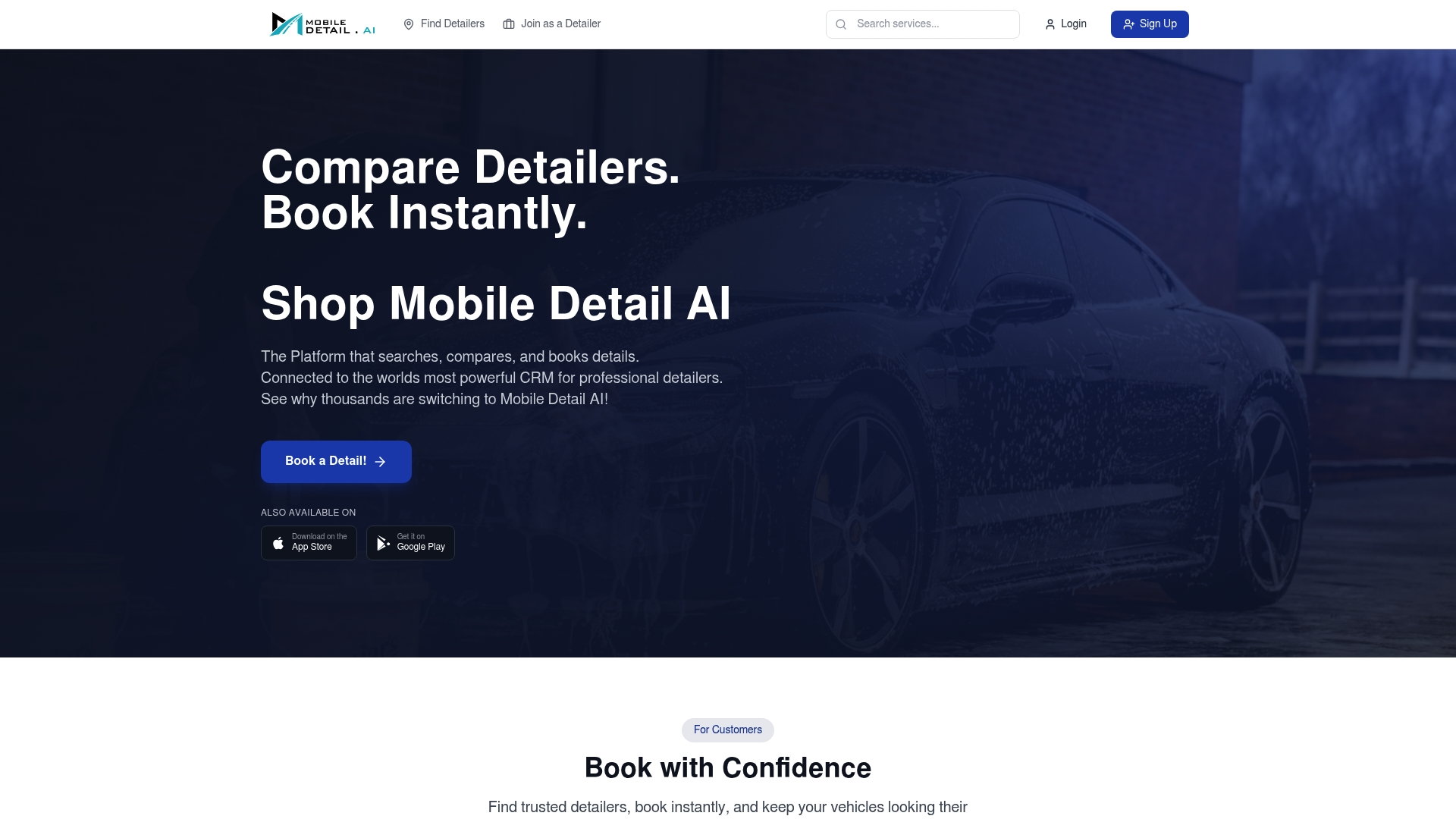
- CRM-Only starts at $1 per month for shops that just need the automation backbone.
- Marketplace at $59 per month adds customer discovery and instant booking.
- Preferred at $139 per month layers in route optimization and priority placement.
Browse our provider subscription plans to find the tier that fits your current booking volume, or explore how customers discover services on the platform before you sign up.
FAQ
Is the car detailing business oversaturated?
Saturation varies heavily by local market and service tier, so there's no single national answer. Shops that differentiate through recurring maintenance programs and consistent follow-up tend to compete well regardless of how many detailers operate nearby.
Is 90% customer retention good?
A high retention rate is strong for most service businesses, since even modest increases in retention are tied to outsized profit gains according to CX economics research. The more useful question is whether that rate is improving or slipping quarter over quarter.
How can I get more clients as a detailer?
Combine visibility (an online booking presence) with retention tactics like automated rebook messages and a maintenance package, since repeat customers also generate referrals. Platforms like Mobile Detail AI connect you with new customers while automating the follow-up that turns them into repeat ones.
How much should I tip for a $200 car detail?
Tipping customs vary by region and are not set by detailing providers themselves, so there's no fixed industry rule.
Sources
- Service KPIs case study — Urban Science
- The ultimate guide to customer retention — Emarsys (SAP/Emarsys)
- 2025 U.S. Aftermarket Service Index (ASI) Study — J.D. Power
- Carwash