
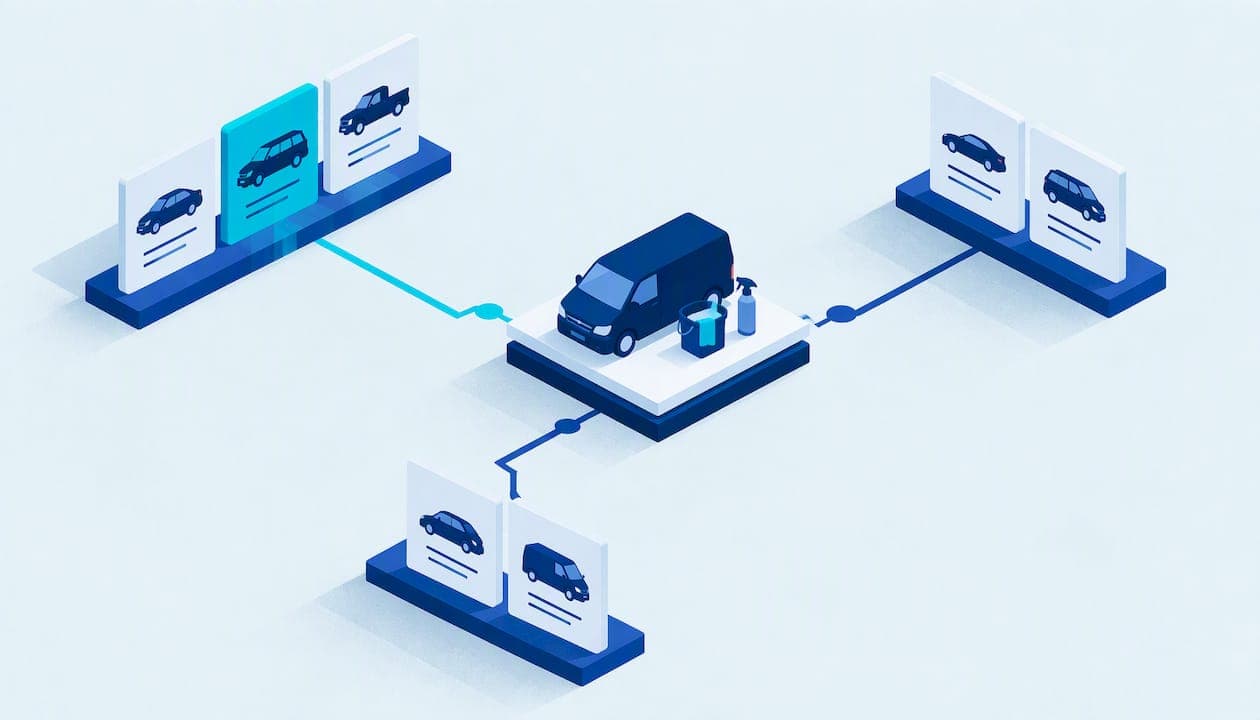
Customer segmentation for a detailer means sorting your clients into groups that need different things, then treating each group differently. Start with four or five segments built on what you already know: vehicle type, service history, how often they book and what they spend. Then set one rule per segment for who you contact, when, and with which offer. You can do this in a spreadsheet. A CRM does it automatically.
TL;DR
- Segment by behavior and vehicle, not just demographics: last service date, service type, vehicle age and ticket size tell you more than age or income.
- Five segments cover most detailers: maintenance regulars, one-time deep-clean buyers, protection buyers (ceramic, PPF, tint), fleet and dealer accounts, and lapsed clients.
- Each segment needs one action: a reminder interval, an upsell, or a quote follow-up.
- Keep service quality and pricing consistent across segments. Personalize timing and recommendations, not your standards.
- Segments only work if your data is clean. Log every job, vehicle and photo in one place.
Table of Contents
- What segmentation means in a detailing business
- Why it matters more for mobile detailers
- Five segments most detailers can use
- Quick reference: segment, signal, action
- Go beyond demographics
- Local context changes your segments
- Retain proactively, not after the fact
- Keep quality consistent across segments
- Perspective: what we see from building for detailers
- What data to capture on every job
- Match segments to service categories
- A one-week setup plan
- Where Mobile Detail AI fits
- FAQ
- Sources
What segmentation means in a detailing business
Segmentation is grouping customers by shared characteristics so you can market and serve them with less guesswork. The academic definition is simple: the point is to understand customers better and use that understanding to improve profitability, as the multidimensional segmentation research puts it.
For a detailer, that is not a marketing exercise. It answers daily questions:
- Who gets a text in March about spring interior resets?
- Which clients get a ceramic coating pitch, and which would find it irritating?
- Which customers are worth a priority slot on a Saturday?
- Who has not booked in nine months and needs a nudge before they move on?
Without segments, you send the same "10% off this week" message to the fleet manager, the minivan parent and the enthusiast with a garage-kept sports car. It fits none of them.
Why it matters more for mobile detailers
A mobile operator sells time and drive miles. Every wasted slot or long gap between stops costs real money. Segmentation lets you fill the calendar with the right work.
The market backs the shift to on-the-go service. Nexdigm's U.S. market report describes mobile and on-demand detailing as the fastest-growing provider category, while fixed-location shops still hold roughly 70% of the market as of 2024. The same report puts exterior detailing at about 64-65% of revenue, with interior detailing the fastest-growing service segment.
Competition is also close. Industry coverage in Auto Laundry News notes that most operators compete with at least three other local providers. When customers can pick among several detailers, the one who remembers the car and reaches out at the right moment wins the repeat booking.

Five segments most detailers can use
You do not need fifteen personas. Start with these five and adjust to your area.
1. Maintenance regulars
These clients book a recurring wash, interior clean or sealant top-up every few weeks or months. They are your most profitable segment because they cost almost nothing to acquire after the first job and they fill predictable slots.
- How to spot them: three or more bookings in 12 months.
- What they need: a standing schedule, a consistent result and easy rebooking.
- Action: offer a fixed interval, with a reminder sent before the next slot is due.
2. One-time deep-clean buyers
They book once before selling a car, after a spill, or after a road trip. Many will never be regulars, but some will if you ask the right question at handoff.
- How to spot them: one full interior or full detail, no rebooking after 60 days.
- What they need: proof of the result and a low-pressure next step.
- Action: send before and after photos, then a single follow-up suggesting a maintenance service sized to what you found in the car.
3. Protection buyers
These owners invest in ceramic coatings, paint correction, paint protection film or window tint. Tickets are larger, decisions are slower, and trust matters more than price.
- How to spot them: newer or higher-value vehicles, questions about durability, requests for quotes rather than instant bookings.
- What they need: education, a clear explanation of prep and aftercare, and a record of the work.
- Action: follow up on quotes within a day or two, then schedule coating maintenance checks after the install.
If you want a plain-language look at how customers weigh protective services, this explainer on professional car waxing services shows what buyers are paying for, which helps you word your own offers.
4. Fleet and dealer accounts
The professional sector is not all retail. According to Auto Laundry News, customer bases typically split about 80% retail and 20% wholesale, mostly auto dealerships. That 20% behaves differently: volume pricing, strict timing, invoices instead of card-on-the-spot.
- How to spot them: multiple vehicles under one contact, business billing.
- What they need: reliable windows, consistent quality and clean invoicing.
- Action: assign a recurring route day and track each vehicle separately.
5. Lapsed clients
Anyone who used to book and stopped. The goal is to catch them before they lapse, which we cover below, but you also need a short list of clients who already have.
- How to spot them: no booking past their usual interval, plus 30 to 60 days.
- Action: one personal message referencing their vehicle and last service. Not a blanket discount.
Quick reference: segment, signal, action
| Segment | Signal in your records | Best next action |
|---|---|---|
| Maintenance regulars | 3+ bookings in 12 months | Reminder at their usual interval |
| One-time deep-clean buyers | Single full detail, no rebook in 60 days | Photo follow-up, one maintenance suggestion |
| Protection buyers | Coating, PPF or tint quotes or jobs | Quote follow-up, aftercare check |
| Fleet and dealer accounts | Several vehicles, business billing | Fixed route day, monthly invoice |
| Lapsed clients | Overdue by 30-60 days | Personal note about their vehicle |
Go beyond demographics
Age, income and neighborhood are fine for deciding where to park your van or which ads to run. They are weak for deciding what to say to a client you already have.
The research on multidimensional segmentation argues that segmentation pays off when it is joined to customer management, meaning the groups feed real actions. For detailers, the behavioral signals are already in your job history:
- Last service date and type. A client who got a sealant in October is due in spring or earlier.
- Vehicle age and model. Auto Laundry News reports most detailers find that over 60% of the vehicles they service are at least three years old. Older cars suggest paint correction, headlight work and upholstery care. New vehicles suggest protection.
- Ticket size. Separate clients who buy add-ons from those who buy only the base package.
- Engagement. Who opens your texts, who requests quotes, who reschedules often.
In practice this means moving from static groups to event-driven triggers. A vehicle's maintenance cycle or a missed interval is an event. A birthday is not.
Local context changes your segments
Your mix depends on where you work. A startup guide for mobile detailers suggests checking for at least two identifiable segments, such as commuters, families and fleet owners, and looking for signals like office parks, luxury vehicles and nearby dealership or fleet activity. In a market like Arizona, where cars sit in sun and heat for long stretches, protection and interior care often deserve their own attention. Check what your own bookings say before assuming.
Retain proactively, not after the fact
A common mistake is waiting for a customer to stop booking and then sending a discount. Researchers reviewing retention management distinguish customers who are at risk from those worth targeting, and note the tradeoffs between reactive and proactive approaches. The practical reading for a detailer: reach out early, with something useful, such as a scheduled maintenance check based on the vehicle's age.
A simple rhythm looks like this:
- Log the service and the date at job completion.
- Set the next-due date based on the service type.
- Send a reminder about a week before the due date, tied to the vehicle ("your SUV's sealant is due for a top-up").
- If there is no reply, follow up once, then move on.
We lay out this approach in more depth in our guide to detailing customer retention.
Keep quality consistent across segments
Segmentation is about relevance, not different standards. A study in Management Science examines how past experiences with a provider shape whether customers renew in repeat-business settings. If your regulars get a great result one visit and a rushed one the next, no reminder will fix it.
Two rules follow:
- Vary timing, recommendations and communication by segment.
- Do not vary your quality bar, and avoid constantly shifting prices or offers for loyal clients, who expect reliability.
Perspective: what we see from building for detailers
We built Mobile Detail AI for solo detailers, multi-van businesses and franchises, and the same pattern shows up across all of them: most detailers already hold the data they need for segmentation. It is just scattered across texts, notes apps and memory.
Our view is simple. Segmentation should not be a project you do once with a whiteboard. It should be a side effect of recording each job well: the vehicle, the service, the date, the photos and the follow-up. When that record lives in one place, the segments update themselves. A franchise owner can see that a car received a ceramic coating at another location months ago. A solo detailer can see who is overdue without scrolling through a phone.
We also think detailers should resist over-engineering. Five segments and one action per segment beat a dozen groups you never act on. Capture clean history first. Add sophistication once the basics produce repeat bookings. Our guide to photo documentation that maps to your CRM shows one way to build that habit.
— Mobile
What data to capture on every job
Segments are only as good as the records behind them. At minimum, log:
- Customer name, contact preference and address or service location
- Vehicle year, make, model and color
- Services performed, with add-ons
- Date, price and payment method
- Before and after photos
- Notes on condition, pet hair, stains, paint defects and what the owner asked about
- The next-due date you recommended
This is also what protects you in a dispute, and it gives franchise teams a shared view of each vehicle. Research on CRM use in service operations is encouraging: one study of CRM-based business intelligence found strong positive relationships between CRM capabilities and both customer satisfaction and retention. Correlation is not proof that a tool alone causes results, but it supports putting your history in one system.
Match segments to service categories
Once you know who is who, build your menu around them:
- Maintenance regulars: package-based or recurring interior and exterior services.
- One-time buyers: a single deep-clean package with a clear maintenance follow-on.
- Protection buyers: ceramic coating, paint correction and, where you or your partners offer it, film and tint. For context on how protective products are presented to buyers, see this overview of window tint and paint protection film.
- Fleet accounts: exterior-heavy routine washes at fixed intervals.
Not every detailer should offer every category. Segmentation helps you see which categories your best clients actually buy, so you can drop services that never sell.
A one-week setup plan
- Day 1: export or list your past 12 months of jobs.
- Day 2: tag each client with one of the five segments.
- Day 3: set a reminder interval for each service type.
- Day 4: write one short message template per segment.
- Day 5: send your first round to the most overdue maintenance regulars.
- Weekend: check replies and bookings, then adjust the intervals.
Review segments every quarter. Clients move between groups.
Where Mobile Detail AI fits
If you would rather not maintain this by hand, our platform gives detailers a CRM with visual scheduling, route optimization, customer management, invoicing and business analytics, plus vehicle history tracking. Plans on the provider subscription page are CRM-Only at $1 per month, Marketplace at $59 per month and Preferred at $139 per month. Marketplace bookings also bring in new customers who can find and book you instantly. Car owners looking for a vetted detailer can browse services on our Discover page. For the case for listing, read about the marketplace benefits for detailers.

FAQ
Who is the target audience for car detailing services?
It is broader than most detailers assume: daily commuters, families, vehicle enthusiasts, owners prepping a car for sale, and businesses with fleets or dealership inventory. Industry coverage suggests about 80% retail and 20% wholesale in the professional sector. Your own job history will show which of these actually books you.
What is an example of customer segmentation for a detailer?
Separating clients with three or more bookings in a year (maintenance regulars) from those who booked a single full detail. The first group gets a reminder at their usual interval. The second gets a photo follow-up and one suggested maintenance service.
How do I find customers for a detailing business?
Start where your segments already cluster: office parks, dealerships, fleets and neighborhoods with higher-value vehicles. Ask every happy client for a referral, and list your services on a marketplace so people searching for a detailer can book you directly.
How many segments should a small detailing business use?
Four or five. Each one should lead to a different action, such as a reminder interval, a quote follow-up or a fleet route day. If a segment does not change what you do, merge it into another.
Sources
- Nexdigm: USA Car Detailing Market
- Auto Laundry News: Detailing Sales, Growth, Trends
- Multidimensional segmentation at work
- In Pursuit of Enhanced Customer Retention Management
- Managing Retention in Service Relationships, Management Science
- Quantitative Assessment of CRM-Based Business Intelligence
- School For Startups: How to Start a Mobile Car Detailing Business