
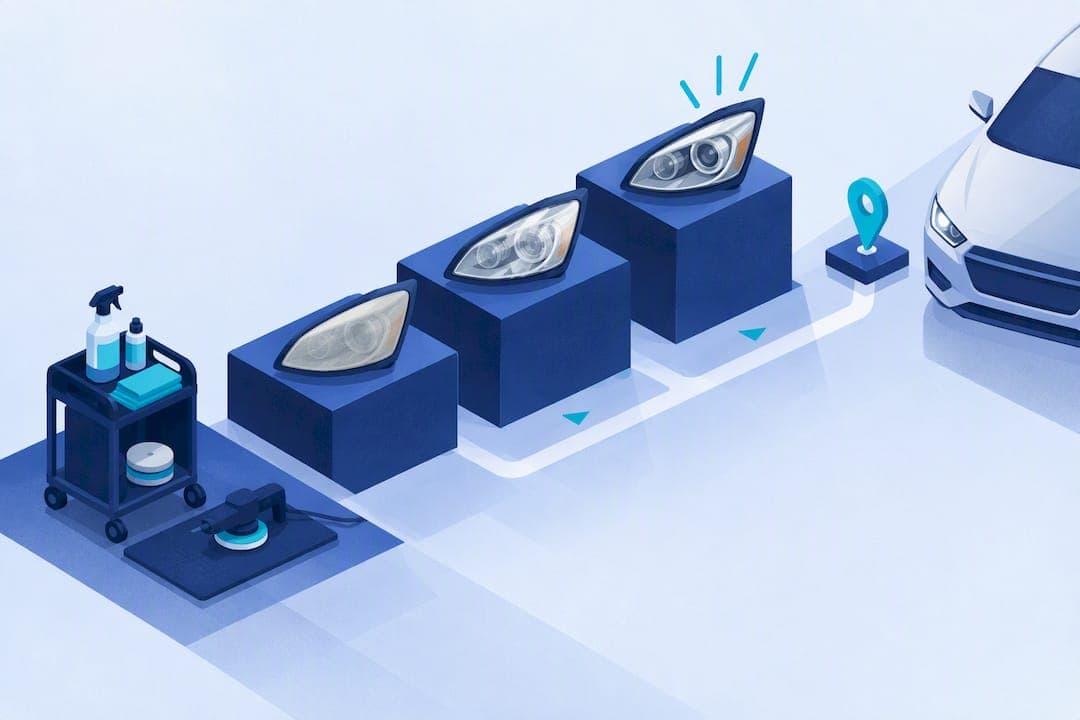
Offer headlight restoration as an on-the-spot, high-margin upsell: typical retail runs $125 to $350, and a short visual demo at intake drives the fastest yes from customers. The service takes under 90 minutes, uses cheap consumables, and solves a problem the customer can see immediately. Lead with the demo, price it clearly on the ticket, and let the cloudy lens do the selling.
TL;DR:
- Tiered pricing based on vehicle size and level of oxidation protects margins on larger or severely damaged lenses.
- Proper professional restoration can improve light output to over 73% of OEM levels, significantly better than DIY kits.
- The most effective workflow includes wet-sanding, machine polishing, and applying a durable UV topcoat to ensure long-lasting clarity.
- Demonstrating results with before-and-after photos during the walk-around increases conversion rates and attachment success.
- Local targeted ads, social proof, and referral partnerships with car dealers or body shops are the most reliable channels to attract headlight restoration customers.
Table of Contents
- How to price restoration so it hits target gross margins
- What the professional restoration workflow looks like
- Scripts and tactics that raise your attach rate
- How to package, schedule, and staff restoration work
- Where to find buyers and which offers convert
- How Mobile Detail AI helps you run this at scale
- Why this upsell deserves priority
- Put pricing and scheduling on autopilot
- FAQ
- Sources
How to price restoration so it hits target gross margins
Single flat-rate pricing is easier to quote, but tiered pricing by vehicle size and lens severity protects margin on SUVs and trucks with larger, more oxidized lenses. A three-tier model (sedan, SUV, severe oxidation) keeps your quote honest without a lengthy explanation at the curb.

Per-job supply costs for a professional job stay low relative to retail price. Trade posts and lab data point to consumable costs often under tens of dollars per job(https://newsroom.aaa.com/wp-content/uploads/2018/12/E.1-Research-Report-Headlamp-Lens-Deterioration-FINAL-11-19-18.pdf), which is what makes this one of the highest-margin add-ons in a detailer's menu once labor is priced right.
Three models worth testing:
- Flat rate: one price for all vehicles, fastest to quote, lowest perceived risk for new customers.
- Tiered by vehicle: sedan, SUV/truck, and severe-oxidation pricing that protects margin on harder jobs.
- Bundled rate: restoration folded into a detail package at a lower add-on price than standalone.
Professional restoration raised light output to about 73.4% of OEM baseline in lab testing, compared with around 70% for DIY kits, which gives you a real performance gap to quote against a cheaper home remedy. Put the price on the written estimate next to the base detail, not as a verbal afterthought, so acceptance reads as a decision rather than a surprise.
What the professional restoration workflow looks like
A professional job follows a predictable sequence, which is part of why it is easy to train and price consistently.
- Assess the lens for oxidation depth and any pitting or cracking that restoration cannot fix.
- Mask the surrounding paint and trim to protect it from sanding dust and polish.
- Wet-sand through a grit progression, commonly 320 to 2000, to remove the degraded outer layer.
- Machine polish to restore clarity and remove fine sanding marks.
- Apply a UV-cured topcoat or 2K sealant and allow it to cure before the vehicle leaves.
Most jobs run 45 to 90 minutes depending on oxidation severity and whether a topcoat needs extended cure time. Heavily pitted or deeply yellowed lenses can push past that window and may be better quoted as a separate appointment.
With a proper UV topcoat, restored clarity commonly holds for several years rather than fading within months, which is the main difference between a professional job and a bargain spray kit.

Pro Tip: Quote cure time on the ticket so customers don't expect to drive off immediately after polish, especially on mobile jobs done in direct sun.
Scripts and tactics that raise your attach rate
The best moment to pitch restoration is during the walk-around, before the customer has mentally checked out of the sales conversation. A cloudy headlight is one of the few defects a customer can see without you pointing at a gauge or a report.
Three scripts worth keeping on a laminated card in the van:
- Curbside walk-around: "I noticed your headlights have some yellowing. We can restore them today in under 90 minutes, and it noticeably improves your night visibility."
- Mid-service add: "While we're working on the exterior, want us to knock out the headlights too? It's a quick add at this stage."
- End-of-service close with objection handling: when a customer says it's too expensive, respond with the cost-versus-replacement contrast rather than a discount: "A new assembly runs well beyond this, and restoration gets you most of the clarity back for a fraction of that."
Visual proof closes more jobs than any script alone. Snap a quick before photo, polish one spot on the lens for 30 seconds to show the contrast, and hold the phone up next to the lens. Document acceptance with a signed estimate line item, which also protects you if a customer disputes the charge later.
Visual demos and walk-arounds are commonly cited by detailers as the top conversion tool, with attach rates often exceeding a quarter of customers on existing customers when the offer is shown rather than just mentioned. Track attach rate weekly and set an early target around that figure before pushing higher with better scripts or bundling.
How to package, schedule, and staff restoration work
Packaging decides how customers perceive value. Offer restoration as a standalone service for walk-ins, as a flagged add-on during booking for existing customers, and as a bundled line inside paint correction or ceramic coating packages where it reads as a natural pairing rather than an extra charge.
- Standalone: best for lead generation and search ads targeting the specific problem.
- Add-on: best attach rate, shown at booking or during the walk-around.
- Bundled: pairs naturally with paint enhancement, polishing, and corrections or ceramic coating packages.
Block dedicated time on the schedule rather than squeezing restoration into gaps between other jobs, since cure time matters. A single technician can usually run one restoration at a time on a mobile setup, though a two-tech crew can stagger sanding and polish on multiple vehicles.
Keep a running inventory of sandpaper grits, polish, masking tape, and topcoat sealant, since running out mid-job on a mobile unit costs you the appointment. Put a short, plain warranty line on the invoice covering a defined window against re-yellowing, which heads off disputes without overpromising permanence.
Where to find buyers and which offers convert
Local search ads targeting phrases like "headlight restoration near me" tend to outperform broad detailing ads because the search itself signals high purchase intent. Before-and-after photos on social posts are the single most repeated tactic among detailers for generating organic interest, since the transformation does the convincing.
Referral partnerships extend reach without ad spend:
- Used-car dealers who want clean headlights on lot vehicles before sale photos.
- Body shops and collision centers that can refer customers needing cosmetic work alongside repairs.
- Mobile service partners in adjacent categories, such as mobile auto glass repair, who see the same vehicles and can cross-refer.
- Fleet or rental operators needing headlights refreshed on a schedule.
Test a visual-demo discount for first-time customers, a seasonal campaign tied to fall or winter night-driving safety, and a bundled upgrade offer alongside a full detail. Track cost per lead, attach rate uplift, and revenue per booking to see which channel actually pays for itself.
How Mobile Detail AI helps you run this at scale
Running this upsell well means tracking who said yes, who declined, and why, across every booking. Our CRM tools let you add headlight restoration as a service line, flag it during scheduling, and pull attach-rate data by technician or location. For a multi-van operation, route optimization keeps restoration jobs grouped efficiently instead of scattering cure-time-sensitive appointments across a sprawling route.
Why this upsell deserves priority
This is one of the clearest revenue wins in detailing: visible problem, fast fix, strong margin. The catch is training, since a rushed sanding job looks worse than no job at all. Expect modest attach rates at first and improve them through better scripts, not discounts.
— Mobile
Put pricing and scheduling on autopilot
Adding headlight restoration to your menu is only half the work; pricing it consistently, scheduling the cure time, and tracking which technician closes the most jobs is the other half. Our provider subscription plans, from CRM-Only at $1 per month to Marketplace at $59 per month and Preferred at $139 per month, give you the scheduling, booking, and payment tools to run this upsell without extra spreadsheets.
Add the service to your profile and start tracking attach rates on your next ten bookings.
FAQ
What is the average price to restore headlights?
Professional headlight restoration typically retails for $125 to $350 depending on vehicle size and oxidation severity. Flat-rate pricing works for simpler jobs, while tiered pricing protects margin on larger vehicles or heavily yellowed lenses.
How do I get headlight restoration customers?
Local search ads targeting the specific problem convert well because the searcher already has an intent to buy. Before-and-after photos on social media and referral partnerships with used-car dealers or body shops also generate steady demand.
Is headlight restoration worth the money?
Yes for most vehicles with oxidized but intact lenses, since professional restoration raised light output to roughly 73.4% of OEM baseline in lab testing, a meaningful gain for nighttime visibility. Industry safety research also ties lens deterioration to reduced forward lighting, which makes restoration a safety-relevant fix rather than a purely cosmetic one.
What is the best headlight restorer on the market?
Definitions vary, but the strongest results come from a full professional process: wet-sanding through a fine grit progression, machine polishing, and a UV-cured topcoat rather than a one-step spray kit. Spray-on kits without a durable topcoat tend to re-yellow within months, while a properly applied UV topcoat holds clarity for several years.