

Most daily drivers should get a full detail several times a year, while garaged or lightly used cars can usually stretch to longer intervals between visits. That's the baseline. Everything else, climate, mileage, kids, pets, whether you've got a ceramic coating, either shortens that window or lets you push it further.
TL;DR:
- Outdoor parked daily drivers typically require full detailing several times per year, while garaged cars can go longer between visits.
- Climate factors like UV exposure, salt, and pollen can accelerate paint degradation, prompting an earlier or more frequent detailing schedule.
- Exterior maintenance involves biweekly washes, semiannual decontamination, and quarterly waxing, while interiors need monthly vacuuming and periodic deep cleanings.
- Wax needs reapplication every two to three months, whereas ceramic coatings can last several years with proper maintenance.
- Setting a regular, calendar-based schedule and using booking platforms helps prevent neglect and keeps the car’s condition consistently Protected.
Table of Contents
- How Often to Detail a Car by Usage Type
- What Factors Change How Often You Should Detail Your Car?
- Do Exterior and Interior Detailing Need Different Schedules?
- Should You DIY or Hire a Professional Detailer?
- How Long Do Wax, Sealant, and Ceramic Coatings Last?
- What Are the Warning Signs You Need a Detail Now?
- How Do You Build a Detailing Schedule That Actually Works?
- How a Booking Platform Keeps You on Schedule
- Book Your Next Detail and Set a Recurring Schedule
- Author Perspective: Pick a Cadence and Let the Calendar Do the Work
- Sources
How Often to Detail a Car by Usage Type
Your ownership pattern matters more than the calendar. A car that lives outside in Phoenix summers has completely different needs than one parked in a climate-controlled garage six days a week. Here's how the intervals break down by profile:
- Daily driver, parked outside: Full detail several times per year. Maintenance wash weekly, interior wipe-down regularly.
- Daily driver, garaged: Full detail a few times per year. Maintenance wash every 1 to 2 weeks, interior clean monthly.
- Family car with kids or pets: Full detail more frequently. Interior deep clean monthly, spot-cleaning as needed.
- Weekend or collector car: Full detail about once or twice a year, since low mileage and covered storage do much of the protective work.
- Off-road or work truck: Full detail more frequently. Undercarriage and wheel wells need attention regularly.
These aren't rigid rules. They're starting points you adjust once you know how your car actually lives, according to the general use-case schedule most detailers work from.
What Factors Change How Often You Should Detail Your Car?
Climate does more damage than most owners realize. Intense UV exposure breaks down wax and sealant faster than almost anything else, coastal air accelerates corrosion through salt in the atmosphere, and road salt in winter climates eats at paint and undercarriage components within weeks if it's not rinsed off. Heavy pollen seasons leave a sticky film that bonds to paint if it sits for more than a few days.
Beyond weather, a few practical variables shift your schedule:
- Outdoor parking versus garage storage (outdoor cars need detailing roughly twice as often)
- High monthly mileage or stop-and-go city driving that kicks up more brake dust and grime
- Kids and pets, which turn interior detailing into a monthly rather than seasonal task
- Tree sap, bird droppings, and insect splatter, all of which etch clear coat if left untreated
Pro Tip: If your car sits under a tree, near the coast, or in a snowy region for winter months, move your full detail up by 1 to 2 months from whatever baseline you'd otherwise use. Bonded contaminants get harder to remove the longer they sit, and the added correction work costs more than the earlier appointment would have.
Do Exterior and Interior Detailing Need Different Schedules?
Yes, and treating them as one combined task is where a lot of owners waste money. Exterior surfaces face constant environmental attack. Interiors degrade more from use, moisture, and UV fading through glass.
- Exterior: Maintenance wash every 1 to 2 weeks. Iron decontamination and clay bar treatment every 6 months. Machine polish only when swirls or oxidation appear. Wax or sealant reapplied every 2 to 4 months, ceramic coating maintenance washes as directed by the installer, following the common minimum baseline detailers cite for these tasks.
- Interior: Vacuum weekly if you commute daily. Steam extraction or shampoo every 3 to 6 months, dropping to every 2 months if you've got pets or frequent beach trips, per typical interior-specific cadence guidance. Leather conditioning every 3 to 4 months to prevent cracking.
Prioritize glass and mirrors immediately when they're compromised. Visibility is a safety issue, not a cosmetic one. Odors and stains, on the other hand, can wait a week or two without consequence beyond mild annoyance.
Should You DIY or Hire a Professional Detailer?
Split the work by what actually requires skill and equipment versus what just requires consistency. Weekly washing, glass cleaning, and interior vacuuming are all things you can do in your driveway with a bucket and twenty minutes. Spot-cleaning fresh stains the day they happen is free and takes five minutes.
Professional-only work includes iron decontamination, clay bar treatment, machine polishing, and deep upholstery extraction, tasks that need specialized tools and enough experience to not damage the paint. A workable hybrid plan looks like this:
- DIY: wash weekly, vacuum weekly, glass cleaning weekly, spot-clean immediately
- Professional: decon and clay every 6 months, machine polish only when needed, full detail every 3 to 6 months depending on your usage profile
Detailers generally recommend an inspect-first approach. Skip aggressive polishing unless the paint condition actually calls for it, since correction work you don't need just adds cost and risk.
How Long Do Wax, Sealant, and Ceramic Coatings Last?
Wax is the shortest-lived protection, generally lasting a couple of months before it needs reapplication. Polymer sealant holds up longer, typically several months. Ceramic coatings can last multiple years depending on the product and preparation, and paint protection film (PPF) can last several years as a physical barrier against rock chips and light abrasion.
- Wax: Requires reapplication every few months for full protection.
- Sealant: Requires reapplication every few months.
- Ceramic coating: Lasts multiple years but still needs periodic professional maintenance visits to inspect bonding and refresh hydrophobic performance.
- PPF: Has a multi-year lifespan with periodic inspections recommended.
Coatings and PPF cut down on how often you need corrective polishing, since they're absorbing the damage instead of your clear coat. That's not the same as skipping maintenance entirely. A coated car that never gets inspected can still develop bonded contamination underneath a surface that looks fine from three feet away.
What Are the Warning Signs You Need a Detail Now?
A few red flags mean you shouldn't wait for your scheduled appointment:
- Water no longer beads up and rolls off. It sheets flat across the paint, meaning your wax or sealant has worn off.
- The paint feels rough or gritty when you run a hand over it after washing. That's bonded contamination, tree sap, rail dust, or industrial fallout sitting on the surface.
- Visible swirl marks or dull, oxidized patches under direct sunlight.
- Upholstery stains that have set for more than a week, or a lingering odor that air fresheners aren't fixing.
- Rust colored spots near the wheels, which usually means brake dust has started corroding into the clear coat.
Run the hand-feel test after a wash. Smooth means you're fine. Gritty means book a decontamination soon, before it needs a full correction instead of routine maintenance.
How Do You Build a Detailing Schedule That Actually Works?
- Assess your exposure. Note your monthly mileage, whether you park outside or in a garage, how many kids or pets ride regularly, and what level of appearance you actually care about maintaining.
- Pick a starting interval. Heavy exposure means 2 to 3 months. Moderate daily driving means 3 to 4 months. Garaged and low-mileage means 4 to 6 months.
- Set a reassessment point. Check in after your first 3 to 6 months and adjust up or down based on how the paint and interior actually held up.
- Put it on a real calendar. Weekly wash reminders, a monthly interior wipe-down, and a recurring full-detail appointment every 3 to 4 months (or your chosen interval) so it doesn't quietly slip to "whenever I remember."
Treat the first cycle as a test run. Most owners overestimate how much upkeep they'll actually do themselves and end up adjusting toward more frequent professional visits within the first year.
How a Booking Platform Keeps You on Schedule
Good intentions rarely survive a busy month, which is exactly where most detailing schedules fall apart. A booking platform can help solve that problem. Instant booking removes the back-and-forth of calling around for availability, and stored service history means you and your detailer both know exactly when the last decon or wax application happened, instead of guessing.
- Automated reminders nudge you before intervals lapse, not after swirls show up
- Route-optimized scheduling for mobile detailers means faster turnaround near you
- Vetted providers reduce the risk of inconsistent work between visits
The tools exist to make the schedule stick, not just to set one.
Book Your Next Detail and Set a Recurring Schedule
Compare that to calling around for quotes or hoping a shop has a same-week opening. On Mobiledetail, you search vetted detailers in your area, compare packages, and book instantly instead of playing phone tag.

The process takes three steps: find a service provider near you, select the package that matches your car's needs (maintenance wash, full detail, coating application), and schedule it as a recurring appointment so you're not relying on memory. Your service history stays attached to your profile, so every detailer you book with can see what's already been done and what's due next. That alone solves the biggest reason schedules slip: nobody remembers when the last decon happened. Set your interval once on Mobiledetail and let the reminders handle the rest.
Author Perspective: Pick a Cadence and Let the Calendar Do the Work
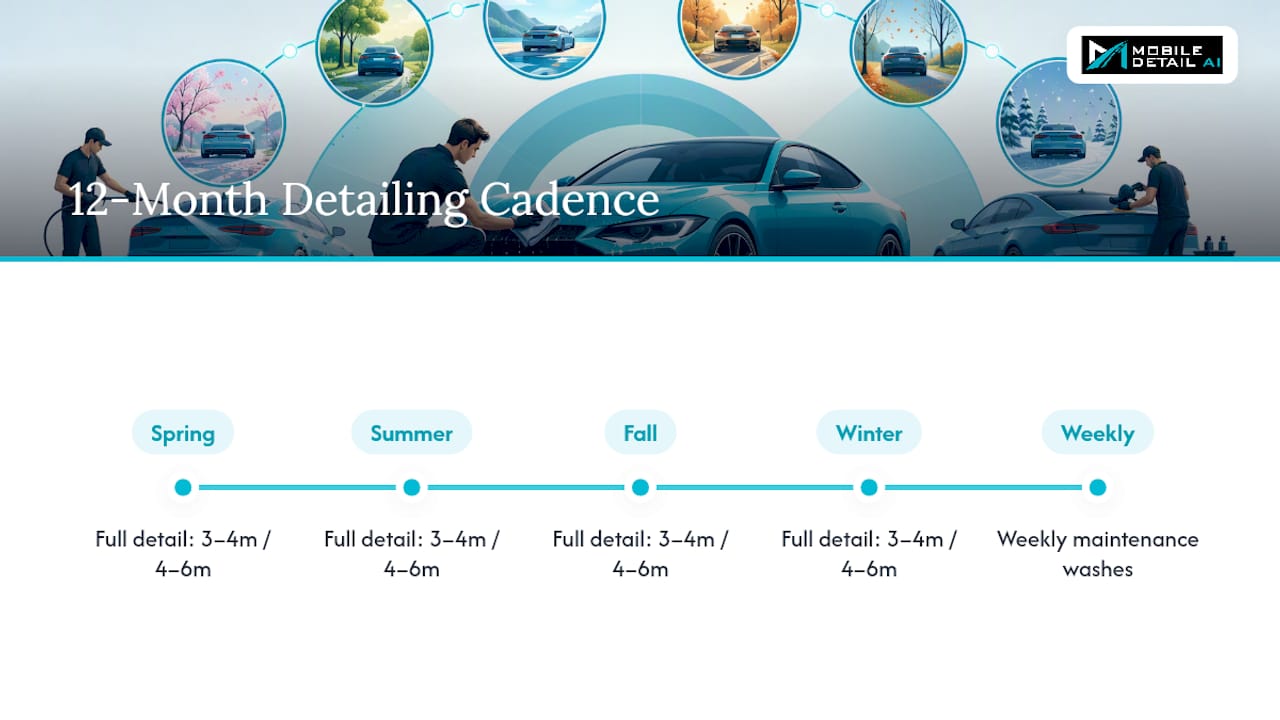
The mistake most owners make isn't skipping detailing. It's treating every visit as a decision instead of a default. Daily drivers do best on a 3 to 4 month full-detail rhythm, garaged cars can relax to 4 to 6 months, and both benefit from weekly maintenance washes in between.
The schedule that survives is the one that doesn't require willpower. Pick your starting interval this week, put it on a recurring calendar entry, and use booking and reminder tools to keep it from quietly disappearing into "I'll get to it." Cars don't punish neglect immediately. They punish it slowly, in etched clear coat and stained upholstery, which is exactly why a fixed cadence beats good intentions every time.
— Mobile