
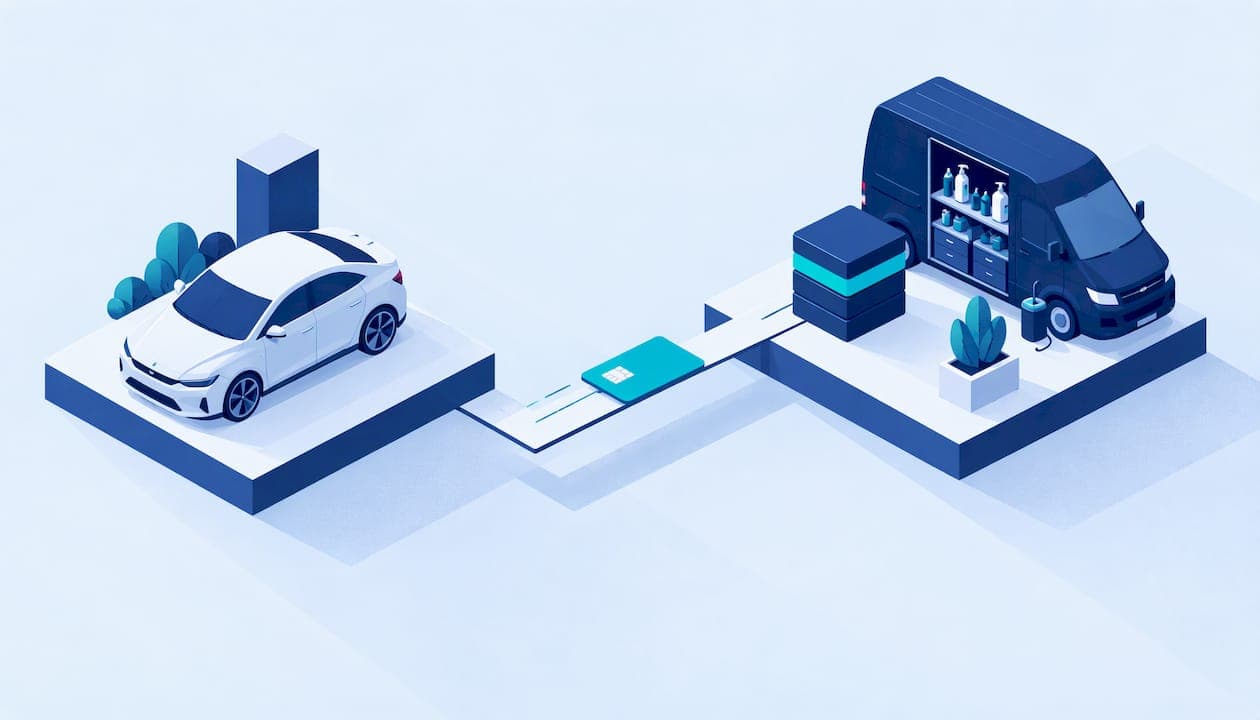
To accept ACH payments, you need a business bank account, a payment provider that supports ACH, a signed or electronically authenticated customer authorization, and the customer's routing and account numbers. Money then moves bank to bank, usually in one to three business days, without a card network in the middle. For a detailer, the payoff is biggest on high-ticket work like ceramic coatings, paint correction, fleet accounts and monthly maintenance plans, where a percentage-based card fee gets expensive.
This guide walks through how ACH works, how to set it up, what an authorization form needs, how it compares with cards, and how to handle returns, so you can add a bank-payment option without chasing customers.
TL;DR
- ACH is a bank-to-bank transfer run through the ACH Network. You can pull a payment the customer has authorized, or the customer can push funds to you.
- Setup takes four steps: a business bank account, an ACH-capable processor with an origination agreement, integration with your invoicing, and authorization forms.
- Standard ACH usually lands in one to three business days, and sometimes takes up to five. Plan job-day cash flow around that.
- Keep every customer authorization on file. You must be able to prove permission if a bank asks.
- ACH suits big tickets, memberships and fleet billing best. Keep cards or cash for walk-up, same-day jobs.
Table of Contents
- What an ACH payment is, in detailing terms
- When ACH makes sense for a detailer
- How to start accepting ACH payments: four steps
- Customer authorization: what your form needs
- How long ACH takes to land
- ACH vs. credit card fees
- Returns, failed payments and fraud
- A simple ACH workflow for a mobile detailing business
- Perspective
- Run your billing from one place
- FAQ
- Sources
What an ACH payment is, in detailing terms
ACH electronically moves money and payment data through the ACH Network. Nacha describes two ways a business gets paid: you receive an authorized pull from the customer's account, or the customer pushes funds into yours. Most ACH payments occur the next day or the same day.
The same network that carries direct deposit of paychecks and tax refunds also carries direct payments such as mortgage and utility bills. Nacha explains that your bank (the originating bank, or ODFI) groups instructions into files and sends them to an ACH Operator, either the Federal Reserve or The Clearing House. The operator sorts them and routes them to the customer's bank (the RDFI). The network is batch-oriented, and that batching is why it is a low-cost alternative to wire transfers, and also why it is not instant.
Two things to keep straight:
- ACH debit (a pull): you collect from the customer's checking account after they authorize you. This is what you use for invoices and recurring plans.
- ACH credit (a push): the customer sends money from their bank to yours. A fleet manager paying a monthly invoice from their accounts payable system often works this way.
There is no Visa or Mastercard involved, so there are no interchange fees. That is the root of the cost difference discussed below.
When ACH makes sense for a detailer
A $40 exterior wash on a driveway is a card or cash job. A $1,800 ceramic coating, a $600 correction package, or a dealership account that sends ten vehicles a month is different. ACH fits when:
- The ticket is large. Percentage-based card fees grow with the invoice. A bank transfer's cost generally does not grow the same way.
- The customer relationship repeats. Maintenance memberships, monthly washes for a household with three cars, and fleet accounts all involve repeated billing with an authorization signed once.
- You invoice after the work. Commercial clients, property managers and dealerships often prefer paying by bank transfer and expect it.
- You take deposits. A deposit on a multi-day paint protection film or coating job reduces no-shows, and ACH is a low-cost way to collect it from a customer you already know.
It fits less well when a customer wants to pay at the curb in the next five minutes and has no payment link ready. Offer ACH as one option, not the only one.
If you run memberships, see our breakdown of detailing membership programs, plans, prices and terms. For commercial accounts, our guide to fleet billing for detailers covers how to structure net terms.
How to start accepting ACH payments: four steps
The U.S. Chamber of Commerce lays out the setup in four parts. Here is how each looks for a mobile detailing business.
1. Use a business bank account
Keep detailing revenue in an account in the business's name, separate from personal funds. Nacha's quick start tells businesses to confirm the account is ACH-enabled. Call your bank and ask. If you are still setting up the business itself, our Arizona mobile detailing license guide covers the licensing and tax steps that come first.
2. Pick a processor that supports ACH
You generally need a provider that supports ACH and an ACH origination agreement with it. When you compare providers, ask these questions:
- What does it charge per transaction, and is there a monthly fee?
- How long until funds reach your account?
- Does it handle return codes and retries for you?
- Does it offer fraud monitoring, and what does it do with suspicious activity?
- Does it connect to the invoicing tool you already use?
The fee is set by your bank or processor, so get it in writing.
3. Connect it to your invoicing
The cleanest setup lets you send an invoice with a pay-by-bank link, so the customer enters their account details in a secure portal and you never handle raw account numbers by text or email. If you currently invoice by hand, our mobile detailer invoicing templates and the four-step billing workflow show how to get an invoice out within minutes of finishing a job.
4. Prepare authorization forms
You need forms for one-time payments, cards or accounts kept on file, and recurring payments. That is the next section.
Customer authorization: what your form needs
Before you debit a customer's account, you need their permission. Nacha's developer guide puts the burden on the business: the originator is responsible for proving permission to transact and providing proof within 10 days of a request. Keep each authorization somewhere you can find it quickly, tied to the customer's record.

For consumer accounts, federal rules also expect a signed or similarly authenticated writing, and the customer should be able to get a copy. An electronic signature works when your method of verifying identity is sound.
The U.S. Chamber lists what a compliant authorization form includes:
- Clear language stating what the customer is authorizing.
- Account type, routing number and account number.
- Amount, frequency and start date.
- How to revoke authorization, including the notice period.
- Your business name, phone, address, email and website.
- A dated signature, handwritten or electronic.
The same logic applies to any form where a customer grants you permission to act. Shops in other trades have written about repair authorization form requirements for the same reasons: a clear, signed record protects both sides if a charge is questioned later.
A plain-language template for detailers
Adapt this structure and have your bank or processor review the final wording:
- Who and what: "I authorize [Your Business Name] to debit the checking account below for detailing services."
- Which payments: one-time amount for a specific job, or a recurring amount on a stated day each month, for a named membership.
- Account details: account type, routing number, account number, and name on the account.
- Changes: you will give notice before changing a recurring amount or date. The Chamber recommends at least seven to ten days.
- Revoking: how and how far in advance the customer can cancel, and who to contact.
- Signature and date.
If you already collect a vehicle intake form with signatures, add the payment authorization to that flow instead of making it a separate step. Our one-page intake for detailers shows how to capture eSignatures at booking.
How long ACH takes to land
Plan on one to three business days. The U.S. Chamber notes that the ACH network settles in windows four times a day, and merchants typically receive funds in one to three business days, though it can take up to five for a bank or processor to release them. Transactions submitted after a cutoff roll to the next batch, and weekends and federal holidays do not count.
Same Day ACH exists for faster settlement, and your processor may charge extra for it. Ask whether it is available and what it costs before you promise a customer or yourself a particular timeline.
The practical rules for a detailer:
- Do not count ACH money for buying chemicals the day you invoice.
- Collect deposits early, so the funds have cleared before the job.
- Invoice the same day you finish, because every day of delay adds to the wait.
- Tell customers the timeline in your invoice email so no one thinks a payment is missing.
The Federal Reserve's Small Business Payments Toolkit also notes that ACH credits are not final until interbank settlement, and that recurring payments can fail when an account lacks sufficient funds. Treat a payment as received when it settles, not when the customer clicks pay.
ACH vs. credit card fees
The exact numbers depend on your provider, so use your own quote. The structure of the cost is what matters: cards typically charge a percentage of the sale, while bank payments are commonly priced per transaction or with a small percentage and a cap. Here is a worked example using an assumed 3% card rate (replace it with your own rate):
| Job | Invoice | Card fee at an assumed 3% | ACH fee |
|---|---|---|---|
| Interior detail | $250 | $7.50 | Your processor's flat or capped rate |
| Paint correction | $900 | $27.00 | Your processor's flat or capped rate |
| Ceramic coating | $1,800 | $54.00 | Your processor's flat or capped rate |
| Monthly fleet invoice | $5,000 | $150.00 | Your processor's flat or capped rate |
The card column climbs with every dollar. Ask your processor for its ACH quote, then fill in the last column. On large invoices the gap is usually the reason detailers add the option.
Cards still have real advantages: instant authorization, customer habit on one-time purchases, and rewards that some customers prefer. A good setup offers both and lets large-ticket and recurring customers choose the bank option.
Returns, failed payments and fraud
A failed ACH is not a disaster if you know the rules. A payment can be returned for insufficient funds, a closed account, wrong banking details, or revoked authorization. The system sends back a code that tells you which.
The rules for trying again are specific. According to a May 2025 ACH rules update from First Financial:
- After a return for insufficient or uncollected funds, you cannot retry for more than the original amount, so you cannot add a return fee to the retry.
- You can retry at most two times.
- After a return for revoked authorization, a stopped payment, or the customer saying it was not authorized, you cannot retry without a new authorization from the customer.
A few habits cut your return rate:
- Verify details at collection. Have the customer enter their own account details in a secure portal rather than reading numbers over the phone.
- Send reminders before recurring debits. The customer remembers the charge and keeps funds available.
- Give notice of changes. The Chamber advises telling customers at least seven to ten days before a recurring amount or date changes.
- Know your cancellation process. Decide in advance who handles revocations and how fast.
On security, the Chamber recommends multi-factor authentication and role-based access for anyone who touches your ACH system, and a payment gateway that monitors transactions and flags suspicious activity. Nacha's quick start adds that you should discuss fraud prevention with your provider. Ask what monitoring they run for you, since fraud-monitoring requirements for ACH originators have been tightening.
If you employ techs, give them no access to bank details. Only the owner or office manager should see payment settings.
A simple ACH workflow for a mobile detailing business
- At booking: the customer picks a service and, for large jobs, a deposit. Offer pay-by-bank next to the card option.
- At intake: collect the signed payment authorization with the vehicle details and photos.
- After the job: send the invoice from your phone before you leave the driveway, with a bank-payment link.
- Within a few days: watch for settlement. Mark the invoice paid only when funds clear.
- If it fails: read the return reason, contact the customer, and follow the retry rules above.
- Monthly: for membership and fleet customers, send a reminder a few days before each debit.
Perspective
We built Mobile Detail AI around a simple observation: detailers lose money in the gaps between finishing a job and getting paid. The work is done, the vehicle is clean, and then comes a week of texting about the invoice.
That is why we pair a customer marketplace with a CRM made for detailing businesses: visual scheduling, route optimization, customer management, invoicing, secure payment processing and business analytics in one place. When a booking, a customer's vehicle history and an invoice live in the same record, a payment authorization stops being a separate piece of paper and becomes part of the job.
Our view is that a payment method is only as good as the workflow around it. Whether a customer pays by card, cash or bank transfer, the detailer should send the invoice the same day, keep the authorization attached to the customer, and know at a glance who has paid. We designed the platform to make that routine, for solo operators and multi-van teams alike.
Mobile
Run your billing from one place
If you are tired of piecing together scheduling, invoices and payments from separate tools, Mobile Detail AI gives detailers a CRM with invoicing, secure payment processing, customer management and route-optimized scheduling. Our provider plans are CRM-Only at $1 per month, Marketplace at $59 per month, and Preferred at $139 per month.

Car owners can browse vetted detailers and book on the Mobile Detail AI marketplace, and detailers can see which plan fits how they work.
FAQ
Can I accept ACH payments instantly?
Usually not. Standard ACH typically takes one to three business days, and in some cases up to five, according to the U.S. Chamber of Commerce. Same Day ACH is faster, and your provider can tell you whether it is offered and what it costs.
Is there a fee to accept ACH payments?
Yes, though it is generally lower than a percentage card fee on large invoices. Your bank or payment processor sets the rate, and it may be a flat amount per transaction or a small percentage with a cap. Ask for the fee schedule in writing before you sign an origination agreement.
What should an ACH payment authorization form include?
It needs clear authorization language, the customer's account type, routing number and account number, the amount, frequency and start date, how to revoke, your business contact details, and a dated signature. Handwritten and electronic signatures are both used. Keep the signed copy so you can provide proof of permission within 10 days if asked, per Nacha's developer guide.
Should a mobile detailer accept ACH at all?
It is a strong fit for large jobs, deposits, memberships and fleet accounts, where card fees add up and customers have an ongoing relationship with you. Keep cards or cash available for quick one-time jobs. Most detailers do best offering both.
Sources
- ACH Quick Start Tool: B2B, Nacha
- How ACH Payments Work, Nacha
- How ACH Works, Nacha ACH Developer Guide
- How to Accept ACH Payments and Lower Processing Costs, U.S. Chamber of Commerce
- Small Business Payments Toolkit, Federal Reserve Financial Services
- May 2025 ACH Rules Update, First Financial
- Repair Authorization Form Requirements for US Shops