
Bill fleet customers with one bundled, itemized monthly invoice that lists every vehicle visit, backed by a payment term that protects your cash flow. Pick a pricing model up front, per vehicle, retainer, or volume tier, and stick to it. Software that supports account-level billing with CRM tools can turn this from a spreadsheet chore into a five-minute close at month end.
TL;DR:
- Using a hybrid pricing model with volume discounts and retainer fees offers predictable revenue and better margins for fleet detailing contracts.
- A well-structured fleet contract must include clear service scope, frequency, billing, payment, and dispute procedures to prevent misunderstandings.
- Software with account grouping, automated invoicing, and dispatch-to-invoice flow significantly reduces billing errors and streamlines reconciliation.
- Building or pilot testing billing workflows before full implementation minimizes errors caused by untagged visits and unbilled add-ons.
- Protect cash flow by requiring deposits, keeping cards on file, and scheduling invoices regularly, especially when offering Net 30 or Net 60 payment terms.
Table of Contents
- What Is Fleet Billing for Detailers, Exactly?
- How Do You Price Fleet Detailing Contracts?
- What Should Go in a Fleet Detailing Contract?
- Which Software Features Actually Matter for Fleet Billing?
- What Does a Monthly Fleet Billing Workflow Look Like?
- How Do You Protect Cash Flow With Net 30 or Net 60 Fleets?
- What I've Learned Watching Fleet Accounts Succeed and Fail
- How Mobile Detail AI Handles Fleet Billing for You
- Sources
- FAQ
What Is Fleet Billing for Detailers, Exactly?
Fleet billing for detailers means consolidating every vehicle visit for one commercial account into a single, itemized invoice on a recurring schedule, instead of sending a new invoice after each job. A rental agency with 30 vans, a delivery company with 15 box trucks, or a car dealership with a rotating inventory of loaner vehicles doesn't want 30 separate invoices landing in its accounts payable inbox every week. Fleet work centers on consolidated monthly billing cycles and volume pricing rather than one-off payments, and that single shift in structure is what separates a detailer who lands fleet accounts from one who burns out chasing them.
Before you write your first fleet contract, get comfortable with a few pieces of vocabulary and infrastructure:
- Account record: a master profile for the fleet customer that tracks every vehicle, its unit number or VIN, and its service history in one place.
- Line item: a single service entry tied to one vehicle and one visit date, the building block of your bundled invoice.
- Consolidated invoice: one document per billing period that rolls up every line item for every vehicle under that account.
- Recurring schedule: the cadence at which vehicles get serviced, weekly for high-turnover rental fleets, bi-weekly for delivery vans, monthly for lower-mileage corporate cars.
- AR terms: the payment conditions attached to the account, whether that's a deposit up front, a card on file for auto-charge, or negotiated Net 30 or Net 60.
Cadence should match how hard the vehicles work. A rideshare or delivery fleet accumulates soil fast and often needs weekly interior resets. A corporate sedan fleet used for client meetings might only need bi-weekly exterior washes and a monthly deep interior clean. Match the schedule to the vehicle's job, not to what's convenient for your route.
Payment terms deserve equal weight. A deposit at signing protects you against a fleet account that cancels after one billing cycle. Auto-charge on a saved card removes the collections step entirely. Net 30 or Net 60 terms are common with larger corporate fleets whose accounts payable departments run on fixed cycles, but they mean you're financing the work for a month or two before you see the money. Decide which trade-off you're willing to make before a prospect asks.
How Do You Price Fleet Detailing Contracts?
Three pricing structures cover almost every fleet scenario: per-vehicle/per-visit, tiered volume discounts, and a flat monthly retainer. Most detailers land on a hybrid: a base per-vehicle rate that steps down as volume climbs, wrapped in a retainer for predictable months.
Per-vehicle/per-visit pricing charges a set rate for each vehicle serviced, adjusted for vehicle type and service level. This works best for fleets with irregular visit counts, like a dealership rotating loaners in and out of service.
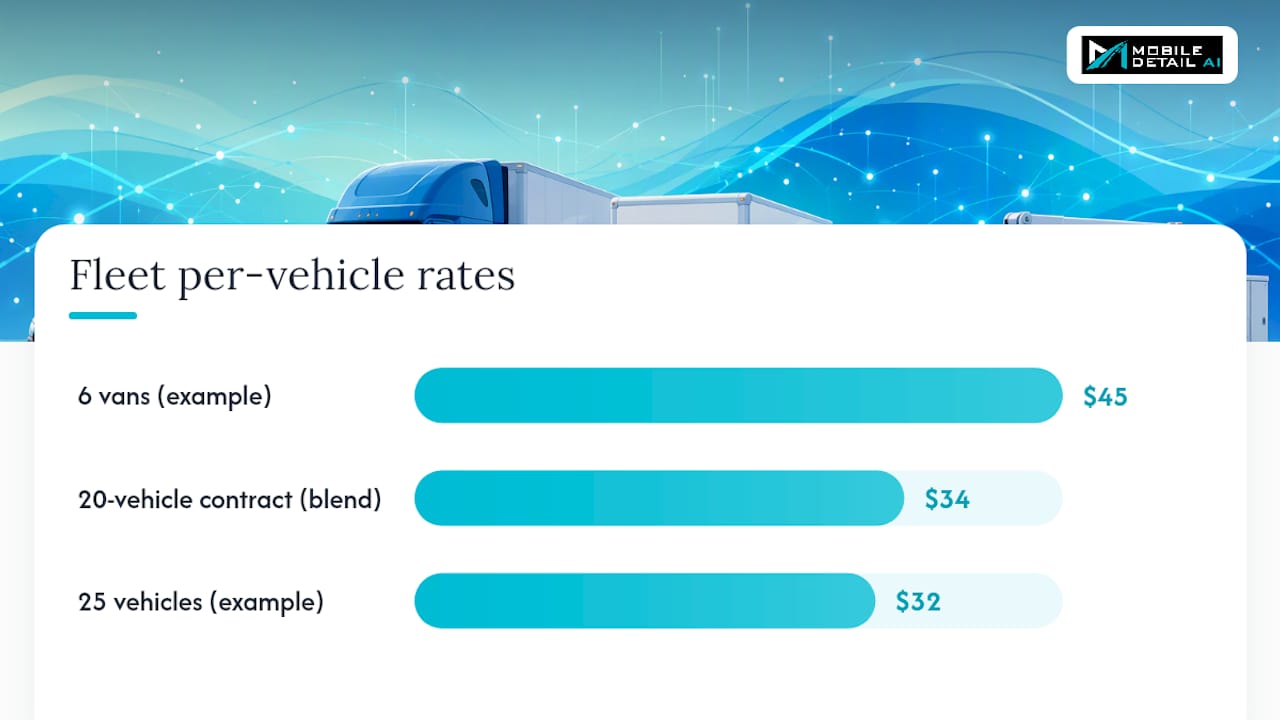
Tiered volume pricing drops the per-vehicle rate as the fleet size grows. Fleet programs commonly start offering fleet-specific pricing at five or more vehicles, with steeper discounts kicking in at 10 and again at 20-plus units. A fleet of six vans might pay $45 per vehicle for an exterior wash and vacuum, while a fleet of 25 pays $32 for the identical service.
Monthly retainer pricing charges one flat fee regardless of exact visit count, within an agreed range. This suits fleets with predictable, steady schedules and gives you guaranteed monthly revenue without invoicing every trip separately.
To build any of these from scratch, use a simple cost-plus formula:
- Calculate your labor cost: hourly rate × estimated time per vehicle (typically 20 to 45 minutes for a maintenance wash, 60 to 90 for a full interior detail).
- Add materials cost: chemicals, microfiber, interior protectant, roughly $3 to $8 per vehicle depending on service level.
- Add a vehicle-use cost buffer, since a mobile detailer's own driving between fleet stops isn't free. The IRS standard business mileage rate sits at 76 cents per mile for July through December 2026 (72.5 cents per mile for January through June), a useful benchmark for modeling what your route actually costs you.
- Add 15% to 25% overhead for insurance, water, equipment wear, and admin time.
- Apply a heavy-soil modifier for vehicles that run hot: delivery vans with food debris, work trucks with mud and job-site grime, or rideshare vehicles with heavy interior wear typically add $10 to $25 per visit.
A worked example: a maintenance wash and vacuum on a standard sedan might run $28 labor plus $5 materials plus $6 overhead, landing around $39 per vehicle. The same service on a work truck with a bed liner and heavy interior soil might climb to $55 once you add the heavy-soil modifier. Volume discounts then apply on top, so a 20-vehicle fleet contract might average $34 per vehicle blended across sedan and truck mixes.
Pro Tip: Build your heavy-soil modifier into the contract as a stated line item, not a surprise upcharge. Fleets budget better when the exception is priced in advance, and you avoid the awkward call explaining why this month's invoice ran higher.
What Should Go in a Fleet Detailing Contract?
A fleet contract should function as an operating manual, not just a price sheet. If a fleet manager can't answer "what happens if a vehicle gets missed" or "how do we dispute a charge" by reading the document, the contract has gaps that will surface as phone calls later.
Run through this checklist before any fleet account signs:
- Service scope: exactly what's included per visit (exterior wash, interior vacuum, dashboard wipe) and what counts as an add-on.
- Frequency: the agreed cadence, weekly, bi-weekly, or monthly, and how schedule changes get requested.
- Pricing formula: the base rate, volume tier, or retainer amount, plus how heavy-soil or add-on charges get calculated.
- Billing cadence: when invoices go out (end of month is standard) and the billing period they cover.
- Invoicing contact: the specific accounts payable email or portal, not just "the manager," since fleet AP departments are often a separate team from the fleet coordinator you negotiate with.
- Accepted payment methods: card on file, ACH, or check, and whether auto-charge is required or optional.
- Dispute process: the window for flagging a billing error (commonly 10 to 15 business days) and how credits get applied.
- Cancellation terms: notice period required and how partial-month billing gets prorated.
On payment structure, new fleet accounts should generally start with a deposit, one visit's worth of value or a flat setup fee, before the first service. Once you've run two or three billing cycles cleanly, moving to card-on-file auto-charge removes the manual collections step almost entirely. Net 30 or Net 60 terms are reasonable for established corporate fleets with formal AP departments, but reserve them for accounts large enough to justify the cash-flow lag, and never extend Net 60 to a brand-new account with no payment history.
Negotiation works both directions. If a fleet wants a bigger volume discount, ask for something back: a shorter payment window, a signed annual term instead of month-to-month, or a retainer structure that guarantees revenue even in slow months. A dealership or rental agency evaluating outside vendors is also weighing reliability and paperwork clarity, not just price, which is exactly why clear vehicle documentation matters to fleet buyers in the first place.
Which Software Features Actually Matter for Fleet Billing?
The single feature that eliminates the most invoicing headaches is dispatch-accounting sync, the ability to push a completed, verified work order straight into your accounting records without retyping anything. Dispatch-accounting integration lets operators send verified work to accounting in one click, cutting out the manual entry step where most billing errors originate.
Before you commit to any billing software, require these features:
- Account grouping: the ability to tie multiple vehicles to one fleet account so every visit rolls up automatically.
- Recurring and bundled invoicing: automated generation of a single consolidated invoice per billing period, not a manual export-and-merge process.
- Saved payment methods: cards on file or ACH details stored securely so auto-charge is actually possible.
- Mobile work-order-to-invoice flow: a technician logs the completed job on a phone in the field, and that entry becomes the invoice line item without re-entry at a desk.
- QuickBooks sync: two-way sync so invoices, payments, and reconciliation happen in one bookkeeping system instead of two disconnected ones.
- PDF invoice delivery: automatic emailing of a formatted invoice to the AP contact on file.
- AR and DSO reporting: a dashboard showing outstanding balances and how long invoices sit unpaid, not a manual tally in a spreadsheet.
Recurring auto-charge and bundled invoicing don't just save you admin time. Consolidated billing improves customer retention because it reduces the friction fleet AP departments feel when reconciling charges, and a fleet buyer who never has to chase down a missing invoice is a fleet buyer who renews. Fleet-focused tools that sync dispatch data with accounting automatically also report meaningful reductions in reconciliation time and invoice errors, since automated receipt matching catches pricing mistakes before they ever reach a ledger.
If you're testing a new billing tool or a new integration, don't flip the switch on every account at once. Map your fields first, which vehicle field in your app corresponds to which customer field in QuickBooks, run a 30-day pilot on one account, and manually audit every invoice from that pilot against the actual work orders before you trust the system with your whole book. Office-side platforms built for detailers increasingly bundle quoting, online payments, and QuickBooks sync into one interface specifically to avoid the double-entry problem that causes most billing mistakes.
What Does a Monthly Fleet Billing Workflow Look Like?
A reliable fleet billing cycle runs the same seven steps every month, whether you're managing one fleet account or a dozen.
- Onboard the account. Set up the master account record with every vehicle, unit number, and the agreed service scope.
- Set payment terms. Lock in the deposit, auto-charge setup, or Net terms before the first visit happens.
- Tag every visit to the account. Each work order gets linked to the fleet account record, not logged as a standalone job.
- Log line items from the field. Technicians record completed services on mobile, including any heavy-soil upsell or add-on, at the moment of service.
- Reconcile exceptions weekly. Catch missed visits, disputed charges, or credits before they pile up into a month-end scramble.
- Generate the bundled invoice. Roll up every line item for the billing period into one document with a summary page and per-vehicle detail.
- Deliver the invoice with remittance instructions. Send the PDF to the AP contact with clear payment instructions and a due date.
Exceptions are where most billing systems break down, so build the handling into the workflow rather than treating it as an afterthought. A heavy-soil upsell gets logged as its own line item with the modifier applied, not folded silently into the base rate. A missed visit gets flagged and either credited or rescheduled, and that credit shows up explicitly on the next invoice so the fleet's AP team can see exactly why the total moved. Refunds work the same way: a line item, not a vague adjustment.
Pro Tip: Track three numbers monthly, and only three: invoice accuracy rate (invoices sent without a correction needed), days sales outstanding, and percent of accounts on auto-charge. If accuracy is climbing and DSO is falling, your workflow is working. If either stalls, the problem is almost always an untagged visit or a missed reconciliation step, not the software.
How Do You Protect Cash Flow With Net 30 or Net 60 Fleets?
Net 30 and Net 60 terms create a real cash-flow gap, since you're covering labor and materials costs for a month or two before payment lands. Syncing dispatch data with accounting and keeping a card on file are the two most reliable ways to close that gap without turning down large accounts.
A few tactics work in combination:
- Require a deposit on every new fleet account before the first service, regardless of how large the prospective contract is.
- Keep a card on file even for Net terms accounts, so you have a fallback if an invoice goes unpaid past the due date.
- Offer a small early-pay discount, 1% to 2%, for accounts that pay within 10 days instead of the full Net 30 window.
- Invoice on a fixed schedule every time, so the fleet's AP team can build your invoice into their own payment cycle rather than treating it as an irregular request.
- Sync completed work and receipts to your accounting system as they happen, not in a month-end batch, so errors surface while they're still easy to fix.
For very large accounts, six figures a year or more, some detailers negotiate partial upfront payment for the quarter or explore invoice factoring to smooth out the Net 60 lag. That's a bigger financial decision than most solo operators need to make, but it's worth knowing the option exists before a major fleet prospect asks for 60-day terms as a condition of the contract.
Vehicle-use costs belong in this cash-flow conversation too. If you're calculating what a route actually costs you before the invoice ever gets sent, the IRS mileage rate gives you a defensible number to work from rather than a guess.
What I've Learned Watching Fleet Accounts Succeed and Fail
The mistake that sinks more fleet accounts than bad pricing is the unbilled add-on. A technician does the heavy-soil upcharge in the field, mentions it to the driver, and it never makes it onto the invoice because nobody tagged the line item. Multiply that across 20 vehicles a month and you're quietly working for free on a meaningful share of your visits.
The second most common failure is not tagging visits to the account at all, so work orders sit as orphaned jobs that never roll into the bundled invoice. Both problems trace back to the same root cause: treating fleet billing like retail billing, one job, one invoice, instead of building the account-level structure fleet work actually requires.
The fix isn't complicated. Pilot one account for 30 to 60 days, track invoice accuracy against your actual work orders every week during that pilot, and only add a second fleet account once the first one is running clean. Scaling a broken process just multiplies the errors.
— Mobile
How Mobile Detail AI Handles Fleet Billing for You
Features such as account grouping, recurring bundled invoices, saved payment methods, and dispatch-to-invoice flow exist in CRM solutions built specifically for detailing businesses. Instead of stitching together a scheduling app, a separate invoicing tool, and a spreadsheet to track which fleet vehicle got serviced when, you run the whole cycle, from route optimization to the final PDF invoice, in one system.

Before you book a walkthrough, have three things ready: your current fleet account list with vehicle counts, your preferred invoice cadence for each account, and a rough sense of your current AR profile, meaning who's on Net terms and who's on auto-charge. That prep turns a generic demo into a conversation about your actual accounts.
Mobile Detail AI offers three provider tiers: CRM-Only at $1 per month, Marketplace at $59 per month, and Preferred at $139 per month, each built around the account-level billing tools fleet work demands. Review the provider subscription details and pick the tier that matches the size of your fleet book today.
Sources
- IRS — Standard Mileage Rates
- Smarfle — Auto detailing billing (recurring billing and bundled invoicing)
- FleetPanda — Billing and invoicing (dispatch-accounting integration)
- Rally — Fleet management (automation and reconciliation)
FAQ
How much should I charge to detail a work truck?
A work truck typically runs $45 per visit for a standard exterior wash and interior vacuum, before any heavy-soil modifier for mud, job-site debris, or bed liner cleaning. Fleet volume pricing can bring that per-vehicle rate down 10% to 25% once an account passes five or more vehicles.
What does fleet detailing mean?
Fleet detailing means providing recurring detailing service to multiple vehicles under one commercial account, billed on a consolidated schedule rather than per single job. It typically runs on a weekly, bi-weekly, or monthly cadence with one bundled invoice covering every vehicle visit in that period.
What is the best CRM for detailers?
The right CRM depends on whether you need consumer booking tools alongside fleet billing, but any platform you choose should support account grouping, recurring invoices, and saved payment methods at minimum. Mobile Detail AI builds these specifically for detailing businesses, with plans starting at $1 per month for CRM-Only access.
Can I write off car detailing as a business expense?
Detailing costs on a business-use vehicle are generally deductible, and self-employed detailers who drive between fleet accounts can also deduct vehicle-use costs using the IRS standard mileage rate, currently 76 cents per mile for the second half of 2026. Keep accurate mileage and service records, since the deduction depends on documentation, not just the rate itself.