
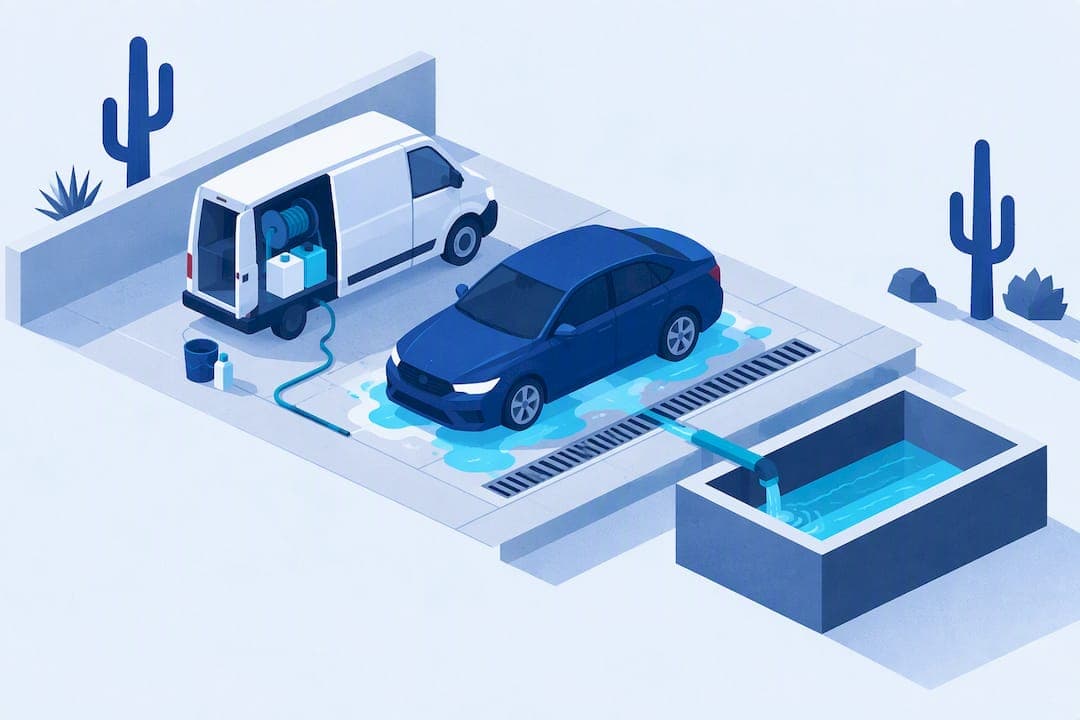
Do not discharge wash water to storm drains or natural waterways. Capture every gallon and dispose of it through a sanitary sewer connection, a commercial carwash partnership, or a certified reclaim system. This standard comes from Phoenix stormwater rules and state permitting through ADEQ. Fixed-facility permits like the 3.03 General Permit rarely apply to mobile work; most of us stay compliant through containment and legal disposal instead.
TL;DR:
- The 3.03 General Permit targets fixed facilities; mobile operators may need individual review when they discharge regularly, use pits, or risk groundwater.
- Before using a sanitary sewer, get written acceptance because districts may require pretreatment or authorization; carwash partners and licensed haulers offer alternatives.
- Phoenix may impose fines from $500 to $10,000 per violation, and biodegradable soap does not exempt wash water from containment or disposal rules.
- Keep timestamped containment photos, recovered volumes, and disposal receipts with each job record, and request written city confirmation before working at new commercial or HOA properties.
Table of Contents
- Which Arizona laws and city rules apply, and when do permits kick in?
- On-the-ground BMPs and containment tactics for mobile detailers
- How to lawfully dispose of collected wash water
- Records, monitoring, and getting inspection-ready
- Why documentation wins compliance disputes
- What actually separates compliant detailers from the rest
- How Mobile Detail AI keeps your compliance records in one place
- FAQ
- Sources
Which Arizona laws and city rules apply, and when do permits kick in?
Arizona's water quality program runs through the Arizona Pollutant Discharge Elimination System, which ADEQ administers on behalf of the federal Clean Water Act. ADEQ decides which permit, if any, a wash operation needs based on how the water is discharged and where it ends up.
The 3.03 General Permit covers vehicle and equipment wash facilities that discharge to an on-site disposal system. It specifies sump and settling requirements, oil and water separation down to 15 milligrams per liter or less, ongoing monitoring, and recordkeeping, and the permit term runs five years with a Notice of Intent and design documentation filed up front. That framework was built for fixed wash pads with permanent plumbing, not a van parked in a driveway or parking lot.
A mobile operation starts to look like it needs individual permitting attention when it discharges regularly and in volume, uses a fixed impoundment or pit, or routes water to the ground in a spot that could reach groundwater. Short of that, capture and legal disposal keep most of us out of permit territory entirely.
City rules add another layer on top of state permitting:
- Phoenix and Tucson both prohibit illicit discharges into storm drains under their municipal codes, treating any non-stormwater flow as a violation subject to inspection.
- Phoenix's enforcement framework can carry fines ranging from $500 to $10,000 per violation, depending on severity and history.
- Reclaimed or gray water reuse tied to a wash operation can trigger a separate Type 3 Reclaimed Water General Permit if that water is reused rather than disposed of.
For a fuller walkthrough of how licensing and local rules fit together, our guide to Arizona mobile detailing licensing steps covers the sequence from tax registration through stormwater sign-off.
On-the-ground BMPs and containment tactics for mobile detailers
Containment is the difference between a routine job and a violation. City of Phoenix guidance is blunt about it: only rain belongs in the storm drain, and anything else needs a barrier between the work and the gutter.
A workable field process looks like this:
- Lay down containment mats or berms before any water touches the surface.
- Route runoff into a portable sump rather than letting it sheet across pavement.
- Pretreat the collected water, separating solids and skimming oils before it moves further.
- Transfer the treated water into a sealed holding tank for later disposal.
Equipment matters here. Containment mats and inflatable berms hold water in a defined footprint, portable sumps give you a collection point, and a small oil/water separator or vacuum recovery unit pulls out the contaminants that would otherwise make disposal harder. None of this needs to be elaborate: a battery-powered wet vacuum paired with a containment mat handles most residential and light commercial jobs.
Cleaning technique reduces the volume you need to manage in the first place. Start with dry pickup for loose debris, skip degreasers outdoors entirely, and treat biodegradable surfactants as a secondary step rather than a first line of defense, since biodegradable soap does not exempt anyone from discharge rules. A partner formulator like SaraWest's Vehicle Wash Eco line makes concentrated detergents built for fleet and commercial wash use, which can cut the volume of chemical residue you need to filter out before disposal.
Pro Tip: Photograph your containment setup and the final recovery tank at every job, with a timestamp, and log it against the job record. That single habit does more to prove compliance than any product spec sheet.
How to lawfully dispose of collected wash water
Once wash water is captured, you still need a legal endpoint for it. Four routes cover nearly every situation a mobile detailer runs into:
- Sanitary sewer disposal: contact your local sewer district to request sewer-acceptance for wash water; some districts require pretreatment or a discharge authorization before you connect, so get that confirmation in writing.
- Commercial carwash partnerships: many carwashes accept hauled wash water for treatment through their existing systems, and setting up a standing account makes repeat drop-offs faster.
- Portable reclaim systems: look for documented recovery rates, confirm how the unit separates solids, and verify where those solids go after separation, then log each session's recovered volume.
- Licensed hauling and disposal: for larger volumes, a licensed liquid waste hauler can take tanks to an approved facility; keep every manifest and receipt as your audit trail.
ADEQ's guidance on car wash permitting lays out how these paths intersect with state rules, including when reclaimed water reuse requires its own notice of intent. Whichever route you pick, the paper trail matters as much as the disposal itself: a receipt or log entry is what turns "we disposed of it properly" into something you can actually show an inspector.
Records, monitoring, and getting inspection-ready
Keep a simple file for every job: containment photos, recovery volumes, disposal receipts or manifests, and safety data sheets for any products used. Arizona's design and monitoring standards for fixed wash facilities give a useful benchmark for what thorough recordkeeping looks like, even though most of that detail applies to permitted sites rather than mobile crews.
A quick self-check before and during a job should cover:
- No visible discharge point where water could reach a street, gutter, or drain.
- Containment mats or berms intact with no gaps or tears.
- Collection tank sealed and not overfilled.
- Disposal receipt or log entry completed before leaving the site.
If you are setting up in a new commercial lot or HOA property, call the city's stormwater or environmental services office and ask for written confirmation that your containment and disposal plan meets local expectations. A short email summarizing your process, with a request for a reply confirming it is acceptable, costs little and gives you something concrete if a complaint ever triggers a visit. Our inspection-readiness checklist walks through what inspectors tend to look for first.
Why documentation wins compliance disputes
The detailers who avoid trouble are the ones who can produce a record, not just describe a process. A CRM that stores job photos, service notes, and completion timestamps turns "we always contain our water" into a searchable history.
A practical playbook looks like this: get property permission documented before the job, photograph the containment setup once it is in place, then log recovered volume and disposal method in the same record. When a commercial or HOA client asks for proof of environmental compliance before awarding a contract, that history answers the question without extra paperwork. Fleet clients in particular tend to ask for this upfront, and our guide to fleet detailing proposals covers how to package that documentation into a bid.

What actually separates compliant detailers from the rest
Most advice on this topic fixates on permits, as if the goal is figuring out which form to file. For the overwhelming majority of mobile detailers in Arizona, that is the wrong question. The 3.03 General Permit was written for wash pads bolted to the ground, not a van and a containment mat in a client's driveway, and chasing that paperwork usually wastes time that would be better spent building a containment routine that actually works every time.

The detailers who stay out of trouble are not the ones with the most permits. They are the ones who treat containment as a non-negotiable step in every job, the same way they treat bringing their own water. Process discipline beats paperwork: a mat, a sump, a sealed tank, and a photo log cost less than an afternoon to set up and cover you on jobs where a fixed permit would never have applied anyway.
If you take one thing from all of this, make it containment first, disposal second, and documentation as the habit that ties both together. Everything else is detail.
— Mobile
How Mobile Detail AI keeps your compliance records in one place
Our CRM-Only plan gives solo detailers a place to log job photos, service notes, and completion records without juggling a separate spreadsheet for compliance. Every job entry can carry containment photos, disposal notes, and timestamps tied to the client and location, so the record is already built by the time anyone asks for it.

For detailers who also want marketplace visibility and customer booking tools, the Marketplace and Preferred plans add route planning and secure payment processing on top of the same documentation workflow. Visit our provider subscription page to see which plan fits your operation.
This article is general information, not a substitute for advice from a qualified lawyer. Consult a qualified legal professional about your own circumstances before acting on anything here.
FAQ
Can I wash a car in my driveway in Arizona?
Washing a car at home is generally fine as long as the water does not run into a street, gutter, or storm drain. Municipal stormwater rules treat any wash water reaching a storm drain as an illicit discharge regardless of where the washing happened.
Do mobile detailers need an ADEQ permit in Arizona?
Most mobile detailers do not need an ADEQ permit because the 3.03 General Permit is built for fixed facilities with on-site disposal systems, not vans working at client locations. Mobile operators typically stay compliant through containment and lawful disposal to a sewer, carwash, or reclaim system instead of permitting.
What happens if I discharge wash water into a storm drain in Arizona?
Discharging wash water into a storm drain violates municipal illicit discharge rules, and Phoenix enforcement can carry fines ranging from $500 to $10,000 per violation. Repeat or large-scale violations can also raise Clean Water Act concerns at the federal level.
Does using biodegradable soap make my wash water exempt from regulations?
No. Arizona's discharge rules regulate wash water based on the pollutants it carries, not the type of soap used, so biodegradable products still require containment and proper disposal.
How do I get written confirmation that my setup is compliant?
Contact your city's stormwater or environmental services office directly and describe your containment and disposal process, then ask for a written reply confirming it meets local expectations. This step is especially useful before working a new commercial or HOA property, since it gives you documentation if a complaint ever prompts an inspection.
Sources
- City of Phoenix — Illicit Discharge Detection & Elimination / Stormwater Management
- Ariz. Admin. Code § R18-9-D303 - 3.03 General Permit: Vehicle and Equipment Washes | LII
- Arizona Department of Environmental Quality — Permit(s) needed for a Car Wash