
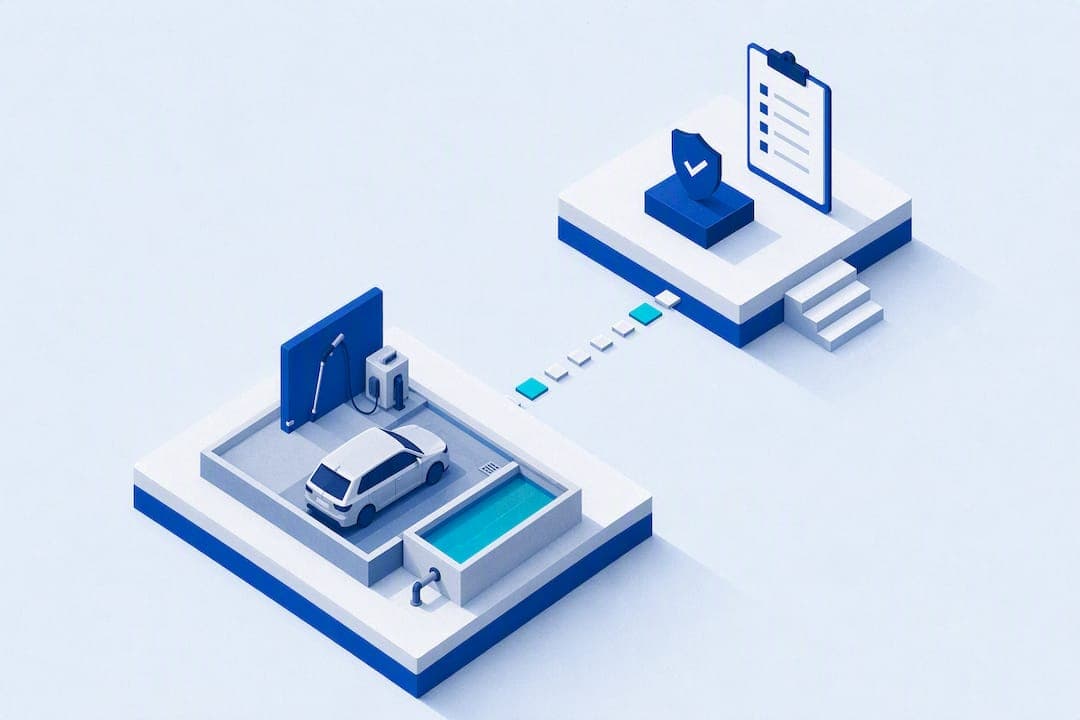
In Arizona, vehicle detailers must capture every drop of wash water and stop it from reaching a storm drain, gutter, or bare ground. That means containing runoff with mats or berms, pulling it out with a vacuum or pump, and sending it to a sanitary sewer connection or a licensed disposal facility, never dumping it on-site. Document each disposal. Skip any step and you're operating outside Arizona law, not just cutting a corner.
TL;DR:
- Mobile detailers must use proper containment, recovery, and documented disposal methods to avoid violations, especially preventing wash water from reaching storm drains or streets.
- Fixed bays require equipment like sumps, oil separators, and monitoring systems, while mobile operations should rely on containment mats, vacuum recovery, and daily checks to stay compliant.
- Disposing of wash water legally must be through a permitted sewer connection or licensed hauler with proper records, avoiding illegal runoff into landscaping or storm drains.
- inspectors verify proof of disposal, equipment maintenance, and chemical safety, emphasizing the importance of keeping detailed, long-term records for at least ten years.
- Water-saving practices and understanding local drought stages help avoid sudden rule changes that could impact operations during severe restrictions.
Table of Contents
- What Arizona Water Restrictions Mean for Detailing Businesses
- The Equipment That Actually Keeps You in Compliance
- How Do You Legally Dispose of Collected Wash Water?
- What Records Do Inspectors Actually Check?
- Your Immediate Compliance Checklist
- Do Drought Conditions Change the Rules for Detailers?
- Are There Set Hours for Water-Intensive Detailing Work?
- How Should You Train Your Team on Water Compliance?
- How Operational Systems Reduce Compliance Risk
- A Smarter Way to Manage the Business Side of Compliance
- Sources
- FAQ
What Arizona Water Restrictions Mean for Detailing Businesses
The phrase "arizona water restrictions detailing" covers a patchwork of state and municipal rules and most detailers only learn about them after a neighbor complains or an inspector shows up unannounced. The core state framework comes from the Arizona Department of Environmental Quality's general permit program, specifically the Type 3.03 general permit for vehicle and equipment washes under Arizona Administrative Code R18-9-D303. This permit authorizes certain discharges from wash operations but only under strict conditions: proper design, monitoring, and recordkeeping. It does not authorize dumping wash water onto soil, into a street, or down a storm drain under any circumstance.
For fixed wash bays, the ADOT Vehicle Wash Manual lays out the design expectations regulators actually look for: sumps, oil/water separators, pretreatment systems, and a documented monitoring schedule. If you run a shop with a permanent bay, this manual is close to a blueprint for passing inspection.
Municipal rules add another layer, and they vary enough that a detailer working across the Phoenix metro needs to know more than one rulebook:
- Phoenix and Scottsdale prohibit wash water from reaching public streets, sidewalks, or the right-of-way, and Scottsdale enforces this specifically against runoff crossing property lines.
- Pima County guidance for mobile power washing requires portable containment and pumping to a sanitary sewer connection or holding tank, never a storm sewer.
- Most jurisdictions require positive shut-off nozzles on any hose used for vehicle washing, a rule pulled straight from state conservation guidance.
Monitoring obligations escalate once you cross certain thresholds. If your discharge shows elevated pH or hydrocarbon levels, or if your volume grows past what a general permit covers, ADEQ can require an individual permit with its own testing and reporting schedule.
The Equipment That Actually Keeps You in Compliance
Compliance on paper means nothing if your rig can't back it up in a driveway. The gear that separates a legal mobile operation from a liability sits in three categories: containment, recovery, and water-saving tools.
Containment starts with a mat or berm system rated for your typical wash footprint. Most mobile detailers use mats sized for a single vehicle bay, roughly 8 by 16 feet, with raised edges that hold several gallons of standing water before it needs pumping. Placement matters more than most detailers realize: a mat set on a slope drains toward the low edge, so a few extra minutes leveling it saves you a wet floor later.
Here's the equipment sequence that works for most mobile operations:
- Lay the containment mat or berm before touching a hose.
- Wash and rinse as normal, letting runoff pool inside the containment area.
- Recover the water immediately with a wet/dry vacuum or a submersible pump into an on-vehicle holding tank.
- Check tank levels and hose connections daily. A slow leak in a holding tank is the most common cause of accidental discharge.
- Transfer collected water to your disposal point the same day when possible.
On the water-saving side, positive shut-off nozzles and low-flow pressure wands cut consumption immediately, and deionization units give mobile detailers a spot-free rinse without the brine waste that reverse osmosis systems generate. Fixed shops with permanent bays should look at recirculation systems too. ADEQ data shows conveyor systems use roughly 44 gallons per vehicle and in-bay automatics use about 72.5 gallons, and recirculation drives fresh water use down further.
Pro Tip: Keep a spare containment mat in every van. A ripped or waterlogged mat mid-job is the fastest way to end up with runoff on a client's driveway, and replacing one on the spot beats explaining a stain to a homeowner.
How Do You Legally Dispose of Collected Wash Water?
You have two real options: a permitted sanitary sewer connection or a licensed disposal facility. Both require documentation, and neither happens by accident.
Getting permission to discharge to a sanitary sewer usually means contacting the local wastewater utility, not just assuming a floor drain is fair game. Municipalities typically want to know your wash volume, whether you're using any chemicals beyond standard soap, and whether your setup includes pretreatment. Pima County's guidance for mobile power washing spells this out clearly: portable containment, pumping to a holding tank or approved sanitary connection, and written permission before you connect to anyone else's system.
Many mobile detailers skip the permitting headache entirely by partnering with a fixed-location car wash or a licensed liquid waste hauler for disposal. If you go this route, keep the paperwork:
- A signed agreement or receipt showing where and when the water was disposed of.
- The hauler's license number or the partner facility's permit information.
- Dates and volumes for every transfer, even rough estimates.
Draining wash water onto landscaping or into a storm drain is illegal everywhere in Arizona, not a gray area. Phoenix and Scottsdale have both cited detailers and contractors for runoff crossing into the public right-of-way, and a single complaint from a homeowner is usually enough to trigger a site visit.
Monitoring thresholds matter here too. Under A.A.C. R18-9-D303, discharges tested for pH and hydrocarbons that exceed set limits can force a facility into individual permit territory, with its own testing calendar and reporting burden. That's a much bigger administrative lift than staying under the general permit, and it's avoidable with basic containment discipline.
What Records Do Inspectors Actually Check?
Inspectors show up looking for proof, not promises. Keep these on hand:
- Disposal manifests or receipts showing where wash water went and when.
- Inspection logs for containment equipment and, for fixed bays, oil/water separators.
- Safety data sheets for any soaps or chemicals used on-site.
- Equipment drawings or as-built plans for permanent wash bay installations.
ADEQ-style guidance recommends keeping these records for up to 10 years. Quarterly visual inspections of containment gear and separator function catch small problems before they become violations. The red flags that trigger enforcement are predictable: visible discharge to a storm drain, no containment at all, or an oily sheen in runoff. Outcomes range from a warning letter to fines or a stop-work order, and fast remediation after a complaint almost always reduces the penalty.
Your Immediate Compliance Checklist
If you're reading this because something already went wrong, start here:
- Stop any runoff to a storm drain or street the moment you notice it.
- Deploy a containment mat and recovery vacuum on your next job, no exceptions.
- Label holding tanks clearly so no one mistakes wash water for clean rinse.
- Arrange disposal through a partner wash bay or licensed hauler, and save the receipt.
- Swap standard nozzles for positive shut-off models and low-flow wands this week.
- Put equipment maintenance on a recurring calendar instead of an "as needed" basis.
Pro Tip: Photograph your containment setup on the first job after any equipment change. A dated photo is cheap insurance if a client or inspector ever questions your process.
None of this requires new certifications or a lawyer. It requires consistency, and consistency is where most detailers actually slip.
Do Drought Conditions Change the Rules for Detailers?
Yes, and the change usually comes from your city, not the state. Arizona's drought status doesn't create one uniform rule for vehicle washing statewide. Instead, individual municipalities build conservation stages into their own codes, and vehicle washing is often one of the first activities restricted once a city declares a higher drought stage.
The City of Prescott's water code is a useful example: it authorizes the city manager to restrict or limit vehicle washing as part of escalating conservation levels tied to drought severity. Other municipalities follow a similar structure, tightening outdoor water use, including washing, as reservoir levels or groundwater conditions worsen.
For a mobile detailing business, this means the rules you operate under in June might tighten by August if a city moves into a higher restriction stage. It's worth checking your city's current conservation level periodically, especially if you serve multiple municipalities across a metro area, since Phoenix, Scottsdale, and Tucson can each sit at different stages at the same time.
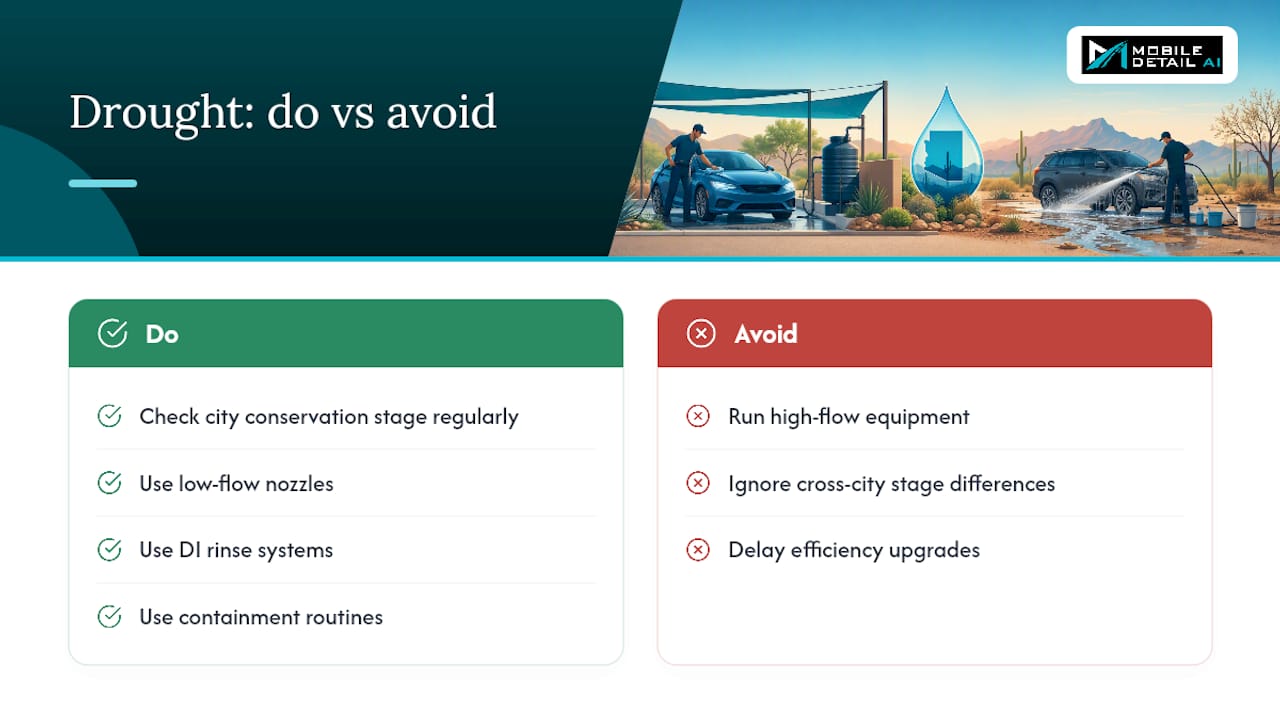
The practical response isn't complicated: build water efficiency into your default process instead of treating it as a drought-only adjustment. Detailers already using low-flow nozzles, DI rinse systems, and tight containment routines rarely notice when a city moves to a stricter conservation stage, because they're already using less water than the restriction demands. The businesses that scramble are the ones running old high-flow equipment with no containment plan, who suddenly have to change everything at once under a compressed timeline.
Are There Set Hours for Water-Intensive Detailing Work?
Arizona doesn't set a single statewide clock for when vehicle washing can happen, but several municipalities regulate the hours or days for water-intensive outdoor activity, and vehicle washing sometimes falls under those same ordinances that govern irrigation and landscape watering.
Cities that regulate outdoor watering schedules by odd/even address or specific days sometimes extend similar logic to commercial washing activity, particularly during declared drought stages. This isn't universal, and it's not always written specifically for detailing, so the safest approach is checking your city's water department or municipal code directly rather than assuming a statewide standard applies.
For most mobile detailers, the bigger practical constraint isn't a legal curfew, it's heat. Arizona summer temperatures push many detailers toward early morning appointments anyway, both for comfort and because products like ceramic coatings and waxes perform better applied out of direct sun. That scheduling habit happens to align well with any jurisdiction that restricts water-intensive work during peak afternoon hours.
If you run a fixed shop bay, check whether your municipal wastewater permit ties into any time-of-day discharge restrictions, since some sanitary sewer agreements include peak-load provisions that affect when high-volume users can discharge. This is rare for small detailing operations but worth a five-minute call to your local utility if your bay handles significant volume.
How Should You Train Your Team on Water Compliance?
Compliance fails most often at the crew level, not the ownership level. An owner who understands the rules perfectly can still get cited if an employee dumps a bucket down a driveway drain because nobody walked them through the containment routine.
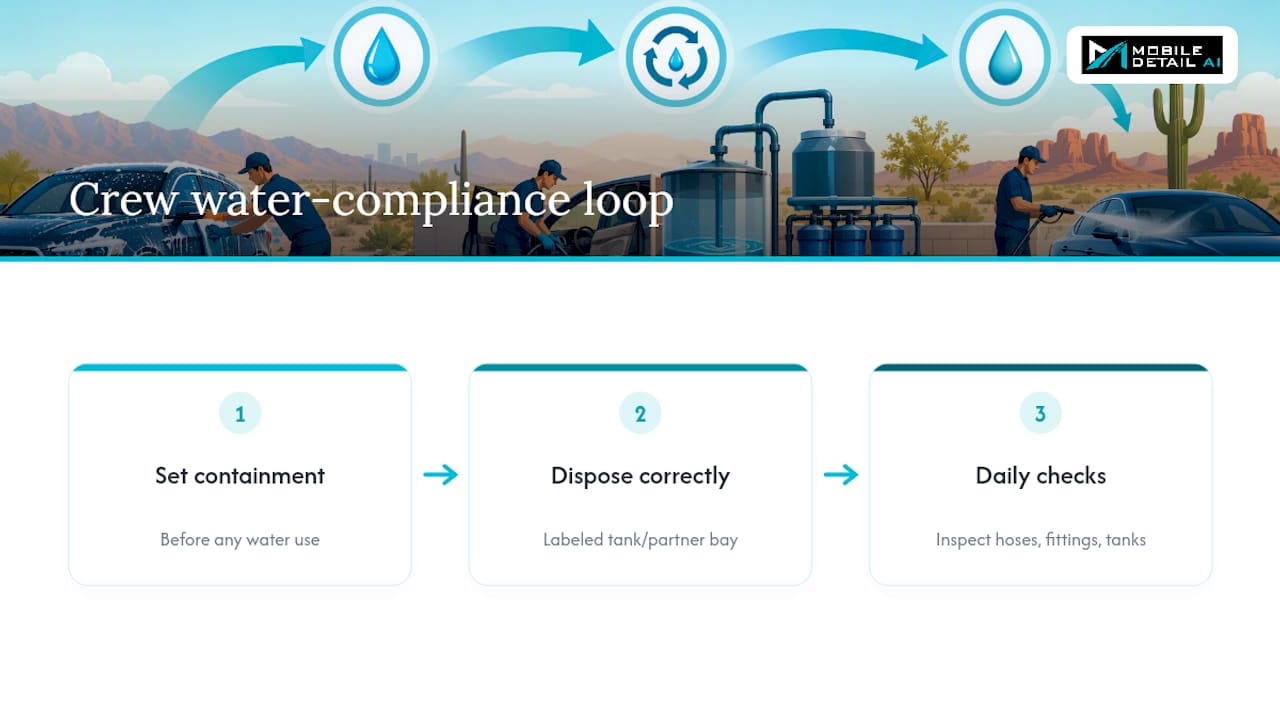
Build training around three habits rather than a thick binder nobody reads. First, every new hire sets up containment before touching water, every single job, no exceptions for "quick" washes. Second, everyone knows where collected water goes, whether that's a labeled holding tank, a partner wash bay, or a specific disposal contact, and nobody improvises a shortcut when the regular disposal point isn't available. Third, equipment checks happen daily, not weekly: a cracked hose fitting or a full holding tank left unnoticed is how small operations end up with an accidental discharge.
Treating these habits as part of normal operations, the same way you'd treat a pre-trip vehicle check, works better than treating them as a compliance lecture. Reviewing ADEQ's conservation guidance with new employees during onboarding gives them a real reference point instead of a verbal summary that gets diluted over time. Quarterly refreshers, even a 15 minute walkthrough, catch bad habits before they turn into a citation.
How Operational Systems Reduce Compliance Risk
Water compliance and route efficiency aren't separate problems, they're the same problem viewed from different angles. A detailer bouncing between five scattered appointments burns more fuel and more water resetting equipment than one running a tight, optimized route. Tools built for scheduling and route optimization, like the CRM inside Mobile Detail AI, cut that waste indirectly by clustering jobs geographically and keeping technicians on a predictable rhythm.
A good system that tracks service history can hold disposal manifests, inspection logs, and equipment maintenance records in one searchable place instead of a shoebox of receipts. That's not a regulatory requirement, but it's the difference between finding a manifest in ten seconds during an inspection and digging through a glove compartment.
A Smarter Way to Manage the Business Side of Compliance
Arizona water rules are non-negotiable on the ground: containment, recovery, and permitted disposal come first, always. But the paperwork trail and the scheduling chaos that make compliance harder than it should be been fixable with better systems. Some CRMs built for vehicle detailing businesses include visual scheduling, route optimization, and service history tracking that can keep disposal records and inspection notes attached to jobs instead of scattered across notebooks and phone photos.

This isn't a substitute for the containment mats, recovery pumps, or licensed disposal partners covered above. Those steps are legal requirements, and no software changes that. What Mobile Detail AI does is remove the administrative drag around them: fewer missed maintenance checks, tighter routes that cut water and fuel waste, and one searchable record instead of a filing cabinet. Detailers already running tight compliance routines tend to be the same ones running tight operations generally, and that overlap is worth acting on. Set up your Mobile Detail AI profile and see how route optimization and built-in service records fit into your current containment and disposal workflow.
Sources
- Arizona Department of Environmental Quality — Auto wash water conservation (Section 3)
- ADOT Vehicle wash manual (vehicle wash facility design and regulatory guidance)
- Arizona Administrative Code R18-9-D303 — General permit: vehicle and equipment washes
- Pima County guidance on mobile power washing and wastewater disposal
FAQ
Is It Legal to Wash Cars in a Residential Driveway in Arizona?
Only if you fully contain and recover the wash water. Letting it run into the street, a storm drain, or onto a neighboring property violates municipal codes in cities like Phoenix and Scottsdale.
Do Mobile Detailers Need an ADEQ Permit?
Most mobile detailers operate under general conservation and municipal rules rather than needing an individual ADEQ permit, as long as they contain and properly dispose of wash water. Volume or discharge quality above certain thresholds can trigger the need for an individual permit under A.A.C. R18-9-D303.
Can I Dump Collected Wash Water Down a Storm Drain?
No. This is illegal everywhere in Arizona and one of the most commonly enforced violations against mobile detailers and pressure washers.
How Long Should I Keep Disposal Records?
Keep disposal manifests, inspection logs, and related documentation for up to 10 years, matching the recordkeeping guidance built into Arizona's general permit framework.
Does a Software Platform Like Mobile Detail AI Handle Compliance for Me?
No. Mobile Detail AI supports the operational side, scheduling, routing, and recordkeeping, but containment, recovery, and legal disposal still require physical equipment and direct compliance with ADEQ and municipal rules.