
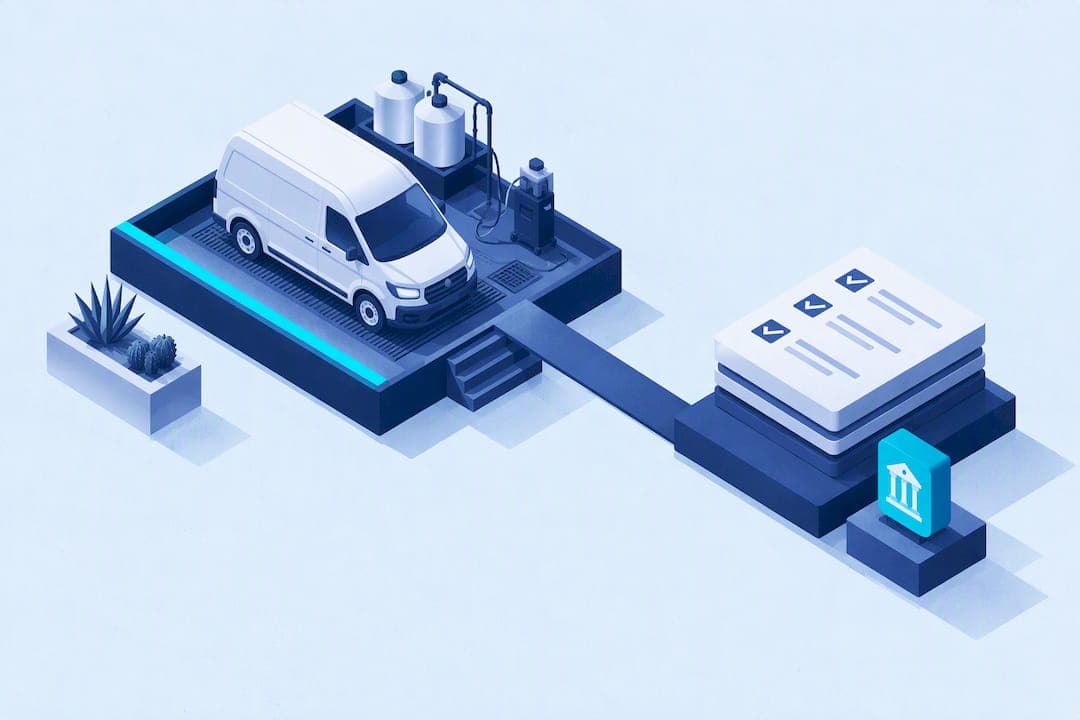
Arizona mobile detailers must follow a zero-discharge standard enforced by ADEQ and EPA, register the business with the Arizona Secretary of State and ADOR for a Transaction Privilege Tax license and secure any local permits a city requires. Get these four pieces right and most of the regulatory risk in this business disappears. The sections below walk through where to register, how to document water handling, and what inspectors actually check.
TL;DR:
- Most mobile detailers must register with the Arizona Secretary of State and obtain a Transaction Privilege Tax license from ADOR before accepting paying jobs.
- Zero-discharge rules require containment mats, vacuum recovery, and proper disposal documentation to prevent fines and waterway violations.
- Adding spray coatings or solvent-based products triggers federal and county air quality permits, requiring VOC and usage recordkeeping.
- Enforcement often results from visible runoff or reported violations, emphasizing the importance of organized documentation and proper waste handling.
- Insurance policies such as general liability and commercial auto coverage are highly recommended to protect against equipment damage, injury, or legal liability.
Table of Contents
- Key registrations and permits: federal, state, and municipal check
- Stormwater, wastewater, and the zero-discharge rule
- Air quality and coatings: when spray or coating work triggers extra permits
- Taxes and Transaction Privilege Tax guidance for mobile detailers
- Operational compliance checklist for containment, chemicals, and recordkeeping
- How to verify local rules across a multi-city service area
- Inspection, fines, and common enforcement actions
- Employee safety regulations and OSHA compliance for mobile detailing
- Insurance requirements and recommendations for mobile detailing businesses
- Waste management and recycling regulations beyond wastewater
- Vehicle signage and advertising regulations for mobile detailing businesses
- Enforcement realities and why compliance is good business
- How Mobile Detail AI supports compliant Arizona operations
- FAQ
- Sources
Key registrations and permits: federal, state, and municipal check
Before you wash a single wheel, you need a federal Employer Identification Number from the IRS, and if you are forming an LLC, corporation, or partnership, you register that entity with the Arizona Secretary of State. Sole proprietors skip that step but typically file a DBA (trade name) with the county or state if operating under a name other than their own.
Arizona does not issue a single statewide "detailing license." Instead, most mobile detailers register with the Arizona Secretary of State if incorporated, then obtain a Transaction Privilege Tax license from the Arizona Department of Revenue, which requires a nominal fee per license location. Many cities layer on their own TPT or general business license requirement on top of the state one.
Federal or state stormwater permits (AZPDES, administered by ADEQ) generally apply only when a facility discharges wash water to a storm drain or waterway. Most mobile operators avoid that permitting path entirely by running a zero-discharge operation and disposing of captured wastewater through a sanitary sewer connection or a permitted facility instead.
- Get an EIN from the IRS and register your entity type with the Arizona Secretary of State if you are an LLC, corporation, or partnership.
- File a DBA if you operate under a trade name as a sole proprietor.
- Apply for a TPT license through ADOR's Business One Stop or AZTaxes.gov before you take your first paid booking.
Stormwater, wastewater, and the zero-discharge rule
Zero-discharge means exactly what it sounds like: no wash water, soap, grime, or vehicle fluids reach a storm drain, gutter, wash, or natural waterway. This standard flows from the federal NPDES stormwater program, which EPA enforces nationally and which Arizona administers through its own AZPDES permit program at ADEQ. A fixed car wash facility operating under a general permit must follow design, pretreatment, and monitoring rules spelled out in Ariz. Admin. Code § R18-9-D303, including sump and oil/water separator provisions; mobile operators achieve the same outcome through containment and capture rather than fixed infrastructure.
In practice, compliance means capturing every drop before it hits pavement and routing it somewhere legal.
- Lay down an impermeable, bermed containment mat under the vehicle before any water touches it.
- Use a wet-vacuum recovery system to pull wash water off the mat as you work, rather than letting it pool or run off.
- Store recovered water in a sealed holding tank until you can dispose of it down a sanitary sewer drain or deliver it to a facility permitted to accept it.
Pro Tip: Keep a disposal receipt or signed acceptance log every time you empty a holding tank, even at your own shop sink, since an inspector will ask for proof, not just an assurance.
Keep photos of your containment setup on a sample job, maintenance logs for your vacuum and tank equipment, and copies of every disposal receipt. Violating zero-discharge rules risks fines and corrective orders from the city or ADEQ, and repeat violations tend to draw closer scrutiny on every future job.
Air quality and coatings: when spray or coating work triggers extra permits
Most detailing work, washing, vacuuming, interior cleaning, never touches air-quality rules. The moment you add spray coatings, paint touch-up, or solvent-based products, a different set of requirements kicks in. Federal NESHAP Subpart HHHHHH governs area-source vehicle and mobile equipment refinishing operations, and it can require an initial notification or a notification of compliance status depending on the coatings and volumes you use.
Locally, Maricopa County's Vehicle and Mobile Equipment Refinishing permit guidance lays out VOC and material-usage limits, along with spray-enclosure and capture requirements for operators doing refinishing work in the county. If your service menu includes any spray application, check these thresholds before you add the service, not after a complaint.
- Use HVLP (high-volume, low-pressure) spray guns or equivalent transfer-efficient equipment to cut overspray and material use; see Proven Ceramic Coating Maintenance for Warranty Compliance for complementary coating care tips.
- Favor coatings that avoid or minimize target hazardous air pollutants where a comparable product exists.
- Keep records of coating volumes and VOC content if your usage approaches county thresholds, since those logs are what an inspector will request first.
Taxes and Transaction Privilege Tax guidance for mobile detailers
Arizona's Transaction Privilege Tax is a tax on the vendor for the privilege of doing business, not a sales tax collected on behalf of the state, though in practice you typically pass the cost to the customer. You register for a TPT license through ADOR, pay $12 per license location, and file returns through AZTaxes.gov on whatever cycle ADOR assigns based on your sales volume.
Most detailing labor, washing, waxing, vacuuming, is a service rather than a sale of tangible goods, but the line blurs when you hand over a product as part of the job. ADOR's Ruling TPR 90-2 addresses this directly: a transfer of tangible personal property incidental to a service stays nontaxable only if its cost stays under 15% of the total job cost and is not separately stated on the invoice. Hand a customer a bottle of leftover spray wax as a throw-in and you are likely fine; sell replacement floor mats or a standalone bottle of ceramic spray as a line item and that portion becomes taxable.
- Register for a TPT license with ADOR before your first paid job, even as a sole proprietor.
- Keep your incidental product costs under the 15% threshold and bundle them into the service price rather than itemizing them.
- Track invoices carefully so you can show which jobs were pure service and which included a taxable product sale.
Operational compliance checklist for containment, chemicals, and recordkeeping
A route that looks compliant on paper only matters if you can prove it on the day an inspector shows up. Build a routine that generates its own paper trail.
- Load your containment mat, confirm the vacuum recovery unit tested clean that morning, and verify your water source and holding tank have room for the job ahead.
- Carry a spill kit and your SDS (Safety Data Sheet) binder for every chemical on the van, checked and restocked on a set schedule.
- Photograph your setup periodically, and file every disposal receipt the same day you generate it rather than at the end of the week.
Pro Tip: Store your SDS sheets, disposal receipts, and equipment logs together in one place, digital or physical, so you can hand an inspector a complete packet in under a minute.
Never pour wash water, degreaser, or chemical runoff into a storm drain, gutter, or wash, and never mix waste streams (oil, solvent, wash water) in the same container, since that complicates lawful disposal and increases hazard classification. Label every chemical container clearly and store them upright and secured in the van. When an inspection happens, the packet that saves you time includes dated photos, signed disposal receipts, your SDS binder, and a simple log tying each job to its disposal event.
How to verify local rules across a multi-city service area
Arizona's cities do not all apply the same stormwater or licensing rules, so a route that covers Phoenix, Tempe, and Scottsdale in the same week means checking three sets of local requirements, not one. Phoenix's Stormwater Management Plan and City Code Chapter 32C prohibit discharging vehicle wash wastewater to storm drains and give the city inspection authority as an MS4 permittee, a useful model for what to expect from any city stormwater page you check.
- Map every city on your route and pull up that city's stormwater ordinance and local TPT or business license page before you book your first job there.
- Centralize your state-level TPT registration and renewals through ADOR's Business One Stop and AZTaxes.gov rather than tracking separate logins.
- Get a written acceptance agreement from any fixed car wash or permitted facility you use for wastewater disposal, and keep a signed copy on file.
Inspection, fines, and common enforcement actions
Inspections for mobile detailers typically come from one of two directions: a city stormwater or code enforcement officer responding to a complaint about runoff, or a routine check at a shared location like a commercial lot where you operate regularly. A city inspector working under a program like Phoenix's SWMP has authority to inspect stormwater practices and issue corrective orders when wash water reaches a storm drain.
The most common enforcement trigger is visible runoff, soapy water in a gutter, a sheen in a parking lot drain, reported by a property owner, a passerby, or another business. A first violation often results in a warning or a corrective order requiring you to fix the practice and show proof. Repeat or uncorrected violations escalate to fines, and in more serious cases a facility or operator can face a stop-work order until compliance is demonstrated.
The practical defense against any of this is the same documentation packet you build for routine operations: dated photos of your containment setup, signed disposal receipts, equipment maintenance logs, and SDS sheets for your chemicals. An inspector who sees a complete, organized packet is far more likely to close the visit with a conversation than a citation. Operators who keep nothing on hand, no receipts, no photos, no logs, carry the most risk, because there is no way to show the system in place even when the actual practice was sound that day.
Treat every job site, not just your home base, as a potential inspection point. A commercial parking lot, an HOA common area, or a customer's driveway can all draw a complaint, so the containment and documentation habits need to travel with the van, not stay behind at an office.
Employee safety regulations and OSHA compliance for mobile detailing
Once you hire even one employee, federal OSHA (Occupational Safety and Health Administration) general industry standards apply to your operation, and Arizona enforces its own state OSHA plan that mirrors and sometimes exceeds the federal baseline. The most relevant rules for a detailing crew cover chemical hazard communication, personal protective equipment, and safe handling of pressurized equipment.

Hazard communication means every employee needs access to the SDS for each chemical they handle and basic training on what the hazard labels mean. Detailing chemicals, degreasers, acid wheel cleaners, solvent-based dressings, carry real risks of skin and respiratory irritation, so gloves, eye protection, and in some cases respiratory protection belong in the standard kit for anyone running those products regularly.
Pressure washers and extraction equipment introduce their own hazards: electrical safety around water, proper footing on wet surfaces, and safe operation of hot-water units. A short, documented safety orientation for new hires, covering chemical handling, PPE, and equipment operation, both protects your crew and gives you a record to show if an incident or inspection ever raises the question of training.
Keep basic safety recordkeeping even as a small operation: a simple injury log, your SDS binder accessible at every job site, and documented PPE provided to each employee. These are inexpensive habits that matter far more the one time something goes wrong.
Insurance requirements and recommendations for mobile detailing businesses
Arizona does not mandate a specific insurance policy for mobile detailing businesses the way it does auto liability insurance for vehicles on the road, but operating without coverage leaves you exposed to costs that can end a small business overnight. General liability insurance is the baseline most operators carry, covering damage to a customer's vehicle, property, or third-party injury that happens during a job.
Commercial auto insurance matters just as much, since a personal auto policy typically excludes business use, and your van or truck is both your workspace and your transportation between jobs. If you hire employees, Arizona requires workers' compensation coverage for most employers, which protects both you and your crew if someone is injured on the job.
Many detailers also carry garage keepers' liability, which specifically covers a customer's vehicle while it is in your care, a gap that general liability does not always close. Before signing with any client, commercial property, an HOA, a dealership, check whether they require a certificate of insurance naming them as additionally insured, since that requirement shows up often in commercial contracts.
Waste management and recycling regulations beyond wastewater
Wastewater gets most of the regulatory attention, but a detailing operation generates other waste streams that carry their own disposal rules. Used rags, applicator pads, and absorbent materials soaked in solvent or degreaser can qualify as hazardous waste depending on volume and chemical content, and tossing them in a regular dumpster is not a safe default.

Empty chemical containers need proper disposal too: triple-rinse where the product label allows it, and never place liquid chemical waste, used oil, or solvent-soaked materials in a standard trash bin or storm drain, a point the City of Phoenix's automotive stormwater guidance makes directly for automotive service businesses. Sweepings from a wash job, dirt, debris, brake dust, should be swept up and disposed of as solid waste rather than left to wash into a gutter.
Aerosol cans, batteries from equipment, and spent filters from recovery systems often qualify for household or small-business hazardous waste drop-off programs rather than regular trash. Many Arizona counties and cities run periodic household hazardous waste collection events that accept small-business quantities, and building a relationship with one of these programs is far simpler than facing an enforcement question about improper disposal later.
Vehicle signage and advertising regulations for mobile detailing businesses
Your branded van or truck functions as a moving advertisement, and most cities treat vehicle signage as ordinary commercial speech rather than something requiring a special permit, as long as the vehicle remains a functioning vehicle and the signage does not obstruct windows, mirrors, or lights needed for safe driving. Where cities do step in is parking: some municipalities restrict using a public street as a long-term parking spot for a vehicle whose primary purpose at that location is advertising rather than transportation.
If you plan any physical advertising beyond your vehicle, a yard sign at a job site, a banner at a pop-up event, check the local sign ordinance for that city, since temporary sign permits and size limits vary significantly between Arizona municipalities. Advertising claims themselves fall under general consumer protection principles: pricing, guarantees, and before-and-after claims need to be accurate and provable, since misleading advertising can draw a complaint independent of any detailing-specific rule.
Keep your DOT or commercial vehicle registration current if your vehicle class requires it, since a lapsed registration is an easy, unrelated violation that can turn a routine traffic stop into a bigger problem during a work day.
Enforcement realities and why compliance is good business
Most enforcement actions we see follow a complaint about visible runoff, not a random audit, which means the detailers who get flagged are usually the ones with no containment habit at all. Documented compliance works both ways: it protects you from fines, and it becomes something you can point to when a customer asks why you charge more than a driveway operator with a garden hose. Keeping service history, disposal receipts, and SDS sheets organized in one system turns a compliance obligation into a trust signal.
— Mobile
How Mobile Detail AI supports compliant Arizona operations
Running a compliant route gets easier when your scheduling, routing, and documentation live in one place instead of scattered notebooks and phone photos. Our CRM-Only, Marketplace, and Preferred plans give detailers route optimization to plan efficient, compliant stops, secure storage for disposal receipts and SDS sheets, and scheduling tools that keep a full service history tied to each vehicle and customer.

If you want to see how these tools fit a route that already includes Phoenix stormwater checks and TPT filings, check our provider subscription options and pick the plan that matches the size of your operation today.
This article is general information, not a substitute for advice from a qualified lawyer. Consult a qualified legal professional about your own circumstances before acting on anything here.
FAQ
What license do I need for a mobile detailing business?
Arizona does not require a statewide detailing license, but you need a Transaction Privilege Tax license from ADOR if you provide taxable services, which costs $12 per location. If you form an LLC, corporation, or partnership, you also register that entity with the Arizona Secretary of State, and many cities require their own local TPT or business license on top of the state one.
Does Arizona have a lemon law on used cars?
Arizona's lemon law protections primarily apply to new vehicles under manufacturer warranty, not general used car purchases, and detailing businesses are not a party to that law in any capacity. This question falls outside mobile detailing compliance and does not affect how you register, operate, or handle wastewater as a detailer.
What's the difference between auto detailing and mobile detailing?
Auto detailing is the deep cleaning and restoration service itself, interior shampooing, paint correction, ceramic coatings, performed at a fixed shop location. Mobile detailing is the same service delivered at the customer's home, office, or another location, which shifts the compliance burden toward portable containment and wastewater capture rather than fixed drainage infrastructure.
What do I need to start mobile detailing?
Beyond basic equipment, you need an EIN, Secretary of State registration if you are an LLC or corporation, and a TPT license from ADOR before taking paid bookings. You also need a containment system, a bermed mat and vacuum recovery setup, to meet Arizona's zero-discharge expectations and a lawful disposal arrangement for the wastewater you collect.
Do I need a permit to use spray coatings during mobile detailing?
Basic detailing work rarely requires an air-quality permit, but spray coatings or solvent-based refinishing can trigger federal NESHAP Subpart HHHHHH requirements and local Maricopa County limits on VOCs and material usage. Check the county's refinishing permit guidance before adding spray services to your menu if you operate in that jurisdiction.
Sources
Before you file anything, bookmark the primary sources that govern each piece of this compliance picture. ADOR's TPT license page walks through registration and the $12 per-location fee, while ADEQ's AZPDES MSGP page covers NOI and SWPPP templates for the rare operation that needs full stormwater permit coverage. EPA's national NPDES stormwater program page explains the federal framework that ADEQ administers at the state level, and Phoenix's Stormwater Management Plan shows what a city-level enforcement document looks like for the Valley's largest market. Maricopa County's refinishing permit guidance applies if your service menu includes spray coatings, and Ariz. Admin. Code § R18-9-D303 lays out the technical design standards fixed wash facilities follow, useful context even for a mobile operation building its own containment system.
- Transaction Privilege Tax | Arizona Department of Revenue
- Stormwater discharges associated with industrial activity | US EPA
- AZPDES Industrial Stormwater Multi-Sector General Permit (MSGP) | ADEQ
- City of Phoenix Stormwater Management Plan (SWMP)
- Ariz. Admin. Code § R18-9-D303 - 3.03 General Permit: Vehicle and Equipment Washes