
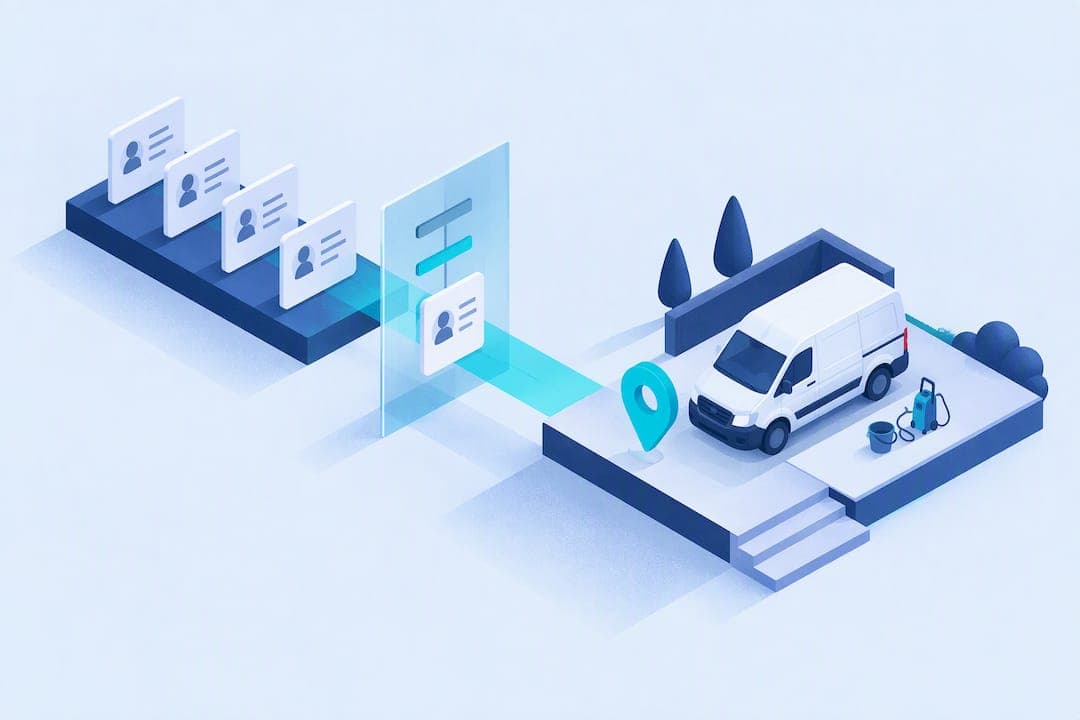
Verify your Google Business Profile and turn on an instant reply plus booking flow this week: those two moves capture and convert more detailing leads than almost anything else you can do. Beyond that, the highest-yield channels are Google Ads lead forms, Instagram or WhatsApp DMs with auto-replies, detailing marketplaces, and email or SMS retention. We built Mobile Detail AI around this exact sequence because speed and follow-up, not just visibility, win the job.
TL;DR:
- Mobile detailers should use accurate service area settings, while storefront shops should emphasize location photos and reviews; respond to every review within a day or two.
- Google Ads lead forms require a privacy policy URL; add qualifying questions and phone verification, then optimize bidding for completed jobs rather than form submissions.
- Send one short question in the first reply, collect vehicle type, service, and location, and hand unusual requests, price negotiations, or damage assessments to a person.
- Send review requests within two hours of each job, include before and after photos in follow ups, and schedule service reminders around protection wear.
Table of Contents
- Which lead channels deserve your time first
- Automate replies and qualification before you lose the lead
- Email marketing and retention sequences that bring repeat jobs
- Local discovery: get found before customers start comparing prices
- Paid capture: Google Ads lead forms and tracking real outcomes
- Website or no website: what actually needs to convert
- Keywords and targeting that match how customers actually search
- Operational playbook: qualify, route, book, and measure
- How Mobile Detail AI maps to this playbook
- Author perspective: the operational mindset behind steady lead flow
- How to start with Mobile Detail AI
- FAQ
- Sources
Which lead channels deserve your time first
Not every channel pays off equally, and chasing all of them at once spreads your attention too thin. Rank them by how fast they convert and how much setup they demand, then test the cheapest, fastest one first.
- Google Business Profile and local search: verify your listing today and add ten real job photos this week.
- Google Ads lead forms: launch a single campaign with one lead form asset and a qualifying question before you spend on broader search ads.
- Instagram and WhatsApp DMs: turn on an auto-reply that asks for vehicle type and location within the first message.
- Detailing marketplaces: list your services where customers already search for vetted detailing providers and let the platform route the first message.
- Organic social and referrals: post a before-and-after set weekly and ask every satisfied customer for one tagged mention.
- Email and SMS retention: set a 60-day reminder sequence for your last twenty customers before you spend another dollar on new leads.
Mobile detailers and fixed-location shops should weigh these differently. A mobile operator depends more on service-area accuracy in Google Business Profile and fast DM replies, since customers want to know you can reach their driveway today. A shop with a storefront benefits more from local search prominence and walk-in visibility, so reviews and photos of the physical location carry more weight.
Automate replies and qualification before you lose the lead
Speed decides more deals than price does. The first business to respond to an inquiry tends to win it, because customers rarely wait around once they've found someone who answers.
A six-stage pipeline keeps leads from going cold between the moment they reach out and the moment they're booked:
- Capture the inquiry wherever it lands, DM, call, form, or marketplace message, in one unified inbox.
- Reply instantly with an automated first response that confirms you received the message.
- Qualify with two or three multiple-choice questions: vehicle type, service needed, and location.
- Quote using a templated price range based on their answers.
- Book through a link that drops straight into your calendar.
- Follow up with a reminder 24 hours before the appointment and a check-in after.
The tool checklist is short: a unified inbox that merges texts, DMs, and web forms, templated responses for common questions, a qualifying question set, auto-quote snippets, and a booking link that writes directly to your schedule. Automate the first four stages entirely. Escalate to a human the moment a customer asks something outside your templates, negotiates price, or describes damage that needs a visual quote.
Pro Tip: Write your auto-reply so it asks one question, not three, because customers answer short texts fast and abandon long ones.

Email marketing and retention sequences that bring repeat jobs
New leads cost more to win than repeat customers cost to keep. A handful of automated sequences do most of the retention work once they're set up.
- Post-job review and referral request: sent within two hours of completion, while satisfaction is highest, paired with a direct review link.
- Service reminders: timed to when wax, ceramic coating, or interior protection typically wears off, so the message arrives before the customer notices the need.
- Seasonal promos: tied to pollen season, road salt, or summer road trips, since these drive genuine urgency rather than generic discounts.
- VIP waitlist for cancellations: a short list of regulars you text first when a slot opens up, which fills gaps faster than reposting availability publicly.
Include before-and-after photos in every sequence; they do more to justify your price than any description. Time the review ask the moment the customer sees their car clean, not a week later when the feeling has faded. Any commercial email you send has to follow the CAN-SPAM Act, which means accurate sender information, a truthful subject line, a real postal address, and a working opt-out honored within ten business days.
A tool like Mailchimp handles these sequences fine while you're running them manually for a smaller list. Once you're tracking vehicle history, service intervals, and multiple locations, a CRM built for detailing takes over the job more reliably because it ties the email trigger to the actual service record instead of a static date.
Local discovery: get found before customers start comparing prices
Your Google Business Profile is often the first thing a customer sees, and an incomplete one costs you visibility before you even compete on price.
- Verify your business and fill in hours, services, and a service area if you're mobile rather than a fixed address.
- Upload real photos of your actual work, your vehicle or setup, and your team, updated regularly rather than left static.
- Keep contact info accurate so a customer can call or message without hitting a dead end.
- Ask for reviews right after a job, when satisfaction peaks, and respond to every review, good or critical, within a day or two.
- Use the fewest accurate categories instead of stuffing in every related term, and avoid creating duplicate profiles for the same business.
Google's own guidance confirms that complete, verified profiles are more likely to show up in local results, since ranking depends on relevance, distance, and prominence. You control relevance and prominence directly through your content, photos, and reviews, while distance is fixed by where the customer searches from. Mobile detailers should lean on service-area settings rather than city-stuffed business names to improve relevance without violating Google's representation guidelines.
Paid capture: Google Ads lead forms and tracking real outcomes
Paid search earns its budget back only when you measure it against booked jobs, not raw clicks.
- Set your campaign objective to Leads and attach a lead form asset with a privacy policy URL, required before the form can run.
- Add qualifying questions so the form filters out tire-kickers before they reach your inbox.
- Turn on OTP phone verification to cut down on fake or mistyped numbers.
- Connect the form to your CRM or a webhook so a new lead triggers your instant-reply flow immediately.
Google Ads lead forms work inside both Search and Performance Max campaigns, and the qualifying-question and verification features exist specifically to raise lead quality rather than volume.
The cheapest lead per click rarely becomes the cheapest job won, because a $12 form submission that never answers your call costs you more in wasted follow-up time than a $30 lead that books on the first call. Import your offline outcomes, lead qualified, contract signed, job completed, using enhanced conversions for leads, so your bidding optimizes toward real revenue instead of form submits. A closed-loop attribution approach makes this even more useful, since tying ad spend to actual outcomes shows which campaigns produce booked jobs rather than just clicks.
Website or no website: what actually needs to convert
A full website isn't mandatory for every detailer, but every online touchpoint needs a handful of conversion basics regardless.
A verified Google Business Profile with a booking link attached often covers a mobile detailer with a tight service area and a steady review flow. A dedicated website earns its cost when you're running paid search, serving multiple cities, or offering packages complex enough that a profile page can't explain them clearly.
- Tap-to-call button visible without scrolling, on mobile especially.
- A short booking form asking for VIN, phone number, and service needed, nothing more.
- Trust photos of real jobs, not stock images of generic cars.
- Clear pricing or ranges, since vague "contact for quote" language loses customers who are comparing options quickly.
Whatever page a lead lands on, route it straight into your CRM or marketplace inbox so your instant-reply automation fires the same second, whether the lead came from a website form or a Google Business Profile message.
Keywords and targeting that match how customers actually search
Most detailing searches combine a service with an intent signal, and your pages need to speak that same language.
- Target patterns like "mobile detailing near me," "ceramic coating price," "interior detail book," and "car wash mobile" rather than broad single words.
- Match each landing page's content to the exact intent behind the ad or search term: a "price" search should land on a page showing price ranges, not a generic homepage.
- Review your search query reports monthly to catch irrelevant terms burning budget and add them as negatives.
- Layer in high-intent modifiers like "today," "same day," and "appointment" where local demand supports them.
Operational playbook: qualify, route, book, and measure
A clean intake process is what turns a pile of inquiries into a predictable booking rate.
- Capture five fields minimum: email, phone, VIN, service requested, and preferred time. These feed directly into both scheduling and lead qualification.
- Route high-intent leads to immediate booking: anyone who names a specific service and a preferred time within 24 hours goes straight to your calendar link.
- Route vague or price-only inquiries to a nurture sequence: a short email or text series that offers a quote range and a reason to book this month.
- Name your offline outcomes consistently: "lead qualified," "quote sent," and "contract signed" as fixed labels, not free text.
- Import those outcomes via enhanced conversions so your ad platform learns which leads turned into real jobs, not just form fills.
A one-page intake form that captures VIN, mileage, and a photo upfront speeds up both quoting and the eventual vehicle history record, which matters if you're also tracking fleet proposals or recurring commercial accounts.
Pro Tip: Collect both email and phone on every intake form, since enhanced conversions match more reliably with two identifiers than one.
How Mobile Detail AI maps to this playbook
We built the stages above directly into Mobile Detail AI rather than leaving detailers to stitch together five separate tools. Our marketplace captures the lead, our CRM qualifies and schedules it with route optimization, and our payment processing closes the loop once the job is done, with vehicle history saved for the next visit.
A detailer can pilot the full sequence in a week or two: list services on the marketplace, connect intake forms to the CRM, and let AI-assisted scheduling fill gaps in the calendar as bookings come in. The pieces that usually take the longest to assemble on your own, instant reply, qualification, and routing, run inside one system from the first lead.
Author perspective: the operational mindset behind steady lead flow
The detailers who keep a full calendar aren't the ones with the biggest ad budgets. They're the ones who measure everything and automate the boring parts fast. Reply speed, not creative marketing, decides most of the deals that get away.
If you want to test this yourself, run three experiments in parallel: a single Google Ads lead form with an auto-reply attached, a push to get ten new photos and five reviews on your Google Business Profile, and a 60-day email reminder sequence for your last batch of customers. Measure each one separately for a month. Keep what moves bookings, cut what doesn't, and treat every channel as a number, not a hunch.
— Mobile
How to start with Mobile Detail AI
We give detailers one system instead of five disconnected tools: a marketplace where customers find and book you directly, a CRM with intelligent scheduling and route optimization, and intake forms that qualify leads before they hit your calendar.
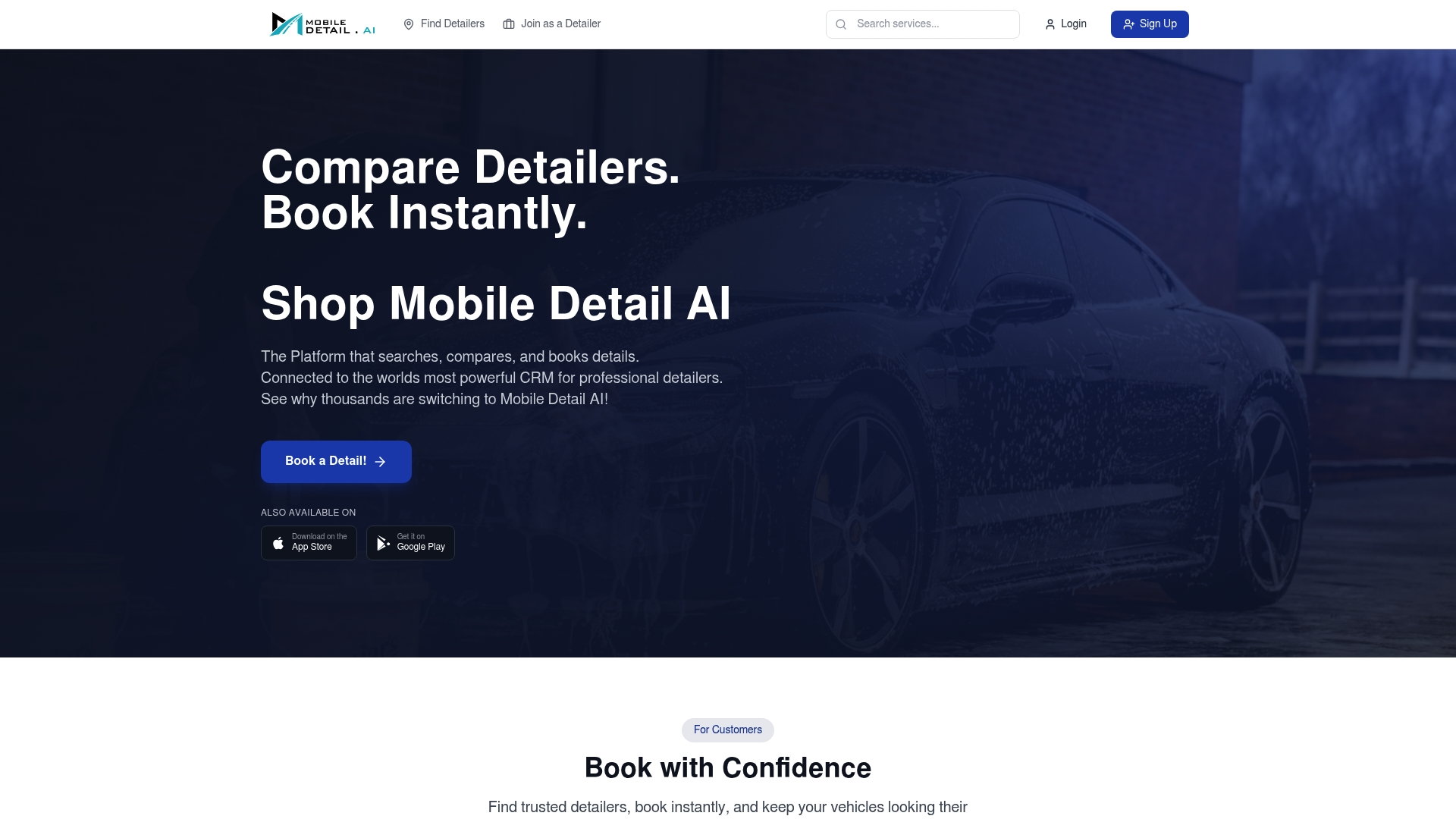
- Marketplace listing that puts your services in front of customers already searching for a vetted detailer.
- CRM and scheduling that handles qualification, booking, and route planning in one dashboard.
- Secure payments and vehicle history so repeat customers rebook faster.
Start with the provider subscription plans, including a $1 per month CRM-Only tier, to see which level fits your current lead volume.
FAQ
How to get more leads for detailing?
Verify and complete your Google Business Profile, turn on instant replies for DMs and texts, and run a single Google Ads lead form campaign with a qualifying question attached. Pair those with a review-request sequence sent right after each job, since fresh reviews directly support your local visibility.
How much should I tip for a $200 car detail?
Tipping practices vary by region and by whether the detailer is independent or part of a larger shop, so there's no fixed industry standard to point to. Many customers tip around the 10% range for service work generally, but check with the specific provider or your own local norms before assuming a figure.
How to find detailing clients?
Combine local search visibility through your Google Business Profile with active channels like Instagram DMs, referral requests to past customers, and a listing on a detailing marketplace where customers are already searching. Add a paid Google Ads lead form if you want faster volume while your organic presence builds.
Is detailing a profitable business?
Detailing can be profitable when you control lead costs and convert a reasonable share of inquiries into booked jobs, since the service itself carries healthy margins once you're past basic equipment costs. Profitability depends heavily on local demand, repeat customer rates, and how efficiently you route and schedule jobs, which is why automation and retention sequences matter as much as finding new leads.
Where can I list my detailing business online?
Beyond your Google Business Profile, detailing marketplaces let customers search for and book vetted providers directly, and general service marketplaces serve a similar purpose for broader local service searches. Listing on more than one platform increases your visibility, provided you can respond to inquiries quickly across all of them.
Sources
- Tips to improve your local ranking on Google - Google Business Profile Help
- CAN-SPAM Act: A Compliance Guide for Business | Federal Trade Commission