

Your policy needs three things to work: a stated notice window before a cancellation counts as late (24 or 48 hours), a disclosure placed right next to your booking button so customers see it before they pay, and a plain statement of when refunds get processed and how customers request one. Skip any of those and you're negotiating fees by text message every time someone cancels. Get them written down and disclosed, and most disputes settle themselves before they start.
TL;DR:
- Clear disclosure placement is crucial: display notice windows, deposit amounts, and fee details directly next to the booking or confirm button to meet legal standards.
- Notice windows should be at least 24 hours for most mobile operators and 48 hours for franchises or jobs needing special preparations or longer drives.
- Deposits of 10-30% or a flat $25-$75 work for standard services, while full refunds are only offered for cancellations made before the notice window, with deposits forfeited inside it.
- Refunds must be processed within five business days of approval, with all records of consent, reminders, and disputes stored together to defend against chargebacks.
- Automating policies via booking platforms ensures consistent enforcement, with disclosures, deposits, reminders, and dispute logs integrated into the scheduling system.
Table of Contents
- Required Clauses: Notice Windows, Deposits, Fees, and Exceptions
- A Copyable Cancellation and Refund Policy Template
- Federal Rules That Can Override Your Policy Wording
- How to Roll the Policy Out Without Losing Customers
- What to Do When a Customer Disputes a Fee
- Automating the Policy So You're Not Enforcing It by Hand
- What Actually Matters Here
- A Simpler Way to Enforce the Policy You Just Wrote
- Primary Sources Worth Keeping Handy
- Sources
- FAQ
Required Clauses: Notice Windows, Deposits, Fees, and Exceptions
A refund policy for detailers works only when every clause answers a specific dispute before it happens. Vague language like "cancellations may incur a fee" invites an argument. Specific language like "cancellations inside 24 hours forfeit the deposit" does not.
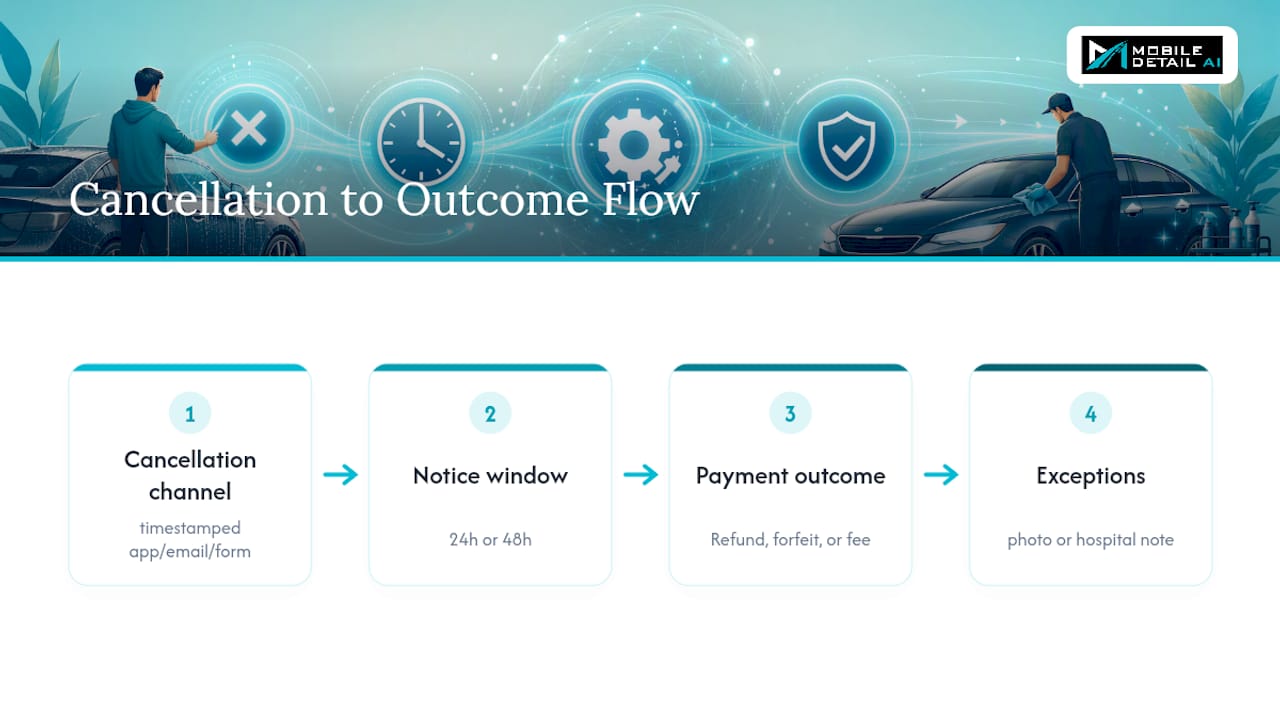
Start with your notice window. A 24-hour window fits most mobile detailers running single-day routes, since a canceled 9 a.m. slot is hard to backfill same day. Shop operators with more foot traffic and walk-in flexibility can sometimes get away with a tighter 12 to 24 hour cutoff, but franchises juggling multiple technicians and drive time usually need the full 48 hours to rebook a route slot profitably. If a job requires special products, a trailer, or a technician driving more than 30 minutes, require 48 hours and full prepayment, not just a deposit.
Deposits should be sized to match what you'd actually lose, not what scares people into showing up. A flat $25 to $75 deposit works for standard washes and interior details. For full details, ceramic coatings, or paint correction jobs running several hours, a 10 to 30 percent deposit is more typical, and contract templates built for detailers commonly frame it that way. Make deposits non-refundable only inside your notice window. A refundable deposit outside that window and forfeited inside it gives customers a real incentive to call ahead instead of just not showing up.
No-show fees deserve the same proportionality test. Charging the full service price for a no-show is defensible when you turned down other bookings to hold that slot. A flat fee makes more sense for smaller jobs where the lost time is minor. Either way, document what the fee is covering: technician time, product prep, or drive time already spent.
Build in exceptions for weather and documented emergencies, and require some proof. A photo of a road closure or a hospital admission note is reasonable to ask for; a text saying "something came up" is not.
Finally, require cancellations to come through a channel that creates a timestamped record. A booking app note, an email, or a form submission all work. A voicemail does not, because you can't produce it later if a customer disputes the charge.
Pro Tip: Write your no-show fee amount right next to the reason for it in your policy text ("50% of service price to cover reserved technician time"). That single line does more to prevent chargebacks than any amount of fine print.
A Copyable Cancellation and Refund Policy Template
Here's a base template you can adapt for a mobile operation, a shop, or a franchise. Swap the bracketed variables for your own numbers and keep the acknowledgment checkbox wherever customers book or pay.
- Scope and acceptance. "This policy applies to all [mobile / in-shop] detailing appointments booked through [business name]. By checking this box and confirming your appointment, you agree to the terms below."
- Deposit clause. "A deposit of [10–30% / $25–$75 flat] is required to confirm your booking. Deposits are refundable if you cancel more than [24/48] hours before your appointment. Deposits are forfeited for cancellations inside that window or for no-shows."
- Late cancellation and no-show clause. "Cancellations made inside the notice window before your scheduled time will be charged a fee. No-shows will be charged the full service price."
- Repeat offender clause. "After multiple missed or late-canceled appointments within a year, future bookings may require full prepayment at the time of scheduling."
- Exceptions clause. "Fees may be waived for documented emergencies or severe weather. Proof (photo, official notice, or provider documentation) should be submitted promptly after the missed appointment."
- Refund method and timing clause. "Eligible refunds will be processed to the original payment method within five business days of approval. You will receive written confirmation once the refund is issued."
Attach this as a standalone page linked from your booking confirmation, not just buried in a longer service agreement. Customers rarely read multi-page contracts, but they will read a half-page cancellation policy if it's the thing standing between them and their deposit.
Federal Rules That Can Override Your Policy Wording
Your own policy doesn't operate in a vacuum. A few federal rules sit above it, and getting the wording wrong can make an otherwise reasonable fee unenforceable.
- The FTC Cooling-Off Rule gives customers a three-business-day right to cancel for sales made at their home or workplace, though it generally doesn't apply when the customer requested the visit themselves for a service like detailing. Sales under $25 at a customer's home are exempt from this rule entirely.
- Disclosure has to sit immediately next to the booking or "confirm" button, not on a separate terms page nobody clicks. The FTC's own guidance calls this the "clear and conspicuous" standard, and fee language buried three scrolls down doesn't meet it.
- Fees have to reflect actual loss, not punishment. A $200 no-show fee on a $60 wash looks punitive on its face and invites a chargeback dispute you'll likely lose.
- If you run membership or subscription plans (monthly detail packages, recurring washes), canceling has to be at least as easy as signing up. That's the substance of the FTC's click-to-cancel standard for negative-option billing.
- Refund timing should follow the same logic as federal rules for mail, phone, and internet orders, which is where the "five business days" benchmark in most templates comes from.
None of this requires a lawyer to implement. It just requires putting the policy text where the customer actually looks before they click "book."
How to Roll the Policy Out Without Losing Customers
A policy that lives only in a PDF nobody opens isn't a policy, it's a liability. It has to show up at every point where a customer could plausibly claim they didn't know.
- Display the policy text (or a summary with a link to the full version) directly above or beside the "Book Now" button, not on a separate page.
- Repeat the key terms, deposit amount and cancellation window, in the confirmation email or SMS sent right after booking.
- Capture consent with a timestamped checkbox, and store that record with the booking, not just in your head.
- Decide upfront whether you're taking a partial deposit or a full preauthorization; preauthorization gives you more leverage on high-value jobs like ceramic coatings.
- Send automated reminders at 48, 24, and 2 hours before the appointment. Reminders at that cadence are one of the more reliable ways detailers report cutting down on no-shows, since a text at the 24-hour mark gives someone enough runway to actually cancel instead of just skipping.
- Keep cancellation confirmations and refund records for at least a year, longer if your state's small claims statute of limitations runs longer.
When a customer cancels late and pushes back, a short script beats an argument: "I understand the timing is frustrating. Our policy holds your slot exclusively, so the [fee/deposit] covers the technician time we couldn't rebook. I can apply it as a credit toward your next visit if that works better."
Pro Tip: Store your consent checkbox timestamp and your reminder delivery logs in the same place as the booking record. When a dispute happens six weeks later, you want all three pulled up in one screen, not three different systems.
What to Do When a Customer Disputes a Fee
- Decide whether the fix is a refund or a service credit. A credit ("we'll apply this toward your next detail") often resolves goodwill disputes faster than cash back, and it keeps the customer on your books.
- If a refund is warranted, process it within five business days and send written confirmation of the amount and method.
- Pull your chargeback defense file: the booking record, the timestamped consent checkbox, reminder delivery logs, and any staff notes from the call.
- Try to resolve the dispute directly first. Escalate to small claims only if the amount is significant and mediation has stalled.
- If the same clause triggers disputes repeatedly, rewrite it. A fee nobody understands isn't worth defending forever.
After two missed appointments without proper notice, many detailers start requiring full prepayment on all future bookings from that customer. It's a blunt tool, but it works, and it's far less confrontational than refusing service outright.
Automating the Policy So You're Not Enforcing It by Hand
A booking and CRM platform like Mobile Detail AI can display your policy right at the consent step, capture the deposit automatically, and log the acknowledgment with a timestamp. It schedules the 48 and 24 hour reminder messages and keeps delivery receipts, so if a customer disputes a no-show fee, the transaction log and cancellation timestamp are already sitting in one place instead of scattered across three apps. That's the difference between enforcing a policy and just having one written down somewhere.

What Actually Matters Here
Most detailers overthink the legal language and underthink the placement. A perfectly worded cancellation clause buried in a terms-of-service link nobody clicks does nothing. The FTC's own standard is about conspicuousness, not cleverness: put the deposit amount, the notice window, and the fee structure right where the customer is about to pay, in plain sentences.
The other mistake is treating every fee as punitive by default, which makes owners undercharge and then resent customers who cancel anyway. If your fee reflects an actual loss, a held slot, lost drive time, prepped product, you're not being punitive. You're being accurate. Write that justification into the policy itself, because it's also your best defense in a chargeback.
Prioritize three things in this order: disclosure placement, proportional fees, and a documented cancellation channel. Everything else, the exact percentage, the exact hour cutoff, is a business decision you can tune once those three are locked in.
— Mobile
A Simpler Way to Enforce the Policy You Just Wrote
Writing the policy is the easy part. Enforcing it consistently, on every booking, every reminder, every disputed no-show, is where most detailers fall behind, especially solo operators juggling a phone and a route at the same time. Mobile Detail AI handles the disclosure, deposit capture, automated reminders, and transaction logging in one system, so the policy you write actually gets applied the same way every time instead of depending on whoever answers the phone that day. Shops that book through third-party channels, like the process ECOLIA uses for its mobile detailing bookings, face the same disclosure and consent challenges regardless of platform. If you're rewriting your cancellation terms anyway, consider setting up your booking page on a platform that automates reminders and deposit rules to streamline enforcement.
Primary Sources Worth Keeping Handy
Bookmark the FTC's cooling-off rule consumer page and its business guidance on disclosure. For clause wording, the detailing contract template breakdown and general cancellation policy guide cover most edge cases.
Sources
- Buyer’s remorse: the FTC’s cooling-off rule may help
- Car detailing contract template: key clauses to include - LegalClarity
- General cancellation policy guide 2026 | Templates, fees, timeframes & best practices
FAQ
Does the FTC Cooling-Off Rule Apply to Mobile Detailing?
Usually not, if the customer requested the visit themselves for a service like detailing; the rule mainly covers unsolicited home sales, and sales under $25 at a customer's home are exempt regardless.
How Long Should a Detailer's Cancellation Notice Window Be?
24 hours works for most single-technician mobile operations, while 48 hours fits franchises or jobs requiring specialty products and longer drive times.
Should Deposits Be Refundable?
Make deposits refundable outside your notice window and non-refundable inside it. That structure rewards customers who cancel early instead of penalizing everyone equally.
How Fast Should Refunds Be Processed?
Most templates and federal guidance point to five business days from approval, with written confirmation of the amount and method sent to the customer.
Can a Booking Platform Help Enforce a Refund Policy?
Yes. Platforms like Mobile Detail AI can place disclosures next to the booking button, capture deposits automatically, and log timestamps and reminder receipts for dispute defense.