

Marketplace commission rates for vehicle detailing bookings typically run 15% to 30% of each job's price, similar to other service marketplaces, but that headline number rarely tells the whole story. Card processing, mandatory visibility fees, and promo charges usually push the real cost 3 to 5 percentage points higher. Before signing with any booking platform, calculate your effective commission on your actual average job value, not the percentage printed on the pricing page.
TL;DR:
- Actual effective commission costs for detailers often reach 25% or more once card processing, visibility fees, and promotional charges are included, exceeding advertised rates.
- Hybrid fee models and higher ticket services like ceramic coatings are more favorable, while small, recurring jobs face a larger share of fees, making volume and service type critical factors.
- Multi-tiered platforms with hidden per-listing, placement, or connectivity fees disproportionately impact larger businesses with multiple service packages.
- Payout timing and fee transparency influence cash flow and budget predictability, with weekly payouts and clear fee breakdowns offering key advantages.
- Careful modeling of monthly volume and average ticket helps determine whether subscription plans or commission rates better suit a detailer's specific business.
Table of Contents
- How Marketplace Fee Models Actually Work
- How Do You Calculate Your Effective Commission Rate?
- What Contract Terms Should You Watch Before Signing?
- Comparing Platforms Without Overpaying for Growth
- How Do Commission Rates Compare Across Marketplace Types?
- Are Marketplace Commission Rates Rising or Falling?
- Why Commission Rates Shape How Detailers Actually Behave
- Publisher Perspective: Fair Fees Change the Math
- How Mobile Detail AI Prices Its Plans
- Sources
- FAQ
How Marketplace Fee Models Actually Work
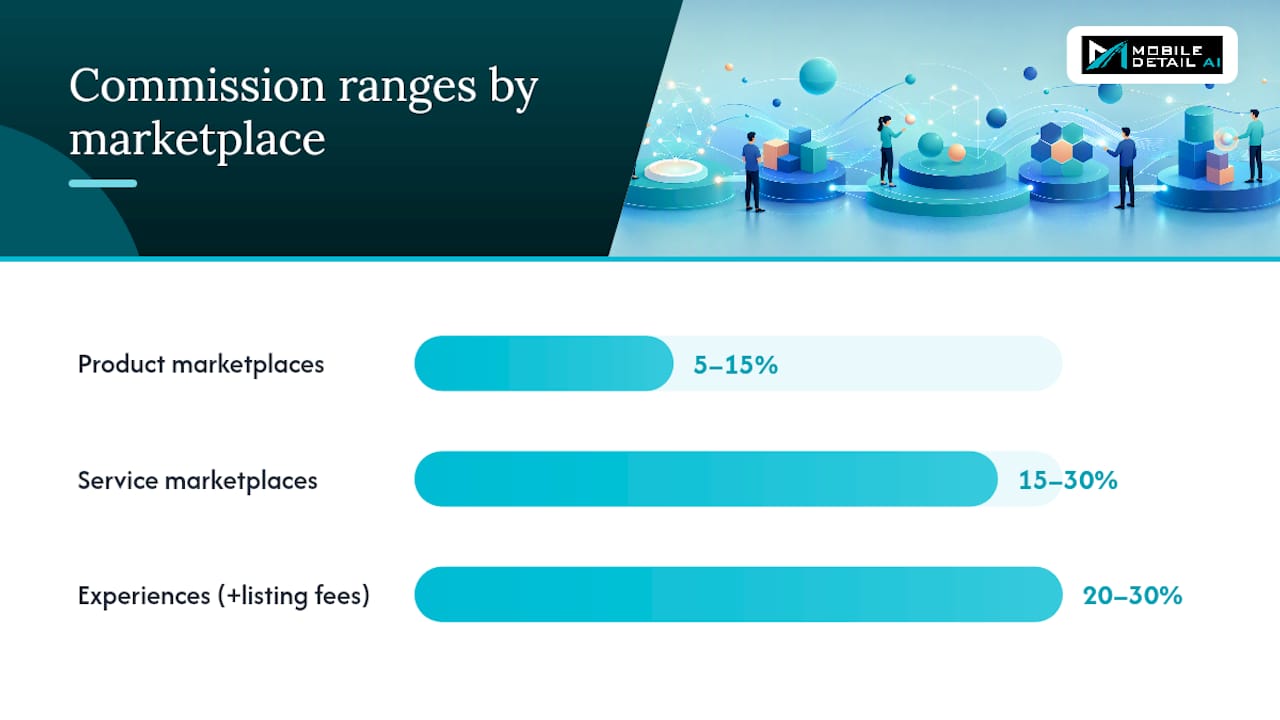
Every booking platform picks one of five basic ways to get paid, and the choice tells you a lot about how that platform thinks about your business. Service marketplaces tend to charge higher headline rates than product marketplaces. Product-focused platforms often run 5% to 15%, while service marketplaces, detailing included, commonly fall in the 15% to 30% band because service bookings need more matching, scheduling, and customer support behind the scenes.
Here's how the major models break down:
- Commission (take rate): A percentage of each completed job, charged only when you get paid. Aligns platform incentives with your success, but scales up as your business grows.
- Subscription: A flat monthly fee regardless of booking volume. Favors high-volume shops since the per-job cost shrinks as bookings increase.
- Lead fees: A flat charge per inquiry or lead, win or lose. Works against you if your close rate is low, since you pay whether or not the customer books.
- Buyer-side fees: A surcharge added to the customer's total instead of deducted from your payout. Keeps your take-home number cleaner but can push price-sensitive customers away.
- Hybrid models: A lower commission paired with a subscription or per-listing fee. Hybrids tend to reward mid- and high-volume providers by lowering the marginal cost of each additional job.
High-ticket services like ceramic coatings tolerate commission models better than fast, recurring washes, where a flat fee eats a bigger share of a smaller ticket.
How Do You Calculate Your Effective Commission Rate?
The headline rate on a pricing page is never the number that hits your bank account. Card processing typically runs 1.5% to 3% on top of the platform's cut, and that's before visibility fees or cancellation exposure enter the math. Add platform processing and promotional charges together and a "20% commission" platform can easily cost you 25% or more per completed job.
Here's a worked example using a $200 mobile detail job on a platform advertising a 20% commission:
Pro Tip: Run this same math on your last 20 completed jobs, not one hypothetical, and average the effective rate. Platforms change promo pricing seasonally, so a single snapshot understates your real annual cost.
OTA and experience marketplaces show the same pattern, where a 25% advertised commission often lands at 27% to 30% once processing and promotional add-ons are counted. Swap in your own average ticket and monthly volume, and you'll see your real number, which is usually worse than the platform's marketing page suggests.
What Contract Terms Should You Watch Before Signing?
The fee schedule is only half the contract. The clauses that quietly raise your effective cost usually live in the fine print, and platforms count on operators skimming past them.
- Mandatory promoted placement. Some platforms require paid boosts just to appear on the first results page, turning "optional" marketing into a fixed cost.
- Per-listing fees. Charging by service or vehicle category can multiply quickly for multi-van operators listing several package tiers.
- Buyer-side surcharges layered on top of your commission. Confirm whether the customer's surcharge reduces your payout indirectly through lower conversion.
- Payout timing. A 7-day payout cycle versus a 30-day cycle materially affects cash flow for a multi-van business covering payroll weekly.
- Dispute and chargeback terms. Find out who eats the cost when a customer disputes a charge after the detail is already done.
- Connectivity or integration fees. Some platforms charge extra to sync with your existing CRM or payment processor.
Per-listing and visibility charges function like hidden fixed costs, and they hit multi-van operators with several service tiers harder than a solo detailer running one package. Ask every platform rep to put the full fee schedule in writing, including anything billed outside the standard commission line, before you sign anything.
Comparing Platforms Without Overpaying for Growth
Choosing a booking platform isn't about finding the lowest advertised number. It's about matching the fee structure to your volume, your average ticket, and how much control you want over customer data.
Run through this checklist before committing to any platform:
- Effective take rate at your actual volume. Model your last three months of bookings against the platform's full fee schedule, not just the commission line.
- Fee predictability. A flat subscription is easier to budget against than a variable commission that swings with promo cycles.
- Customer data ownership. Some platforms restrict access to customer contact details, which limits your ability to rebook directly and avoid future commissions.
- Payout cadence. Weekly payouts beat monthly ones for cash flow, especially with multiple vans and part-time staff.
- Service fit. High-ticket services like paint correction absorb commission percentages better than a $60 wash-and-vacuum.
To model break-even volume, divide a platform's monthly subscription cost by the difference between its commission rate and a competing model's commission rate. Naibrly's home-service fee comparisons show that subscription-heavy models typically break even against pure commission somewhere between 15 and 25 completed jobs per month, depending on ticket size.
On pricing tactics: bundle services into packages rather than pricing every add-on separately, set a minimum job value platforms can book you for, and list the platform fee as a visible line item on customer invoices when your contract allows it. Providers who bundle services into fixed packages tend to protect margin better than those pricing each add-on à la carte.
How Do Commission Rates Compare Across Marketplace Types?
Not all marketplaces play by the same fee logic, and lumping detailing platforms in with product marketplaces leads to bad comparisons. Product marketplaces selling physical goods, think auto accessories or parts, typically charge 5% to 15% commission because the platform's job is mostly matching and payment processing. Service marketplaces run notably higher, often 15% to 30%, because service bookings require scheduling logic, provider vetting, and customer support that product listings don't.
Experience and tour marketplaces sit closest to detailing in structure. OTA platforms commonly charge 20% to 30% commission on tour operators, plus separate per-listing fees for each experience offered, a structure that closely mirrors what a multiservice detailing shop faces when listing several package tiers.
Compare against other service marketplaces instead, where the higher rate reflects real operational cost on the platform's side, not just margin-grabbing.
Are Marketplace Commission Rates Rising or Falling?
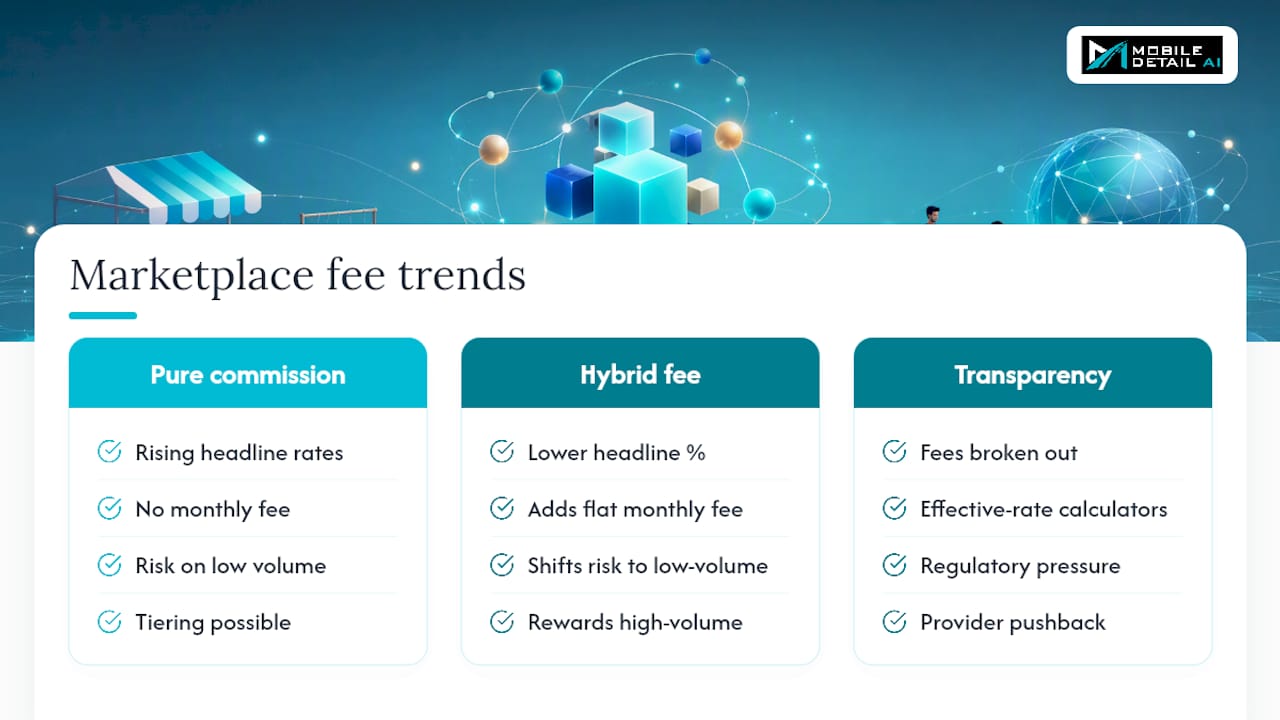
Commission rates in service marketplaces have generally trended upward over the past several years as platforms invest more heavily in matching algorithms, customer support, and trust and safety features. At the same time, hybrid pricing has become far more common than pure commission. Subscription-plus-commission hybrids let platforms lower the headline commission percentage while adding a flat monthly fee, a structure that often looks cheaper on the surface but shifts risk differently across low-volume and high-volume providers.
The bigger shift is in fee transparency. Platforms that once buried processing fees or visibility charges in the fine print increasingly break them out as separate line items, partly due to provider pushback and partly because regulators in several service industries have pushed for clearer fee disclosure. Expect more platforms to publish effective-rate calculators rather than just a single headline percentage, since providers increasingly compare platforms on total cost rather than the advertised number alone.
For detailers specifically, the practical trend is toward tiered structures: lower commission at higher volume, higher commission for occasional or new providers. That rewards shops that commit to one platform rather than spreading bookings thin across three or four apps.
Why Commission Rates Shape How Detailers Actually Behave
High commission rates change provider behavior in predictable ways, and platforms that ignore this end up with unhappy sellers. Some providers respond by steering repeat customers off-platform after the first booking, using the marketplace purely as a lead-generation tool rather than an ongoing sales channel.
This creates a tension platforms have to manage carefully. Lead-fee models can end up costing more than commission unless a provider's close rate is high, which pushes providers with low conversion toward subscription or hybrid models instead. Platforms that keep effective rates predictable and reasonably low tend to retain more providers long term, because detailers stop treating the marketplace as a one-time acquisition channel and start treating it as a real revenue line.
Marketplace competitiveness ultimately depends on this balance. A platform that extracts too much per job pushes its best, highest-volume providers toward competitors or toward building their own booking systems, which thins out the provider pool and hurts the customer experience the marketplace depends on to keep bookings flowing.
Publisher Perspective: Fair Fees Change the Math
Predictable fees matter more than low fees. A detailer who knows their exact effective rate can price jobs correctly the first time, instead of discovering the gap between headline and reality on payout day. That's the real value of pairing a marketplace fee with integrated tools: route optimization cuts drive time between jobs, and a built-in CRM reduces the no-show and rebooking losses that quietly inflate effective commission on paper. The math only works when a platform is transparent about what it charges and helps you close more of the jobs it sends you.
— Mobile
How Mobile Detail AI Prices Its Plans
Most booking platforms make you choose between a flat subscription and a variable commission. Mobiledetail lets you pick the structure that fits your stage: pay $1 per month for CRM-Only if you just want the scheduling and payment tools without marketplace exposure, step up to the $59 per month Marketplace plan to get listed and booked, or go Preferred at $139 per month for priority placement and the full feature set.

What actually moves your effective rate isn't the plan price alone, it's what the platform does with your time. Instant booking cuts the back-and-forth that eats into close rate, route optimization shortens the gaps between jobs on a multi-van schedule, and a detailing-specific CRM keeps repeat customers coming back through the same channel instead of leaking to a competitor's app. You can see how real providers present their service tiers on the platform by browsing a provider showcase page or explore the full range of bookable categories on the service discovery page. If you're comparing booking platforms this quarter, start by checking your plan options on the provider subscription page and run your own average job value through the math above before you commit.
Sources
- Marketplace Pricing Models: Take Rate, Commission vs Subscription (2026 Playbook) | TechVinta Blog
- OTA Commission Models for Tour Operators: What You're Actually Paying - OTA Playbook
- Home service marketplace fees: what providers pay (July 2026) | Naibrly
- How to Price Your Mobile Massage or Beauty Services | Blys
FAQ
What Is a Typical Marketplace Commission Rate for Detailers?
Service marketplaces, detailing included, typically charge 15% to 30% commission on each completed booking. The exact rate depends on the platform's fee model, whether it's pure commission or a hybrid with a subscription component.
How Do I Calculate My Effective Commission Rate?
Add the headline commission percentage to card processing fees, visibility or promo charges, and a prorated allowance for cancellations. On many platforms this pushes a 20% advertised rate closer to 27% in practice, so always run the math on your own average job.
Does Mobile Detail AI Charge Commission or Subscription Fees?
The platform offers plans on a subscription basis, listed on the provider subscription page. This gives detailers a predictable monthly cost rather than a variable commission that swings with volume.
Are Lead Fees Cheaper Than Commission for Detailers?
Not necessarily. Lead-fee platforms can cost more than commission models unless your close rate on incoming leads is high, since you pay for every inquiry whether or not it converts into a booking.
Should I Negotiate Marketplace Commission Rates?
Yes, especially around volume tiers, payout timing, and mandatory promoted listings. Ask platforms for the full fee schedule in writing and request lower rates once you hit consistent monthly booking volume, since many platforms offer tiered pricing they don't advertise upfront.