
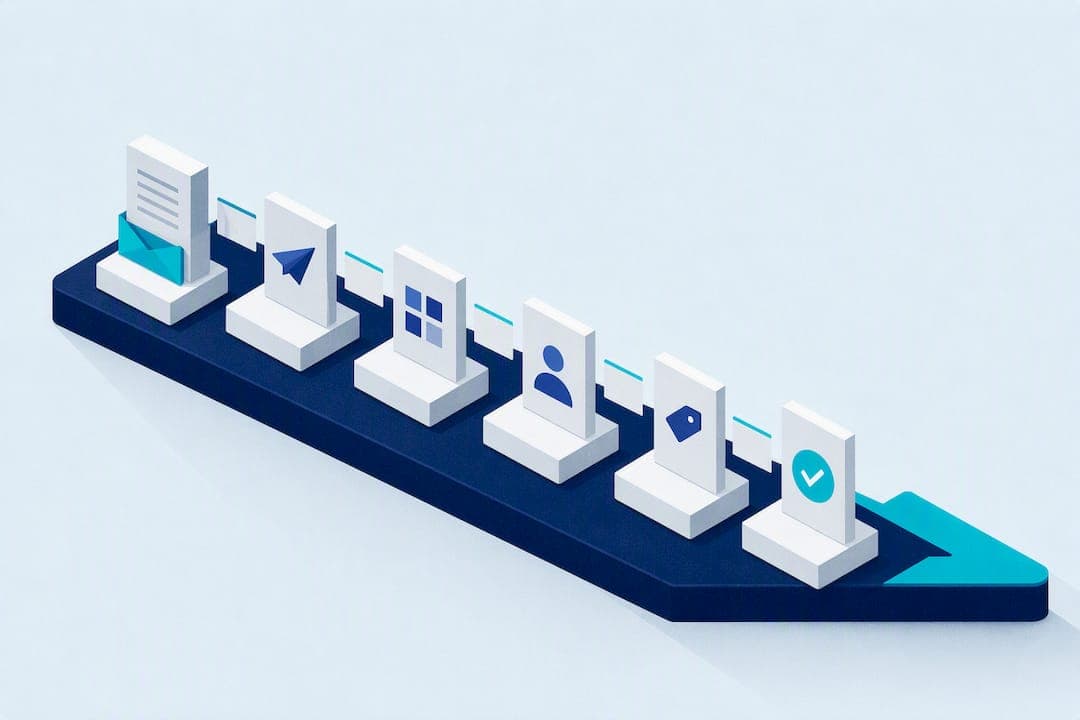
The fastest way to boost rebookings is a service-triggered email sequence layered with basic segmentation. Start collecting customer emails at the point of booking this week, then turn on a reminder automation tied to service type. Most detailers see a shift within a month: more repeat bookings, fewer empty slots on the calendar.
TL;DR:
- Collect customer emails at booking and ask for their contact details in person using clear, benefit-focused prompts to build a clean, engaged list.
- Segment customers by service, recency, and frequency to tailor automated emails that increase the likelihood of rebooking.
- Set up four key automations: welcome email, post-job review request, timed service reminders, and reactivation series to maintain ongoing engagement.
- Run targeted campaigns like slow-week promos, seasonal reminders, and gift vouchers to boost visibility and fill schedule gaps during slow periods.
- Prioritize consistent data capture and automation implementation over trying to launch every sequence at once to achieve measurable improvements efficiently.
Table of Contents
- Why Email and SMS Deliver High ROI for Detailers
- How Do You Build a Clean Email List From Scratch?
- What Customer Segments Actually Move the Needle?
- Which Automated Sequences Should You Set Up First?
- What Campaign Types and Content Actually Convert?
- What Features Should You Look for in an Email Platform?
- What Metrics and Benchmarks Should You Track?
- Your Six-Week Starter Plan
- How Mobile Detail AI Fits Into This Playbook
- What Detailers Consistently Get Wrong
- Sources
Why Email and SMS Deliver High ROI for Detailers
You already have the hardest part of marketing solved: an existing customer who trusts you with their car. Email and SMS let you talk to that person again for close to nothing, which is a very different economics than paid ads chasing strangers who've never heard of your shop. That's the core reason email and SMS rank among the highest-ROI channels for service businesses. You're not buying attention, you're reactivating it.
For detailers specifically, the use cases are narrow and repeatable, which makes them easy to automate:
- Service reminders timed to when a wax, coating, or interior treatment actually wears off
- Upsell offers for customers who've only ever booked a basic wash
- Slow-week fill campaigns that move flexible customers into open calendar gaps
- Review requests sent right after a job, when satisfaction is highest
Detailing consultants increasingly push shops toward a multi-channel system where email and SMS work alongside booking tools and review requests instead of standing alone. That combination is what turns a one-time customer into someone who rebooks every quarter without you having to chase them down.
How Do You Build a Clean Email List From Scratch?
Your booking flow is your best list-building tool, and most detailers waste it. If you're asking for a phone number to confirm an appointment, you're already halfway to a usable contact. The other half is asking for an email with a reason attached, not just a blank field nobody bothers to fill in.
Here's a practical sequence for building the list without annoying anyone:
- Add an email field to every booking form and label it "Get your service reminders and receipts here" rather than a vague "email address" line.
- Ask in person at drop-off or pickup. A simple "want us to text or email you when your ceramic coating needs a refresh?" converts better than a sign-up sheet on the counter.
- Offer a real lead magnet, like a short car-care guide (how to extend a wash between visits, seasonal prep checklist) in exchange for an email on your website.
- Create a VIP list with early access to seasonal promos or slight discounts for members, which gives people a reason to opt in beyond just "updates."
- Use double opt-in on your website forms so you're not building a list of typos and fake addresses, and add a one-line consent statement ("We'll send service reminders and occasional promotions; unsubscribe anytime") so people know what they signed up for.
Pro Tip: Skip the generic "join our newsletter" language entirely. Detailers who frame the signup around a specific benefit, like service reminders or a discount code, see far fewer people bounce at the form.
Data hygiene matters more than list size. A clean list of 400 real customers who open your emails outperforms a bloated list of 2,000 addresses collected without consent, most of which land in spam folders anyway.
What Customer Segments Actually Move the Needle?
Not every customer deserves the same email. A guy who got a $40 wash six months ago and never came back needs a different message than someone on a quarterly detail plan who just booked last week.
The segments worth building first:
- Service type: interior deep clean, ceramic coating, paint correction, basic wash, and fleet or commercial accounts all have different rebooking windows.
- Recency: customers who booked in the last 30 days versus those past 90 or 180 days need entirely different tones, one is a thank-you, the other is a win-back.
- Frequency and lifetime value: someone who's booked five times in a year is a VIP candidate, not someone you send a generic 20%-off blast.
- Membership or subscription status: if you run a maintenance plan, those customers should never receive a "come back" email meant for lapsed one-timers.
Three examples of what this looks like in practice: a customer who got ceramic coating six months ago gets a reminder that coatings typically need refreshing around this point, with a direct booking link. Someone who hasn't booked in 90 days gets a short "we miss your car" note with a modest incentive. A five-time repeat customer gets early access to a seasonal promo before it goes out to the general list. Combining tags like "service: coating" and "recency: 180 days" in most email platforms builds these audiences automatically, so you're not manually sorting spreadsheets every week.
Which Automated Sequences Should You Set Up First?
Four sequences cover most of what a detail shop needs, and none of them require ongoing manual work once they're built.
- Welcome/onboarding: triggered the moment someone books their first appointment. Introduce your services, set expectations on timing, and link to your booking page for future visits.
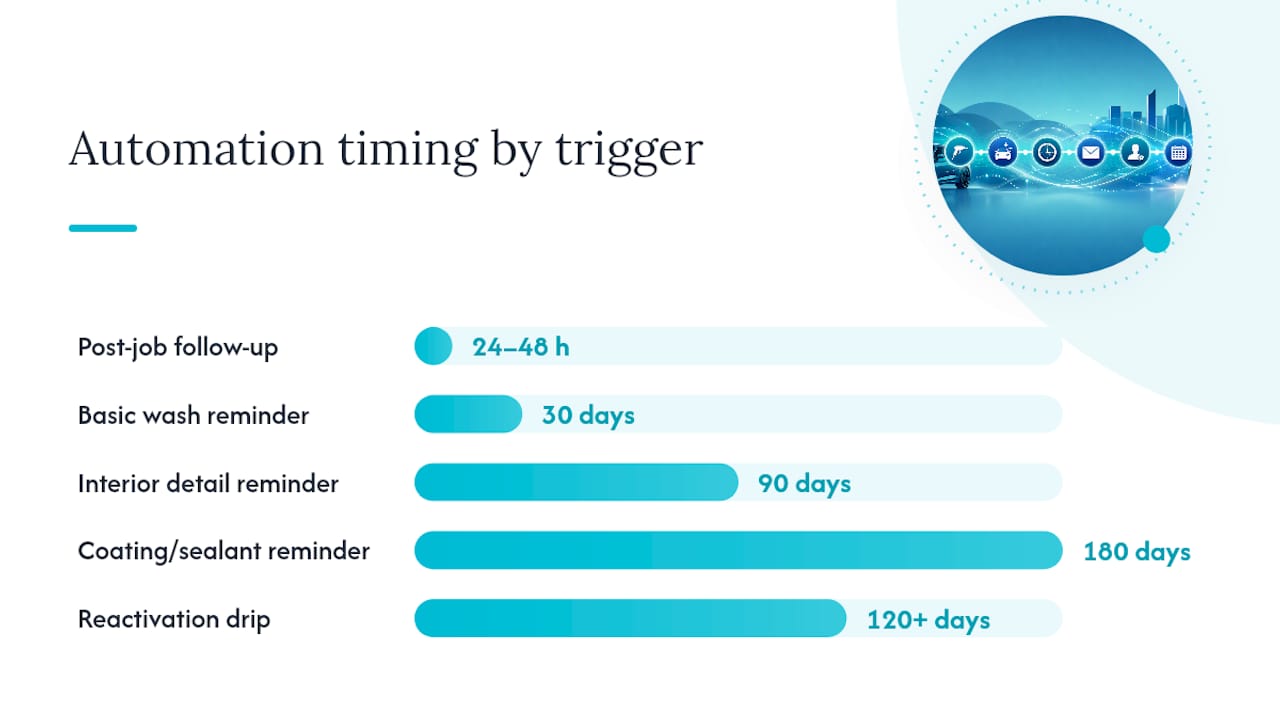
- Post-job follow-up and review request: sent 24 to 48 hours after service completion, when the car looks its best and the customer is happiest. Include a photo request or gallery link and a direct link to leave a review.
- Timed service reminders: the workhorse sequence. Set triggers based on service type, roughly 30 days for basic washes on regular customers, 90 days for interior details, and 180 days for ceramic coatings or paint sealants that naturally degrade on that schedule.
- Reactivation drip: a short 2-3 email series for anyone who hasn't booked in 120+ days, starting with a friendly check-in and escalating to a modest discount if there's no response.
These service-specific sequences aren't a novel idea. Detailing marketing specialists have built templated versions of exactly this structure because it reliably increases rebookings without requiring custom copy for every send.
Every message in these sequences should include a before-and-after image or gallery link, a clear one-click path to book, and pricing that doesn't require a phone call to figure out. Vague CTAs like "contact us for details" kill conversions. "Book your $150 ceramic refresh here" doesn't.
Pro Tip: Build the 180-day coating reminder first if you offer coatings. It's the single highest-value automation for most shops because the service is expensive, the timing is predictable, and customers genuinely forget when they're due.
What Campaign Types and Content Actually Convert?
Automations run in the background, but you still need standalone campaigns to fill slow weeks and stay visible. A few formats consistently outperform generic "check out our services" blasts:
- Slow-week fill promos: a short-notice discount sent to your recency-90-day segment on a Tuesday when Thursday's calendar is half empty.
- Seasonal prep campaigns: pre-summer paint protection pushes, pre-winter undercarriage and salt-protection reminders, tied to weather people actually notice.
- Gift voucher promos: heavy around holidays, framed as "give the gift of a spotless car" rather than a generic coupon.
- Membership or plan upsells: aimed at customers who've booked three or more times, offering a subscription that locks in their business.
- Before-and-after galleries: these are your best-performing content format because detailing is visually satisfying in a way most services aren't.
- Short care tips: a 100-word email on "why you shouldn't wash your car in direct sunlight" builds trust without asking for anything.
- Testimonial spotlights: pull a specific review and pair it with the photo from that job.
Subject lines matter more than most detailers assume. "Your coating is due for a refresh" outperforms "Special offer inside" almost every time because it's specific and personal, not promotional-sounding. Test one variable at a time, subject line first, and let each send run before drawing conclusions.
What Features Should You Look for in an Email Platform?
Skip the brand comparisons and evaluate any platform against a short checklist instead. Automation depth matters most: can the platform trigger emails off a specific date (like "90 days after this service type") rather than just a generic drip? Segmentation flexibility matters almost as much, since you need to combine tags like service type and recency without a workaround.
Look for these capabilities specifically:
- Automation triggers based on service date and type, not just signup date
- SMS alongside email, since some customers respond faster to a text than an inbox
- Booking system integration, so a completed appointment automatically triggers the right follow-up
- Segmentation and tagging that lets you filter by recency, service, and customer value
- Deliverability tools, including double opt-in support and spam-compliance features
Platform guidance from major email providers consistently points to automation and segmentation as the two features that separate an effective program from a list that just sits there collecting dust. On the operational side, weigh your team's comfort with setup complexity against the cost, and confirm the platform actually talks to your booking software before you commit. Most platforms offer a free trial. Use it to build exactly one automation end-to-end, the post-job review request, and see how much manual cleanup it takes before you trust it with the rest of your sequences.
What Metrics and Benchmarks Should You Track?
Four numbers tell you almost everything: open rate, click-to-book rate, conversion to actual rebooking, and unsubscribe rate. If your open rate is healthy but click-to-book is flat, your subject lines are fine and your CTA or offer is the problem. If unsubscribes spike after a specific campaign, that content or frequency isn't landing.
A quick benchmark gut-check: service businesses generally see stronger engagement from triggered, service-specific emails than from generic promotional blasts, since the message arrives exactly when the customer needs it. Simple A/B tests on subject lines, send times, and CTA placement are the fastest way to find your own baseline rather than guessing at industry averages.
Three tests worth running in your first month: swap a generic subject line for a specific one referencing the service or timing, move your CTA button higher in the email versus lower, and compare a morning send against an evening send for the same segment. Run each test on a segment of at least a few hundred contacts if you have the list size, and give it a full send cycle before judging results.
Your Six-Week Starter Plan
You don't need a marketing department to get this running. Here's a realistic week-by-week path:
- Week 1: Add email capture to your booking flow and train staff to ask in person.
- Week 2: Build your welcome and post-job/review-request templates.
- Week 3: Set up your first automation, the timed service reminder, starting with your highest-value service.
- Week 4: Launch your first standalone campaign, ideally a slow-week fill or seasonal prep promo.
- Week 5: Turn on the reactivation drip for anyone past 120 days since their last booking.
- Week 6: Review open and click data, then adjust your segments and messaging based on what actually got clicks.
Pro Tip: Don't try to build all four automations in week one. Shops that launch the service reminder alone and get it working well see faster results than shops that try to launch everything at once and never finish any of it.
If you're solo, expect two to three hours a week during setup, dropping to under an hour once automations are live. A phased rollout that prioritizes capture and a single automation first is consistently the path smaller shops use to get this running without hiring outside help.
How Mobile Detail AI Fits Into This Playbook
Every tactic above depends on data you're probably already generating through bookings, you just need a system that connects the dots. Mobile Detail AI pairs its booking marketplace with a built-in CRM, so a completed appointment can trigger the exact follow-up sequences described here without manual list-building. Service-history tracking feeds your segmentation directly, letting you target the 180-day coating customer or the lapsed 90-day washer without cross-referencing spreadsheets. Route optimization and visual scheduling round out the operational side, so the platform that captures the contact also helps you coordinate servicing the rebooking once the email lands.
What Detailers Consistently Get Wrong
The most common mistake isn't a bad template, it's inconsistent capture. Shops collect emails for a month, get busy, and stop asking. The second mistake is skipping automation entirely and relying on memory to follow up, which fails the moment volume picks up. The third is over-emailing once a system is finally in place, burning out a list that was working fine at once a week.
If you're starting from zero, prioritize in this order: fix your capture process, build one automation (the service reminder), then add a single weekly campaign. Skip the temptation to build everything at once. A narrow system running consistently beats a full-featured one nobody maintains.
— Mobile