

Chemical inventory tracking for detailers means recording receipt and open dates, par levels, and per-job consumption so you never run out on route and you know your true materials cost. The payoff is predictable supplies in the van, controlled chemical cost per job, and safer handling of what you store. Start today: create a per SKU log and label every container you currently own with its receipt date and open date.
TL;DR:
- Tracking SKU, lot numbers, and open dates allows for accurate monitoring of chemical usage and helps prevent stockouts on the job site.
- Using simple spreadsheets with formulas or barcode apps keeps inventory burn rate up-to-date and reduces errors when managing multiple SKUs.
- Proper labeling with manufacturer expiry, receipt, and open dates, along with FIFO storage, maximizes chemical shelf life and safety.
- Reorder points should be based on actual weekly usage calculations plus safety stock, not guesswork, to avoid overstocking or shortages.
- Regular audits, variance analysis, and linking bookings to inventory help detect waste early and improve cost control.
Table of Contents
- What Is Chemical Inventory Tracking, and What Should You Log First?
- How Do You Set Up a Tracking System That Actually Gets Used?
- Labeling, Storage, Shelf Life, and Basic Safety Rules
- Turning Chemical Inventory Into Real Per-Job Cost Numbers
- Setting Par Levels That Match Your Route, Not a Guess
- Receiving, Daily Checks, and Monthly Audits That Actually Catch Problems
- How Scheduling Software Ties Bookings to Chemical Consumption
- What the Rules Actually Require for Hazardous Waste Disposal
- Compliance Considerations Specific to Storing and Tracking Chemicals
- Keeping Chemicals Secure From Unauthorized Access
- Using Inventory Reports to Cut Risk and Spot Waste Early
- Pitfalls Experienced Detailers Warn New Owners About
- Run Inventory-Aware Scheduling With Mobile Detail AI
- Sources
What Is Chemical Inventory Tracking, and What Should You Log First?
"Chemical inventory tracking" is the working term for a task that accountants and operations people usually call inventory management or stock control applied to consumables. For a detailing business, that means a system for knowing what you have, what it costs, and when it runs out, before it runs out on a customer's driveway.
Here's the setup checklist to run once, then maintain weekly:
- List every SKU you buy, from ceramic coating to microfiber towels, with dilution ratio and container size.
- Record lot numbers and dates, both receipt date and the date you opened the container.
- Estimate jobs per container based on your dilution ratio and average job size.
- Set a par level (minimum on hand before you reorder) and a storage location for each item.
- Attach the safety data sheet (SDS) for each chemical to its inventory entry.
- Assign one person as the owner of restocking decisions, even if that's just you.
- Pick an update cadence: log consumption after each job, and do a full count monthly.
None of this needs software on day one. A clipboard in the van and 10 minutes on Sunday night will outperform no system at all.
How Do You Set Up a Tracking System That Actually Gets Used?
The minimum viable version is a spreadsheet with seven columns: SKU, container size, cost per container, dilution ratio, jobs per container, current stock, and reorder point. One formula does most of the work: jobs remaining equals current ounces divided by ounces used per job. Update that number after every shift and you have a live burn rate without touching a dedicated app.
Field-friendly upgrades matter once you're juggling more than a handful of SKUs:
- Barcode scanning apps that log consumption by scanning a container instead of typing
- Offline-capable mobile tools for techs working in garages or lots with no signal
- Shared cloud spreadsheets so a second van's usage rolls into the same count automatically
Automated tracking with barcode or RFID scanning cuts down on the transcription errors that plague paper logs, according to research on inventory and logistics management for detailing entrepreneurs. That accuracy gain becomes worth the setup time once you're running two or more vans, hitting frequent stockouts, or managing SKUs with complicated dilution math.
Pro Tip: Don't wait for a stockout to tell you it's time to upgrade. If you're guessing your reorder point instead of calculating it, you've already outgrown the clipboard.
Labeling, Storage, Shelf Life, and Basic Safety Rules
Every container needs three dates on it before it goes on a shelf: manufacturer expiry, receipt date, and open date. Manufacturer expiry is the ceiling. Once a container is opened, treat it more conservatively, since exposure to air and temperature swings degrades most detailing chemistries faster than an unopened bottle. Proper labeling and storage practice calls for FIFO rotation, meaning the oldest opened stock gets used first, always.
Storage rules that matter for a garage or van:
- Keep flammables (many solvents, some interior cleaners) away from ignition sources and in ventilated storage.
- Separate acidic wheel cleaners from alkaline products; mixing incompatible chemistries by accident is a real hazard, not a theoretical one.
- Watch temperature. A van baking in Arizona heat degrades foam and sealant products faster than climate-controlled shelving.
- Keep SDS sheets accessible, whether that's a binder in the van or a folder on a shared drive every tech can reach.
Document lot numbers on your inventory log, not just the shelf label. If a manufacturer issues a recall, timestamped audit trails and quarantine procedures let you pull the exact affected containers instead of guessing which batch you used on which car.
Turning Chemical Inventory Into Real Per-Job Cost Numbers
Bookkeeping is where inventory tracking earns its keep. Purchases of bulk chemicals sit on your books as inventory on hand, an asset, not an expense, until you actually use them. Each job then converts a measured amount of that inventory into cost of goods sold (COGS). Lump all your chemical purchases into one "supplies" expense line and you lose the ability to see which service is bleeding margin.
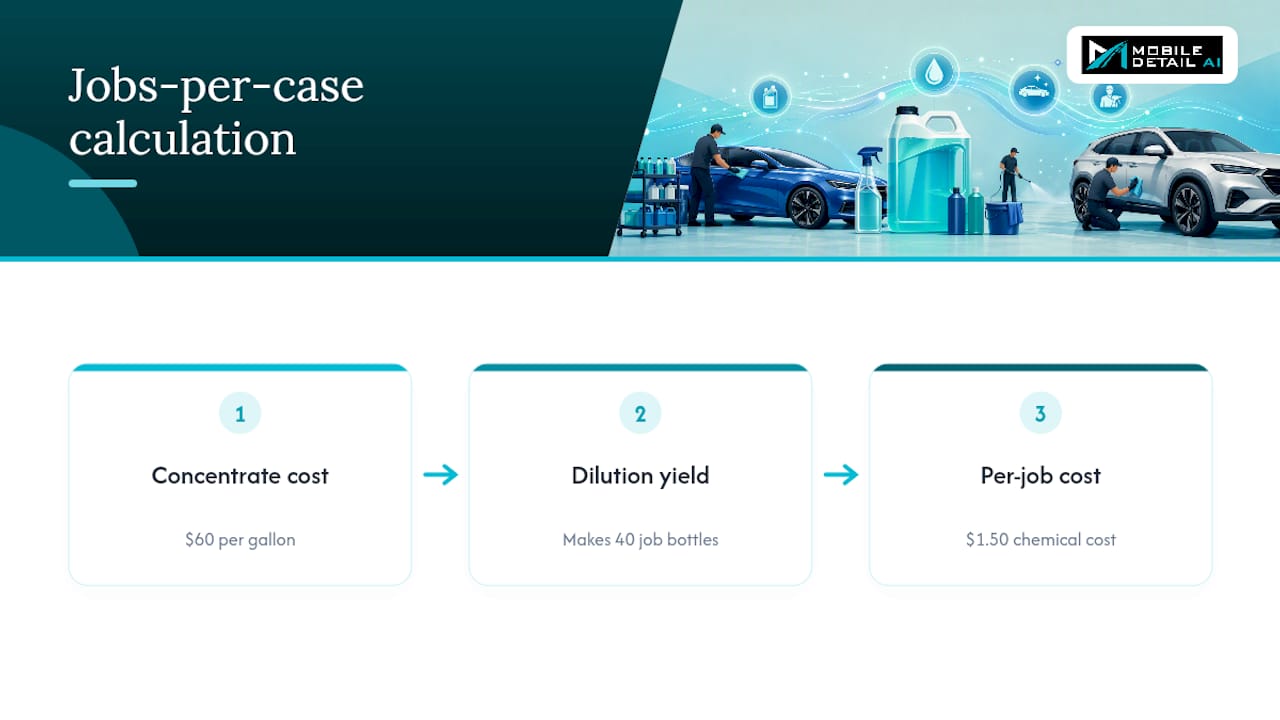
The jobs-per-case method makes this concrete. If a gallon of concentrate makes 40 diluted job-ready bottles and costs $60, your chemical cost per job from that product is $1.50. Stack that across every product used on a full detail, and typical chemical COGS for a standard full detail lands within a moderate range when you're buying concentrates and diluting correctly when you're buying concentrates and diluting correctly.
Reconcile monthly. Compare what you expected to consume against what actually left the shelf, and track materials cost as a percentage of revenue by service type. A jump in that percentage on ceramic coating jobs but not on basic washes tells you exactly where to look, whether that's over pouring, theft, or a tech who isn't diluting correctly.
Setting Par Levels That Match Your Route, Not a Guess
Par level is the stock quantity that triggers a reorder, and it should come from math, not instinct. The formula: average jobs per week times usage per job, plus enough safety stock to cover your supplier's lead time. A detailer running 15 full details a week using 12 ounces of ceramic sealant per job needs roughly 180 ounces weekly, plus a buffer if your distributor takes three days to deliver.
Three reorder trigger styles work for route-based operations:
- Fixed par: reorder the same amount every time you hit the trigger point, simplest for solo operators.
- Min/max bands: reorder up to a maximum, useful when order sizes vary with seasonal demand.
- Automated alerts: software flags low stock automatically, worth it once you're managing multiple vans.
Just-in-time principles reduce carrying costs but only work if your supplier is reliable. Keep a backup local distributor for anything that would stall a job if it ran out, and stagger restock timing across two suppliers so one bad delivery doesn't shut down your week.
Receiving, Daily Checks, and Monthly Audits That Actually Catch Problems
Errors creep in at two points: when stock arrives and when nobody looks at it again until it's gone. Fix both with routine.
- At receiving, log the delivery date, lot number, quantity, and cost per unit immediately, and label the container with its open date field left blank until first use.
- Before it leaves the shelf, confirm the invoice quantity matches what's physically in the box. Short shipments are common and easy to miss without this step.
- Every shift, have whoever loads the van do a two-minute visual check against a printed or app-based restock list.
- Every week, dispatchers or the owner should review consumption logs against the jobs actually run, flagging any product burning faster than expected.
- Every month, do a full physical count of every SKU and compare it to your log's expected balance.
- When variance shows up, investigate before restocking. A pattern of shrinkage on one product usually points to over-application, not theft, but you won't know until you check.
A small procedural habit like this, a daily van check paired with a monthly full count, eliminates most of the shrinkage that shows up in small field-service operations.
How Scheduling Software Ties Bookings to Chemical Consumption
Booking software that talks to your inventory turns a passive log into a working control system. When each appointment on the calendar automatically reserves the expected consumables for that job type, a full detail booked for Thursday shows up as a draw against your ceramic sealant stock before the tech even loads the van. Syncing bookings with inventory this way closes the gap between what's scheduled and what's actually on hand.
Route optimization adds a second layer. Consolidating three jobs into one efficient route means one restock trip instead of three, which cuts both fuel cost and the odds of showing up short on a product.
An integrated system combines scheduling, route optimization, secure payments, and business analytics into a single CRM built for detailers. Solo operators and multi-van businesses use tools like this to keep bookings, routing, and supply visibility connected instead of managed in three disconnected apps. For a shop juggling reorder alerts alongside a growing client list, that connection matters more than any single feature on its own.
What the Rules Actually Require for Hazardous Waste Disposal
Detailing chemicals eventually become waste, and some of that waste falls under hazardous materials rules depending on what's in it. Used solvents, certain degreasers, and some wheel cleaner concentrates can qualify as hazardous waste under EPA regulations, and disposal requirements vary by state and by how much waste your business generates monthly.
Track disposal the same way you track receiving. Log the date, quantity, and type of waste removed, and keep the manifest or receipt from whatever hauler or disposal service picks it up. If you generate small quantities, you may qualify as a conditionally exempt small quantity generator under federal rules, but that status still comes with recordkeeping obligations, not a free pass to skip documentation.
Never pour used chemicals down a storm drain or into a septic system, even diluted ones. Many municipalities treat this as a serious violation with real fines attached, and it's also just bad practice for groundwater in the area you work.
Practical steps that keep this manageable:
- Store waste containers separately from active product, clearly labeled as waste, with the same segregation rules (no mixing acids with solvents in the same waste bin).
- Keep a simple log: date, product type, approximate volume, and disposal method or hauler used.
- Ask your chemical distributor whether they offer take back or disposal programs. Many industrial suppliers do, and it saves you from sourcing a hazardous waste hauler independently.
- Review your state environmental agency's small business guidance annually, since generator thresholds and rules do get updated.
This isn't paperwork for its own sake. A disposal log becomes your proof of compliance if a regulator or your commercial insurer ever asks.
Compliance Considerations Specific to Storing and Tracking Chemicals
Regulatory exposure for a detailing business centers on three things: how you store chemicals, what you disclose to employees, and how you document what you're doing. OSHA's Hazard Communication Standard requires that any employee working around hazardous chemicals has access to the SDS for those products, understands the labeling system, and receives basic training on the hazards they're handling. That applies to a two-person shop just as much as a ten-van fleet.
Storage compliance ties directly back to segregation. Fire codes in most jurisdictions cap how much flammable liquid you can store without additional ventilation or a rated cabinet, and local fire marshals do sometimes inspect commercial garages. If you're storing more than a few gallons of flammable solvents or strippers, check your local fire code before you assume a shelf in the corner is fine.
Documentation is where inventory tracking and compliance overlap directly. An inventory audit log that records lot numbers, dates, and quarantine actions on any degraded or recalled product does double duty: it's a business tool for cost control, and it's the paper trail that shows a regulator or insurer you're handling chemicals responsibly.
Keep in mind compliance requirements shift depending on your entity type and how many people you employ. A solo detailer working out of a home garage faces different practical scrutiny than a franchise operation with a dedicated warehouse, though the underlying OSHA and fire code principles apply to both. When in doubt on a specific storage question, your state's OSHA consultation program (often free for small businesses) is a better source than a general guide like this one.
Keeping Chemicals Secure From Unauthorized Access
Chemical security isn't just about theft, though that's part of it. Concentrated detailing chemicals in the wrong hands, especially strippers, acids, and some ceramic coating activators, pose a real safety risk if a curious employee, a customer's kid, or a break in gives someone unsupervised access.
A locked storage cabinet or closet is the baseline for any fixed location, van included. Vans parked overnight are a common theft target for anyone who knows detailing chemicals resell easily, so a locked storage box bolted inside the vehicle beats loose bottles rolling around the cargo area.
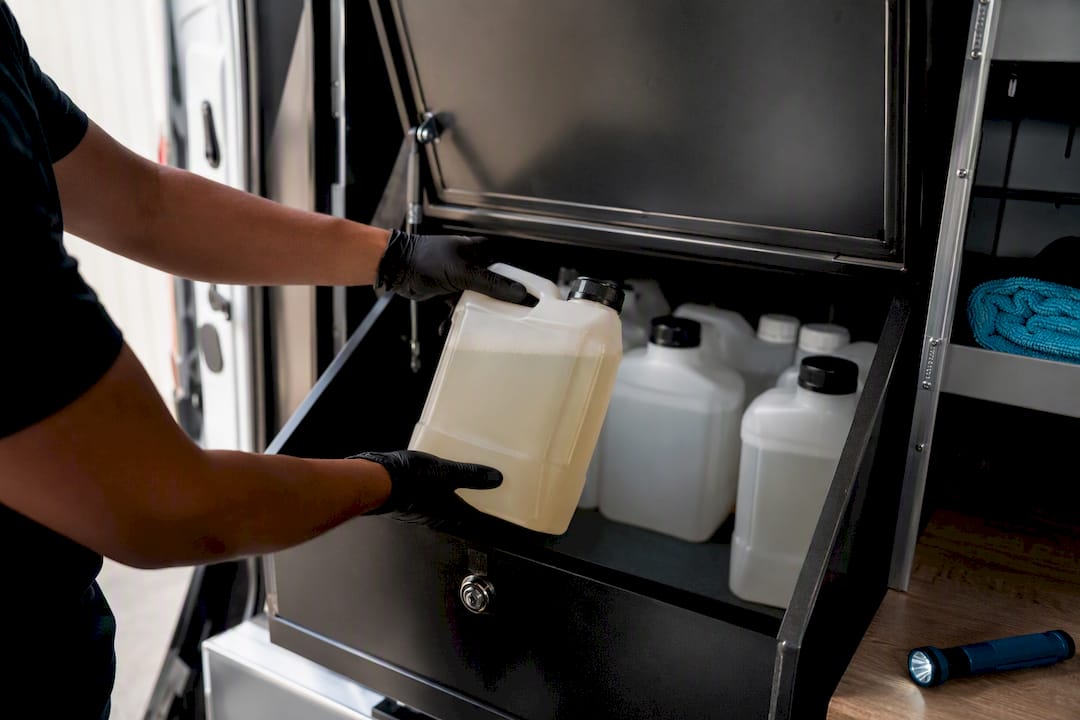
Access control matters as much as physical locks. If you employ more than one or two techs, limit who can open the storage cabinet or approve a restock order. This isn't about distrust. It's about keeping your inventory log accurate, since unauthorized access is one of the most common causes of the "phantom shrinkage" that shows up in monthly counts with no clear explanation.
A few practical measures worth adopting:
- Keep chemical storage separate from customer-facing areas of your shop or vehicle.
- Use a sign-out sheet or app-based checkout for anyone pulling product from a central storage location.
- Store your inventory log itself somewhere access-controlled, since an unlocked spreadsheet is easy to alter after the fact.
- Review who has keys or codes to storage areas whenever staff turnover happens, not just annually.
None of this needs to be elaborate. A $40 lockbox and a consistent sign-out habit solve most of the exposure a small detailing operation actually faces.
Using Inventory Reports to Cut Risk and Spot Waste Early
Raw inventory numbers only become useful once you turn them into a report you actually look at. The metrics worth tracking monthly: materials cost as a percentage of revenue by service type, shrinkage rate (expected stock minus actual stock), and reorder frequency per SKU.
A rising materials percentage on one specific service is usually your earliest warning sign of a problem, whether that's a tech over-applying product, a supplier quietly raising prices, or a dilution ratio drifting off spec. Catching that in month one, instead of month six, is the entire value of running the numbers regularly instead of just restocking when the shelf looks empty.
Inventory management software can cut inventory costs by 10 to 20 percent through real-time tracking and automated alerts, largely because reporting surfaces problems before they compound. A spreadsheet can do a version of this too. Add a simple variance column and a monthly summary tab, and you get most of the same visibility without a subscription.
For risk management specifically, watch expiry-driven waste and shrinkage side by side. High expiry waste means you're over-ordering relative to demand. High shrinkage with low expiry waste usually points to overuse or unauthorized access rather than a purchasing problem. The two metrics look similar on the surface (product disappearing without a matching job to explain it) but they call for completely different fixes, and a decent monthly report is what separates the two causes instead of leaving you guessing.
Pitfalls Experienced Detailers Warn New Owners About
Don't buy a case of anything new. Test small sizes first and finish your current stock before switching products, since half-used old bottles sitting alongside new ones is how shelves turn into clutter and cash turns into waste.
Logging habits fail in week two, not week one. Force the routine for 30 straight days and it becomes automatic. And process beats software every time: a $0 clipboard system used daily outperforms a $50 monthly app nobody updates.
— Mobile
Run Inventory-Aware Scheduling With Mobile Detail AI
A platform can give you one place to see what's booked, what route you're driving, and what that route is about to consume, instead of juggling a calendar app, a group text for restocks, and a memory of what's in the van. Such platforms handle scheduling, route optimization, secure payment processing, and business analytics in a single CRM built specifically for detailing operations.

Solo detailers use it to stop guessing what a busy week will cost in supplies before it happens. Multi-van operations use it to keep every van's consumption visible from one dashboard instead of chasing down each tech for a count. Either way, tying your schedule to your actual chemical burn turns inventory from a monthly headache into a number you already know.
If your reorder points are still based on a gut feeling instead of your booking calendar, that's the gap worth closing first. Check out Mobile Detail AI and see how scheduling and inventory visibility work together for your specific route.